How many watts do ovens use? A practical guide for homeowners
Learn how many watts ovens use, what affects wattage, and how to estimate energy costs. A data-driven guide from Oven Cook Pro to help homeowners compare models and optimize oven performance in 2026.


On average, ovens operate in the 1,500–3,000-watt range for standard baking, with convection modes tending toward the higher end. The exact wattage depends on model and setting; many are rated around 1.6–2.4 kW for bake, while broil or rapid preheat can reach up to 3 kW. For precise figures, check the model’s label and manual. how many watts do ovens use
How many watts do oven use
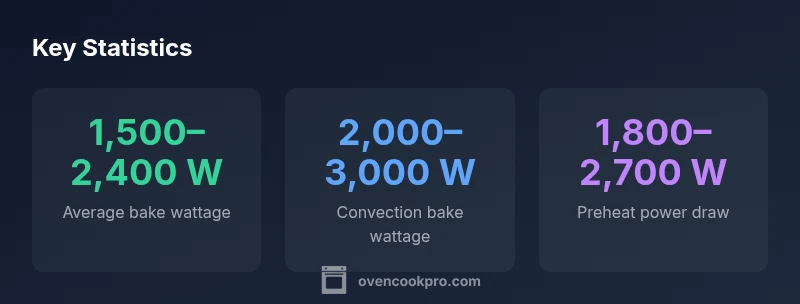
Understanding how many watts an oven uses begins with the basic concept that wattage is the rate of electrical power. In practical terms, wattage tells you how quickly the oven consumes electricity during a function like bake or broil. For most households, the typical baking cycle falls in the 1,500–2,400 W range, while more energy-demanding modes such as convection bake or rapid preheat can push toward 3,000 W. When planning kitchen energy, remember that these are ratings, not steady daily consumption; actual use depends on duration, set temperature, and door-opening habits. According to Oven Cook Pro analysis, 2026, the wattage you see on the label is the maximum the element can draw under ideal conditions, not a constant draw throughout a long bake.
Why wattage varies across models and modes
Wattage is not a fixed number; it varies by oven design, insulation, and the mode selected. Baseline bake mode often sits in the 1.6–2.4 kW range, but convection adds a fan and additional heating elements that can raise peak draw to 2.0–3.0 kW. Broiling tends to peak higher than baking because it uses intense top elements. Efficiency features, such as better seals and insulation, can reduce heat loss, slightly lowering average energy use for the same cooking outcome across different models.
Wattage by mode: bake, convection bake, broil, and preheat
Different cooking modes demand different power profiles. Bake mode provides steady heat at a selected temperature, typically around 1.5–2.4 kW. Convection bake uses the same heat source plus a fan, often raising wattage to 2.0–3.0 kW. Broil mode focuses energy on the top element for browning, with peaks that can equal or exceed convection values depending on the model. Preheating is a short but notable surge, frequently in the 1.8–2.7 kW range, as the oven climbs to target temperature. These ranges help you compare models without needing the exact spec for every setting.
Calculating energy use and cost for a baking session
To estimate energy, multiply the wattage by the time you run the oven in hours, then convert to kilowatt-hours (kWh). For example, a 2,000 W oven used for 0.75 hours consumes 1.5 kWh. Multiply the result by your electricity price to approximate cost. Because actual usage varies with temperature, door openings, and insulation, treat these calculations as planning tools rather than precise bills. Oven Cook Pro analysis highlights how small changes in duration or temperature can shift energy use meaningfully.
Practical tips to reduce energy draw without sacrificing results
- Choose the right mode: use bake or convection only when needed for the recipe. Convection saves time but can draw more power for certain dishes.
- Avoid preheating longer than necessary; many recipes only require a brief preheat before loading food.
- Keep the oven door closed during cooking; each door opening can cause heat loss and longer cycles.
- Use lids, foil, or parchment to minimize moisture loss and maintain heat efficiency.
- Plan multi-dish meals to minimize total bake time by overlapping cooking windows where feasible.
How to compare ovens by wattage when shopping
When shopping, focus on the wattage ranges displayed in the specification label rather than short promotional claims. Look for models with lower peak draw for typical daily use, unless you require faster preheating or higher browning. Compare bake, convection, and broil wattages to understand the energy trade-offs between speed and consumption. Also consider insulation quality and door seals, since better efficiency reduces the effective wattage needed for the same results.
Wattage ranges by oven mode
| Aspect | Wattage range | Typical mode | Notes |
|---|---|---|---|
| Bake | 1,500–2,400 W | Standard bake | Common baseline wattage for bake cycles |
| Convection bake | 2,000–3,000 W | Convection | Higher due to fan and extra heating element |
| Broil | 1,800–3,000 W | Broil | Power peaks during broiling |
| Preheat | 1,800–2,700 W | Initial heat-up | Initial surge before oven stabilizes |
Questions & Answers
What is the typical wattage range for most household ovens?
Most ovens fall in the 1,500–2,400 W range for standard bake, with higher figures for convection and broil. Actual use depends on mode, temperature, and duration.
Most ovens typical bake range is 1,500 to 2,400 watts; convection and broil use more power depending on settings.
Do convection ovens use more watts than conventional ovens?
Yes, convection ovens often draw more power during operation due to the fan and additional heating elements, though they can be more energy-efficient overall by shortening cook times.
Convection ovens usually use more watts during operation, but they can cut cook time and save energy overall.
How can I estimate energy cost for baking a pie?
Estimate energy cost by multiplying the oven wattage by hours of use to get kWh, then multiply by your electricity price. Use the ranges above as a guide.
Multiply the wattage by hours to get kWh, then multiply by your price per kWh.
Is it safe to leave an oven on a low setting for a long time?
Leaving an oven on for long periods can pose safety risks and unnecessary energy consumption. Always follow manufacturer guidance and turn off when not in use.
Don't leave the oven on for long without supervision; turn it off when not needed.
What should I check if my oven isn't reaching temperature quickly?
Check door seals, insulation, and venting; a slowly heating oven may indicate draft loss or an aging gasket, not just wattage.
Look at door seals and insulation; poor seals can waste energy and slow heating.
Can I replace a wattage-hungry oven with a smaller model?
A smaller or more efficient model may reduce energy use, but ensure it meets your cooking needs. Compare mode-specific wattages, not just total rating.
Yes, a smaller or more efficient model can reduce energy use if it fits your cooking needs.
“Wattage provides a practical proxy for energy planning, but real consumption also depends on insulation, door seal, and how often the oven door is opened.”
Main Points
- Know the keyword: how many watts do ovens use
- Wattage varies by mode and model
- Preheat adds a noticeable power surge
- Estimate energy cost with wattage and time
- Check the label and manual for exact figures