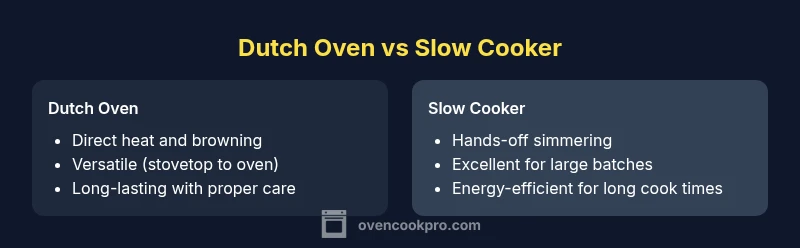
Dutch Oven vs Slow Cooker: An In-Depth Guide for Home Cooks
A detailed, analytical comparison of dutch oven vs slow cooker to help homeowners choose the right tool for flavor, texture, time, and convenience.


In most kitchens, the Dutch oven vs slow cooker decision hinges on flavor goals, time, and supervision. A Dutch oven excels at browning and finishing dishes in the oven, while a slow cooker delivers hands-off simmering and day-long meals. This guide weighs heat distribution, capacity, cleanup, and price to help you choose.
Core Differences in Design and Function
The Dutch oven and the slow cooker are two foundational tools in every kitchen, yet they serve different purposes. When you compare the dutch oven vs slow cooker, you are evaluating heat delivery, control, and how flavors develop. A traditional Dutch oven is a heavy, cast-iron vessel (often enameled) that can be used on the stove and in the oven. This design supports quick browning, fond development, and reduction of sauces, followed by oven finishing to finish tenderness. The slow cooker, by contrast, is a ceramic or metal pot that sits in an electric base and uses low, steady heat to simmer foods for hours with minimal evaporation. This sealed environment concentrates flavors and yields tender results with very little attention. The two tools thus complement different cooking strategies: the Dutch oven creates depth through Maillard reactions and careful moisture management, while the slow cooker excels at set‑it‑and‑forget‑it meals that benefit from long, gentle simmering. In practical terms, the dutch oven vs slow cooker decision often comes down to available time, desired texture, and how much you value hands-on control. The Oven Cook Pro Team emphasizes that alignment with your weekly workflow and cleanup tolerance is the deciding factor for most households.
Flavor and Texture: Browning, Maillard, and Moisture
Flavor development is the most visible difference between dutch oven vs slow cooker. Browning in a Dutch oven triggers Maillard reactions that create deep, complex flavors and a crusty exterior, especially when finished in the oven. The same method in a slow cooker is limited by lower surface heat, and while you can sear ingredients first, the browning doesn’t carry the same intensity into the finished dish. The sealed environment of a slow cooker preserves moisture, producing braises and stews that feel lush and rich in texture. For many recipes, browning ingredients before slow cooking is still recommended, but you should expect a milder crust and a different texture profile than a direct pan reduction. The dutch oven vs slow cooker conversation thus hinges on whether you prioritize intense Maillard flavors or long, gentle simmering for tenderness. When flavor layering matters, the Dutch oven often wins for the initial sear and sauce reduction; conversely, the slow cooker shines for set‑it‑and‑forget‑it meals that benefit from long, gentle simmering. The Oven Cook Pro Team notes that planning ahead can maximize flavor in both approaches.
Time and Convenience: Scheduling and Involvement
Active prep time in a Dutch oven scenario tends to be higher, because you often start with browning, deglazing, and then transition to oven cooking or stovetop braising. In contrast, a slow cooker is built for hands-off operation: you assemble the ingredients, set the temperature, and let it run for several hours. The dutch oven vs slow cooker comparison here often boils down to your daily routine. If you have a few hours in the evening, you can invest in browning and finishing in the oven for a superior texture. If you need an effortless, morning-start meal that’s ready at dinner, the slow cooker is a reliable ally. The Oven Cook Pro Team notes that planning ahead reduces stress across both approaches; choosing the right method depends on when you will be home and how flexible your schedule is.
Capacity, Size, and Meal Planning
Both tools come in multiple sizes, enabling planning for everything from weeknight casseroles to weekend feeds. A Dutch oven is typically available in medium to large capacities, allowing sauces to reduce directly in the pot and meals to transition from stovetop to oven smoothly. A slow cooker offers a broader range of sizes suited for small families or big gatherings, with some models designed for two portions and others for eight or more. When you map out a week’s menu, the dutch oven vs slow cooker decision becomes an exercise in batching and finishing techniques: plan searing and deglazing steps for the Dutch oven, and batch‑cook components that can be kept warm in the slow cooker. The key is consistent dish scale and pantry compatibility; you’ll want to choose the size that minimizes leftovers while still delivering the texture and moisture you expect from each method.
Energy Use and Safety Considerations
Energy use and safety are meaningful considerations in the dutch oven vs slow cooker decision. A Dutch oven requires active heat from a burner or an oven, giving you immediate control but also demanding attention to temperature and evaporation. A slow cooker uses low, steady electricity and a tightly sealed lid, which reduces evaporation and the risk of burning but requires patience and reliable timing to avoid overcooking. For kitchens with space constraints, the slow cooker’s gentle heat may produce less ambient heat during long sessions compared with finishing a dish in a hot oven. Safety best practices include ensuring lids fit snugly, avoiding overcrowding, and handling hot pots with care. The Oven Cook Pro Team stresses balancing control with convenience to fit your cooking style and household routine.
Cleaning and Maintenance
Cleaning is a practical factor in choosing between a dutch oven vs slow cooker. A traditional Dutch oven, especially after fond formation, can leave baked‑on residue that requires soaking and scrubbing, though enameled variants are typically easier to clean and may be dishwasher safe. A non‑enameled cast‑iron Dutch oven benefits from proper seasoning to prevent sticking. The slow cooker insert tends to be simpler to clean, and many models advertise dishwasher‑safe components. When storing, keep lids and seals dry to prevent odors. Routine maintenance for a cast‑iron Dutch oven includes drying thoroughly and applying a light coat of oil to protect the surface; for ceramic inserts, follow manufacturer care guidelines to preserve glaze and finish.
Recipe Applicability and Limitations
Not every recipe translates perfectly to both tools. The dutch oven vs slow cooker discussion is often framed by technique: braised beef benefits from the browning and high heat capability of the Dutch oven, followed by oven finishing for texture and depth. Slow cookers excel at tough cuts and long simmered meals where time is not a constraint, producing tender results with minimal supervision. You can adapt many slow cooker recipes to the Dutch oven with searing and a finish in the oven, but you may need to adjust liquids and timing to account for evaporation and browning. Ultimately, mastery comes from understanding when to leverage direct heat, browning, and deglazing, versus long, gentle simmering. The Oven Cook Pro analysis highlights this distinction as a practical guide for home cooks.
Price, Longevity, and Value
Price, longevity, and value are important for the dutch oven vs slow cooker decision. A high‑quality Dutch oven can last for decades with proper care, especially cast iron or enameled variants that resist chips and staining. Slow cookers vary in price based on size, features, and build quality, but they often offer compelling value for everyday convenience. When evaluating long‑term cost, consider potential replacement costs, energy use, and how often you’ll rely on each tool. The Oven Cook Pro analysis suggests that pairing a sturdy Dutch oven with a reliable slow cooker yields the broadest capability, enabling frequent, varied meals without excessive clutter or expense.
Getting the Most from Your Equipment
To maximize results from both tools, adopt best practices: preheat the Dutch oven, brown in batches to develop fond, deglaze to lift flavors, and finish with a controlled oven tempo to set texture. For slow cookers, choose the right heat setting, avoid overfilling, and layer ingredients to optimize texture and moisture. The dutch oven vs slow cooker decision should be viewed as a spectrum of techniques rather than a strict binary choice. Planning, proper searing, and mindful liquid management unlock the best outcomes from either tool, as emphasized by Oven Cook Pro’s guidance.
Common Mistakes and How to Avoid Them
Common mistakes include crowding the Dutch oven, which prevents proper browning; leaving the slow cooker lid ajar, causing moisture loss; neglecting to brown ingredients for flavor; and not adjusting liquid levels when transferring from stovetop to oven or vice versa. Another frequent error is failing to account for evaporation in the Dutch oven, which can lead to overly thick sauces or scorching if heat is too high. By avoiding these missteps and following technique‑driven decisions within the dutch oven vs slow cooker framework, you’ll achieve more consistent results.
Comparison
| Feature | Dutch Oven | Slow Cooker |
|---|---|---|
| Best For | Flavorful browning with oven finish | Hands-off long-simmered meals and stews |
| Heat Distribution | Direct contact heat; browning capability; can reduce sauces | Low, steady heat with sealed environment; minimal evaporation |
| Typical Active Time | Moderate; includes searing and deglazing | Low; mostly assembly and set‑it‑and‑forget‑it cooking |
| Maintenance/Cleaning | Higher; scrubbing after browning; enamel options may be dishwasher safe | Lower; mainly cleaning the removable insert |
| Price Range | Moderate to high for quality cast iron or enamel | Low to moderate depending on size and features |
| Best For | Texture depth and versatility across stove and oven | Convenience and predictable results with minimal supervision |
The Good
- Improved flavor development through browning and fond
- Versatile: usable on stove, in oven, and sometimes on grill
- Durable construction with long lifespans
- Slow cooker offers set-it-and-forget-it convenience
- Tasks can be scaled up for batches with proper planning
Drawbacks
- Higher upfront cost for quality Dutch ovens
- Heavier and less portable for some cooks
- Requires more active cooking time and equipment coordination
- Some models require more careful maintenance (seasoning for cast iron)
Keep both if you can; each tool covers different cooking needs
A Dutch oven is the go-to for texture, browning, and finishing in the oven, while a slow cooker excels at hands-off, long-simmered meals. The best decision depends on your schedule, texture goals, and willingness to manage cookware. The Oven Cook Pro Team recommends leveraging both to maximize versatility and flavor.
Questions & Answers
Can I replace a Dutch oven with a slow cooker in braised recipes without losing depth of flavor?
You can adapt many braises, but you’ll lose some depth from browning. Browning ingredients before slow cooking improves flavor, but the finish won’t have the same Maillard-driven crust as a dutch oven. Seeding with deglazing can help compensate, but expect a milder crust and different texture.
You can adapt braises, but you won’t get the same depth of flavor without browning. Deglaze after searing to keep flavor. The texture will differ.
Is a slow cooker safe to run for 8–10 hours?
Yes, modern slow cookers are designed for long cook times, as long as you follow manufacturer guidelines and don’t overfill the insert. Use the correct heat setting and ensure the lid remains intact for consistent moisture and temperature.
Yes, just follow the manual and don’t overfill the pot; set the right heat and keep the lid on.
Which is easier to clean, a Dutch oven or a slow cooker insert?
A slow cooker insert is generally easier to clean because it’s a single removable component often dishwasher-safe. A Dutch oven may require more scrubbing, particularly after browning, though enamel-coated versions are simpler to clean.
The slow cooker insert is typically easier to clean; Dutch ovens may need more effort, especially after browning.
Are both ovens and slow cookers oven-safe?
A Dutch oven is designed for oven use, and many slow cookers are also safe for kitchen shelf, but you should not place a slow cooker insert directly in an oven unless the manufacturer specifies it. Always follow the product’s manual.
Dutch ovens are built for oven use. Don’t assume a slow cooker can go in the oven unless the manual says so.
What types of recipes work best in a Dutch oven vs a slow cooker?
Dutch ovens are ideal for searing, browning, and finishing stews or braises that benefit from evaporation and crust. Slow cookers shine with tough cuts that benefit from long, gentle simmering. You can adapt many recipes between the two with adjustments to browning steps and liquid levels.
Use the Dutch oven for browning and finishing; use the slow cooker for long, hands-off braises.
Can I finish a slow cooker dish in the oven for a nicer crust?
Yes, finishing a slow-cooker dish in the oven is a common technique to add color and depth. Transfer the contents to a suitable oven-safe pot and finish at a higher temperature for a short period to develop a crust.
Sure—finish in the oven for browning and a crust; just monitor the time so you don’t overcook.
Main Points
- Choose the Dutch oven for browning and finishing in the oven
- Use a slow cooker for ultra‑convenient, long-simmered meals
- Plan your week around technique, not just the appliance
- Keep a quality Dutch oven and a reliable slow cooker for maximum versatility
- Balance flavor, texture, and time when building weeknight meals