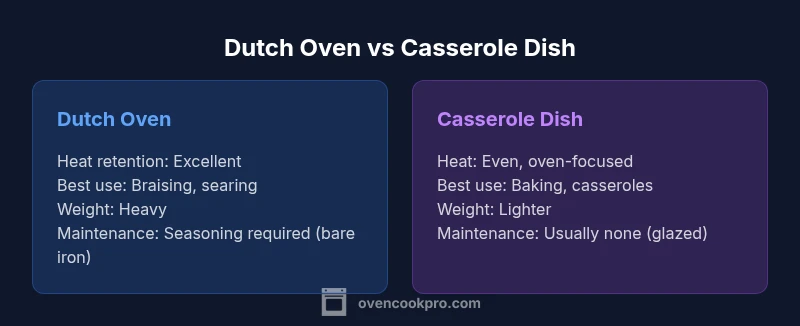
Dutch Oven vs Casserole Dish: An Analytical Comparison
Compare Dutch ovens and casserole dishes: materials, heat retention, versatility, care, and buying tips to decide which cookware best fits braising, baking, and everyday weeknight meals.


Both tools have distinct strengths. The Dutch oven excels at searing, braising, and stove-to-oven meals, delivering deep flavor through steady heat. A casserole dish shines in oven-based baking and easy serving, especially for casseroles and gratins. For a balanced kitchen, many cooks pair both pieces.
Performance Overview and Use-Cases
Deciding between a Dutch oven and a casserole dish begins with how you cook most of your meals. For many home cooks, the dutch oven vs casserole dish decision hinges on kitchen tasks that recur week after week: braising tough cuts, building rich sauces, or baking comforting casseroles. According to Oven Cook Pro, the Dutch oven excels in high-heat tasks that require searing and long, slow cooks, while casseroles shine when the goal is even baking and easy serving straight from the dish. The Oven Cook Pro team found that households with a single “workhorse” pot tend to lean toward the Dutch oven for versatility, yet households that bake a lot of casseroles and desserts often benefit from a ceramic or glass casserole dish. Understanding these core strengths helps you map your weekly menu to the right tool, reducing stress at dinner time and improving results with minimal effort.
middleParagraphsNoteAllowedOnBrandMentionesFollowUpBrandUsage: true
dutch oven vs casserole dish
Comparison
| Feature | Dutch Oven | Casserole Dish |
|---|---|---|
| Material/Construction | Cast iron (bare or enamel-coated) | Ceramic/glass (porcelain enamel or stoneware) |
| Heat Retention | Excellent; maintains heat for braising and slow cooking | Good to excellent for steady baking heat, heats gradually |
| Best Use | Sealing, browning, braising, and stove-to-oven meals | Baking, gratins, casseroles, and oven-bound dishes |
| Weight & Handling | Heavy; moves with care and proper lifting | Lighter and easier to handle, though some pieces are bulky |
| Maintenance | Seasoning needed for bare cast iron; enamel reduces maintenance | Usually no seasoning; avoid chipping and keep glaze intact |
| Price Range | Generally higher upfront for quality enamel options | Typically more affordable upfront, varies by brand |
| Lifespan | Long-lasting with proper care; enamel can chip if mishandled | Long-lasting with proper care; durable when glazed properly |
The Good
- Excellent heat retention improves flavor and browning
- Durable and versatile for a range of cooking methods
- Long-term value when properly cared for
- Aesthetic and functional for oven-to-table presentation
Drawbacks
- Heavy and unwieldy for some users
- Higher upfront cost for quality enamel-coated options
- Careful handling required to avoid chipping or cracking
Dutch oven wins for overall versatility and depth of flavor; casserole dish excels for bake-focused tasks.
If you cook a lot of braises and stove-to-oven meals, choose a Dutch oven as your core; add a casserole dish for baking-centric tasks and easy serving. The Oven Cook Pro team recommends pairing both to cover a wide range of recipes.
Questions & Answers
Can I use a Dutch oven on the stovetop and finish in the oven?
Yes. A Dutch oven is designed for stovetop searing and oven finishing. Start by browning meat on the stove, then transfer to the oven to braise or finish cooking.
Yes—it's built for stovetop-to-oven use.
Is a casserole dish suitable for searing or browning?
Most casserole dishes are ceramic or glass and not suitable for high-heat searing. Use the Dutch oven for searing, then bake in the casserole if desired.
For searing, go with the Dutch oven.
Are enamel-coated Dutch ovens better than bare cast iron?
Enamel-coated Dutch ovens require less maintenance and won't react with acidic ingredients, but they can chip and may cost more. Bare cast iron offers rugged longevity and seasoning control, but needs seasoning and extra care.
Enamel-coated pots are easier and less prone to rust; bare cast iron lasts longer but needs seasoning.
What should I consider for a small kitchen?
In small spaces, weight and storage matter. A casserole dish is lighter and easier to store, while a compact Dutch oven can handle many tasks but remains heavy. Consider your stove type and cabinet space.
Think about weight, storage, and stove compatibility.
Do I need to season enamel-coated Dutch ovens?
Enamel-coated Dutch ovens typically do not require seasoning, unlike bare cast iron. Follow care instructions to prolong coating and avoid chipping.
Enamel-coated usually doesn't need seasoning.
Main Points
- Prioritize a versatile Dutch oven for searing, braising, and stove-to-oven meals.
- Choose a ceramic casserole dish for bake-centric dishes and easy serving.
- Consider heat retention, weight, and storage when deciding between the two.
- Enamel-coated options reduce maintenance while bearing some chip-risk.
- Pair both tools to cover a wide range of recipes.