Difference Between Oven and Air Fryer: A Practical, Analytical Comparison
A rigorous, analytics-driven comparison of oven vs air fryer. Learn how each appliance works, when to use them, energy considerations, and practical tips for achieving optimal results in a home kitchen.


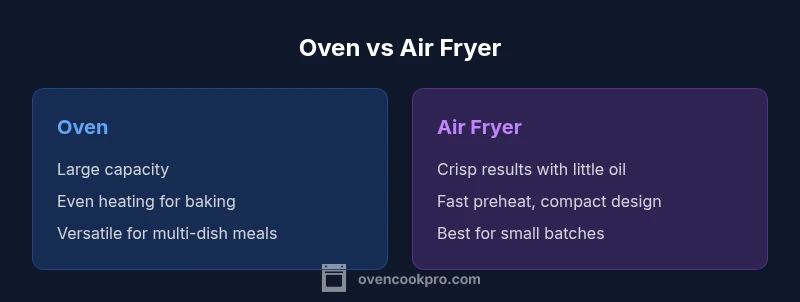
TL;DR: An air fryer is a compact convection appliance that cooks with rapid airflow for crisp textures with minimal oil, while a traditional oven is larger, more versatile, and better for baking and multi-dish meals. The difference between oven and air fryer mainly lies in size, cooking speed, and use cases: air fryers excel at quick, small-batch crisping; ovens handle large batches and baking.
What is an Oven and What is an Air Fryer?
Understanding the difference between oven and air fryer starts with the basics: what each appliance is designed to do and how it delivers heat. An oven is a large, versatile cavity that uses radiant heat from coils and, in many models, a convection fan to circulate hot air for even cooking. An air fryer, in contrast, is a compact countertop device that uses a high-powered heating element and a fan to produce rapid airflow around small batches of food. This design mimics frying characteristics with far less oil. According to Oven Cook Pro, the most noticeable distinction is scale and control: ovens handle big meals and baking, while air fryers excel at quick, crisp textures on small portions. For households aiming to reduce cooking time on leftovers or reheat foods while achieving a near-fried finish, the air fryer offers impressive efficiency. Yet, when you need to roast a whole chicken, bake a sheet of cookies, or prepare multiple dishes at once, the oven’s larger capacity and more even heat distribution become invaluable. The practical difference between oven and air fryer is driven by size, airflow, and intended use, not by quality alone. Both appliances can be high-performing tools in a well-equipped kitchen.
How Convection Works in Ovens vs Air Fryers
Convection is the shared backbone, but the implementation differs. In a traditional oven, convection fans are usually located at the back, circulating warm air to reduce hot spots and shorten bake times. This is especially helpful for sheet-pan dinners, roasting root vegetables, and pastries that require even browning. An air fryer uses a compact chamber with a high-velocity fan and a powerful heating element positioned directly above or around the basket. The airflow is intense, creating a circulation pattern that dramatically increases heat contact with food surfaces. This mechanism is why air fryers excel at crisping edges with minimal oil. The result is a texture that resembles deep-frying but without submerging food in fat. When comparing oven performance to air fryer performance, consider that the air fryer’s small cavity heats up quickly and hot spots can be more pronounced if you don’t shake or turn food. In practice, ovens offer steadier conditions for large items, while air fryers brag about rapid surface dehydration for small, uniform pieces.
Temperature Range and Heat Distribution
Most ovens offer broad range settings from about 175°C to 260°C (350°F to 500°F). They can bake, roast, broil, or slow cook depending on the mode. Heat distribution tends to be even on good-inside-out convection ovens, but there are occasional hot spots near the back walls. Air fryers typically operate in a similar range but are optimized for 200°C to 230°C (392°F to 446°F) with aggressive airflow. The heat distribution in air fryers is less about ambient oven warmth and more about direct radiative heating plus forced air, so you often see faster browning at the surface. However, because the basket restricts air flow to a smaller area, you may need to shake or flip foods to prevent uneven crisping. In both devices, preheating can help set a stable baseline, but many air fryers reach cooking temperature within minutes, while ovens can take longer depending on their size and insulation. Practical takeaway: choose temperature guidance based on batch size, desired texture, and the appliance’s airflow design.
Texture and Moisture: Crispiness, Browning, Juiciness
Texture outcomes hinge on moisture management and surface contact. An oven’s larger cavity and even heat produce reliable browning for roasts, casseroles, and baked goods. If you’re after juicy interiors, cover or use rack placement to maximize steam escape and establish a gentle browning. Air fryers create a rapid surface dehydration that dries surface moisture quickly, producing crisp exteriors with less fat. This makes air fryers excellent for french fries, chicken tenders, and roasted vegetables where you want a crisp bite with minimal oil. Keep in mind that very wet batters or delicate pastries are not ideal for air fryers; the vigorous air flow can cause uneven expansion or breakage. Both devices benefit from dry surfaces, even spacing, and minimal crowding. A light coat of oil on food surfaces can help transfer heat, but you’ll generally need far less oil than traditional pan-frying in either device.
Use Cases: Large Roasts, Baked Goods, and Small-Batch Frying
This section focuses on real-world scenarios. For holiday roasts, casseroles, sheet-pan dinners, and large batches, the oven remains unmatched due to its capacity and consistent heat for longer cooking times. When you want quick, crisp snacks or reheating leftovers with a fried-like texture, an air fryer shines. Baked goods present differing challenges: many ovens handle breads and pastries with consistent rise and even crumb structure, while air fryers may over-cook or unevenly brown delicate items due to restricted space. However, some bakers successfully use air fryers for small-batch pastries and crisp toppings, provided they monitor temperature and use proper bakeware. For households juggling multiple trays, a two-oven setup or a dedicated air fryer can streamline workflows. In summary, choose the oven for large-scale cooking and baking, and the air fryer for rapid finishes on small batches with a crispy edge.
Speed, Efficiency, and Energy Considerations
Speed matters, but efficiency is more nuanced. Air fryers typically heat quickly and heat up the air faster, shortening preparation and preheating times for modest portions. Their smaller footprint means less energy is used per batch, especially when cooking small items that don’t require the volume of an oven. Ovens consume more energy per cook due to larger airspace and longer preheating, but they make sense for multi-dish meals and longer cooks that leverage features like convection and rotisserie where applicable. If you compare energy efficiency per serving, air fryers may offer advantages for single-item, small-batch tasks; if you’re feeding a family or testing many recipes in one session, the oven’s larger capacity and fuel economy per plate can be more favorable. Always consider insulation quality, preheating needs, and the total cooking time to gauge energy impact.
Easy Cleanup and Maintenance
Cleaning habits influence the overall convenience of either appliance. Air fryers have a removable basket and a nonstick interior that is easy to wipe and sometimes dishwasher-safe; however, the compact basket can trap grease and crumbs if not cleaned promptly. Ovens usually require a more thorough wipe-down of racks and racks liners, with some people using self-cleaning modes or periodic professional cleaning. The oven’s larger interior can make cleaning more involved, but you can often remove racks and trays for easier washing. For both devices, a quick wipe after use, regular emptying of crumb trays (air fryer) or crumb deposits in the oven (especially around heating elements), and using parchment paper or silicone liners to minimize residue can save time. Safety tip: unplug units and let them cool completely before cleaning, and avoid harsh abrasives that could scratch coatings.
How to Decide: Quick Rules of Thumb
Begin with capacity: if you routinely cook for two to four people and prefer a crispy finish with minimal oil, an air fryer is a practical add-on. If you regularly bake bread, roast a chicken for a family, or entertain with multi-dish meals, a full-size oven is the better workhorse. Consider space: countertop footprint matters, as does the potential to consolidate functions with a single large oven. Price and energy use: air fryers are typically budget-friendly upfront and energy-efficient for small batches, while ovens offer more versatility but at a higher price and energy footprint. Lastly, think about workflow: do you want a dedicated device for crispy snacks, or a versatile oven that does most tasks in one cavity? The best choice often comes down to your kitchen size, cooking habits, and how much you value speed versus capacity.
Common Mistakes and How to Avoid Them
Home cooks often over-crowd the air fryer basket, sacrificing crispness and even cooking. In ovens, under-baking or not using convection properly can lead to uneven browning. Not preheating when recommended, using the wrong rack position, or using metal containers that aren’t oven-safe can create safety hazards or cooking inefficiencies. For air fryers, adding too much oil defeats the health and texture advantages; for ovens, relying on a single bake mode for everything may yield inconsistent results. Finally, neglecting to clean regularly can shorten equipment life. A practical approach is to plan batches, lay trays with space between pieces, and monitor food with a timer to ensure consistent results across methods.
Practical Tips for Kitchen Setup
To maximize value from both devices, organize your kitchen around your typical cooking workflow. Store baking sheets and racks in a dedicated area for oven use and keep the air fryer nearby for weeknight crisping tasks. Label temperatures and recommended cook times for common foods to reduce decision fatigue. Invest in bakeware compatible with both devices where possible and use silicone mats or parchment to simplify cleanup. For new cooks, start with simple recipes in each device to build mental models for time and texture. With practice, you’ll know when to reach for the oven and when to reach for the air fryer to optimize texture, flavor, and overall efficiency.
Comparison
| Feature | Oven | Air Fryer |
|---|---|---|
| Cooking Speed | Slower overall, suitable for long cooks and multi-dish meals | Faster for small batches, excels at crisping |
| Capacity | Large cavities, true multi-dish capacity | Compact baskets, limited space |
| Texture Outcomes | Even browning and robust texture for baking/roasting | Crisp exterior with minimal oil |
| Versatility | Baking, roasting, broiling, and more | Reheating, frying-like results, limited baking |
| Energy Use | Higher energy per cycle for large meals | Lower energy per batch for small items |
| Maintenance | Racks and cavities require more cleaning | Basket and nonstick interior easy to clean |
The Good
- Faster reheating and crisping for small portions
- Compact countertop footprint
- Lower oil usage for similar textures
- Versatile for a range of everyday tasks
Drawbacks
- Limited capacity compared to ovens
- Less versatile for baking large items or multiple trays
- Potential uneven heating in some models
- Requires separate appliance for heavier baking
Air fryer is ideal for quick, small-batch crisping; ovens win for large meals and baking.
Choose the air fryer when speed and crisp texture on small portions matter most. Choose the oven when you routinely cook large dishes, bake, or need to manage multiple trays at once.
Questions & Answers
Is an air fryer better than an oven for everyday cooking?
It depends on meals. An air fryer is excellent for quick, crispy results on small portions, while an oven handles large meals and baking. Neither is universally better; many homes benefit from having both for different tasks.
For everyday cooking, an air fryer is great for quick crisps, but an oven handles large meals and baking. Use whichever fits the task best.
Can I bake pastries in an air fryer?
Yes, you can bake small pastries in an air fryer, but watch for uneven browning and adjust time and temperature. Use appropriate bakeware and monitor closely.
You can bake small pastries in an air fryer with careful temperature and time, using proper bakeware.
Do air fryers use less energy than ovens?
Air fryers often use less energy per batch due to faster preheat and smaller space, but overall energy depends on batch size and cooking duration.
Yes, for small batches they typically use less energy, but total energy depends on what you’re cooking.
Is preheating required for both devices?
Ovens generally benefit from preheating for even results, though some recipes may skip it. Air fryers often do not require preheating for many foods.
Ovens usually require preheating; air fryers typically don’t, depending on the recipe.
What can you cook in an oven that you can't in an air fryer?
Large roasts, multi-tray baking, and sheet-pan meals are easier in an oven due to its capacity and heat distribution.
Ovens excel with large items and multiple dishes at once.
Are air fryers safe for nonstick coatings?
Yes, if you follow manufacturer temperatures and avoid metal utensils that could scratch coatings.
Air fryers are safe for nonstick if you use proper bakeware and avoid scratches.
Main Points
- Air fryer excels at small, crisp items with little oil.
- Oven handles large batches and diverse cooking tasks.
- Convection boosts both devices, but size drives results.
- Preheat when appropriate; avoid overcrowding for even cooking.
- Choose based on typical meals and kitchen space.