Which Oven Rack to Use: A Practical Guide
Learn how to choose the right oven rack for baking cookies, roasting vegetables, and more. This step-by-step guide explains rack positions, convection effects, safety, and tips for consistent results in any kitchen.


You’ll learn how to pick the correct oven rack for any dish, from cookies to roasts, and why rack position matters for heat, browning, and airflow. By the end, you’ll know where to place pans for even cooking, when to use convection, and how to adjust if you’re using multiple racks. This quick guide sets the stage for reliable results every time.
Why the right oven rack matters
Choosing the correct rack position can dramatically affect heat exposure, browning, and airflow. If you’re wondering which oven rack to use for specific tasks, you’re not alone. Rack position changes how close food sits to heat sources and how air circulates around it, which in turn affects texture and color. According to Oven Cook Pro, small changes in rack height can produce noticeably different results for delicate pastries and dense roasts, so knowing when to switch racks is a practical skill. In this guide we’ll cover rack positions, convection vs. conventional effects, and a simple pre-cook checklist to set you up for success. Expect practical rules of thumb you can apply to everyday cooking, whether you’re new to baking or refining your technique.
Rack positions and what they do
Oven racks are not interchangeable random surfaces; each height interacts with the heating elements to shape heat distribution. The bottom rack tends to yield crisper bottoms and more browning on roasts, while the middle rack offers balanced heat for even baking. The top rack is great for finishing and browning, but can overcook foods quickly if left unchecked. For most standard baking (cookies, muffins, sheet-pan dinners), the middle rack is the default starting point. When you need extra browning on top, move closer to the top, but monitor closely. Always consider the food’s thickness and moisture; a tall loaf may benefit from a slightly lower position to avoid a dense crust.
How to choose rack for different cooking tasks
Different tasks benefit from different rack placements. For cookies and delicate pastries, use the middle rack to promote even browning without scorching the edges. For roasts and vegetables, start with the middle rack and adjust to the bottom if the crust browns too slowly. When broiling, place food on the top rack so the flame or heat source is closest, but stay close to the food and watch for scorching. If you’re baking on multiple trays, rotate them halfway through to equalize heat exposure. For very dense foods, consider lowering the rack slightly to promote a stronger bottom crust. These guidelines help you avoid common pitfalls like uneven browning and soggy bottoms.
Convection vs conventional ovens: Rack position matters
Convection ovens rely on a fan to circulate hot air, which can cook more evenly and reduce bake times. With convection, you can often bake on a single rack in the center for most recipes, but for larger batches or when you want extra browning, using two racks with one rack spacing is acceptable provided there’s ample airflow. If your oven lacks strong circulation, keep foods on the middle rack and rotate pans. When using convection, reduce the stated recipe time by a few minutes and monitor closely to prevent over-browning.
Using multiple racks: spacing and airflow
If you must use two racks, keep a minimum 2–3 inches of space between pans to allow air to flow and to prevent steaming. Place heavier or denser foods on the lower rack to maximize heat exposure and prevent undercooking the bottom layers. Avoid stacking pans directly on top of each other; stagger them and rotate halfway through cooking. When space is tight, use shallow pans and aim for even distribution of food across racks to minimize hot spots. This reduces the risk of uneven cooking and helps you achieve consistent results.
Cleaning and maintaining oven racks
Regular maintenance keeps rack performance reliable. Remove racks carefully with oven mitts when the oven is cool, and avoid bending or warping them. Soak racks in warm, soapy water for gentle cleaning, or use a non-abrasive scrubber for baked-on residue. Dry thoroughly before reinserting to prevent rust or rust staining on food. If racks are particularly worn, consider replacement to ensure even support for pans and correct heat transfer.
How to measure, adjust, and replace damaged racks
Before replacing a damaged rack, measure its width and height relative to the oven cavity to ensure compatibility. Look for smooth gliding tracks and no bent supports. If you notice warping or corrosion, replace the rack to maintain safe operation and even cooking. Keeping a spare rack of the correct size on hand is convenient for busy weeks and supports consistent results across recipes.
Troubleshooting common rack placement mistakes
Common mistakes include using the bottom rack for delicate cookies (leading to burnt bottoms), placing a heavy pan on the top rack (causing uneven cooking and sagging), and ignoring ventilation when using multiple racks. To fix: reposition to the middle, space pans apart, and consider rotating halfway through. If you’re new to convection, start with one rack to learn its heat pattern before expanding to multiple racks. Small adjustments can make a big difference in outcomes.
Quick-start checklist and practical scenarios
Before you bake or roast, confirm the rack position matches the task, ensure pans are clean, and preheat if your recipe requires it. For cookies on a standard sheet, a middle rack typically yields even color; for a roast with vegetables, start with the middle rack and adjust to the bottom for crisper edges. If you’re broiling, keep food on the top rack and watch closely. This practical approach helps you apply the rack selection rules in real kitchens.
Tools & Materials
- Oven mitts or heat-resistant gloves(Heat-resistant, comfortable fit; safe for 400–450°F handling)
- Kitchen timer(Helps track bake times and avoid overcooking when adjusting rack height)
- Soft sponge or microfiber cloth(For quick clean-up of spills and residue)
- Oven-safe thermometer (optional)(Useful for validating internal temperatures when testing new rack positions)
Steps
Estimated time: 45-60 minutes
- 1
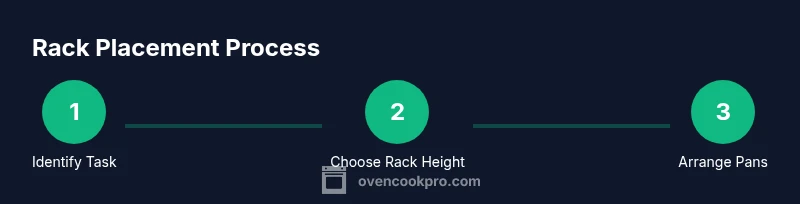
Identify the cooking task
Review the recipe or goal (cookies, roast, or broil) and note the desired texture and browning. This sets the rack position before you touch the oven door.
Tip: Knowing the task lets you pick the starting rack height with confidence. - 2
Check the oven’s current rack setup
Remove any racks if needed to inspect for dents, warping, or corrosion. Clean the rack grooves so it slides smoothly back in.
Tip: A smooth rack prevents misalignment that could affect heat distribution. - 3
Choose the initial rack height
For cookies or cakes, start with the middle rack; for roasts, start at the middle and be ready to move to the bottom if browning is slow.
Tip: If you’re unsure, starting in the middle is a safe default. - 4
Consider convection or standard bake
If using a convection oven, you may benefit from one rack and slightly shorter bake times. For standard ovens, plan for a longer bake and check color frequently.
Tip: Convection fans help with even browning; adjust times to prevent overcooking. - 5
Arrange pans with proper spacing
Place pans with 2–3 inches of air between them to promote airflow and even cooking.
Tip: Avoid crowding; crowded pans steam instead of roast or bake evenly. - 6
Insert racks carefully and preheat if required
Slide racks in with mitts and preheat only if the recipe calls for it. Position pans on the chosen rack and close the door gently.
Tip: Always use mitts; a hot rack can cause burns or slips. - 7
Monitor and adjust as needed
Watch color and doneness; rotate trays if baking on multiple racks. Move to a higher or lower rack if browning is uneven.
Tip: Small adjustments early can prevent over-browning later. - 8
Finish, cool, and clean
Remove food, let it rest as needed, and clean racks once cool. Dry racks completely before reinserting.
Tip: Keeping racks clean maintains good heat transfer and longevity.
Questions & Answers
Which oven rack should I use for cookies?
For most cookies, start with the middle rack to promote even browning and avoid scorching the edges. If cookies spread too much, a slight raise or rotation can help. Always monitor the first batch to adjust future racks.
For cookies, start in the middle rack to get even color. If they spread too fast, move the rack slightly lower or rotate the tray and watch closely.
Can I bake on two racks at the same time?
Yes, you can bake on two racks if you leave at least 2–3 inches between pans and rotate them halfway through. This helps ensure consistent heat exposure across both layers.
Yes, you can use two racks. Leave space between pans and rotate halfway through for even cooking.
What should I do if browning is uneven?
Adjust the rack position, rotate trays, and check for airflow obstructions. Moving from middle to bottom or top can balance browning, depending on the dish.
Move the rack, rotate the trays, and check airflow. A simple rack adjustment often balances browning.
Does convection require different rack placement?
Convection can allow for more even cooking with less time. Start on the middle rack and monitor closely, moving as needed to prevent over-browning.
Yes, convection often means you can use the middle rack and shorten bake times; adjust as you go.
How do I clean oven racks after use?
Soak racks in warm soapy water, scrub gently, rinse, and dry before re-inserting. Regular cleaning prevents residue buildup that affects heat transfer.
Soak, scrub, rinse, and dry the racks before putting them back in the oven.
What if I don’t have a rack that fits perfectly?
If a rack doesn’t fit exactly, place it as close to the center of the oven as possible and ensure it slides smoothly in the tracks. Avoid forcing a rack that binds.
If a rack doesn’t fit, center it as best as you can and don’t force it in the track.
Watch Video
Main Points
- Match rack height to task for best results
- Space pans to maintain airflow and even cooking
- Convection changes optimal rack positions and times
- Rotate or reposition as needed for even browning
- Keep racks clean to ensure consistent performance