Oven vs Air Fryer: What to Buy in 2026
Decide whether to buy an oven or an air fryer with a clear, practical guide. Compare performance, capacity, energy use, and cost, plus buyer tips for small kitchens and family meals.


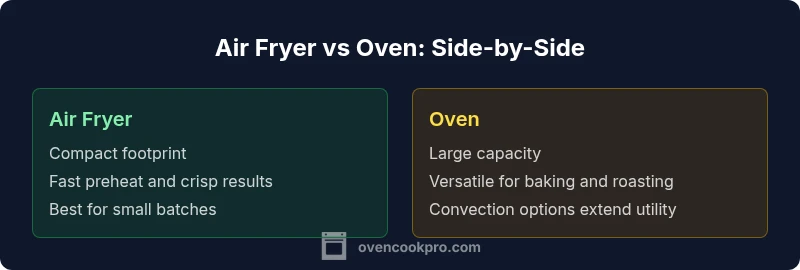
For most households, an air fryer shines for quick, crisp results in small batches, while a traditional oven—especially with convection—excels for large meals and versatile baking. If space and budget are tight, consider the air fryer; if you regularly cook for several people or bake roasts and sheet-pan dinners, the oven remains the better general-purpose choice.
Context and Market Overview
If you're weighing options for a modern kitchen, you may be asking what to buy oven or air fryer. This decision shapes every week of meals, from weeknight dinners to weekend baking. According to Oven Cook Pro, most households evaluate these two appliances by batch size, space, and cooking goals rather than by fancy features. The core difference is that a full-size oven provides broad capacity and versatility, while an air fryer concentrates on speed, texture, and compact convenience. The result is a trade-off between scale and speed, with the oven letting you bake multi-course meals and the air fryer delivering crisp textures in a fraction of the time. When making a purchase, it’s crucial to map your typical cooking scenarios: how many mouths you feed, what you bake most often, and how much counter space you’re willing to dedicate. The market today supports both pathways: you can rely on a single workhorse oven, or you can pair a countertop air fryer with an existing oven for a balanced setup. Oven Cook Pro’s 2026 analysis notes that this is less about “one size fits all” and more about aligning tools with real cooking habits.
Key Differences in Technology and Performance
The air fryer works by circulating hot air around food using a compact basket. This rapid air movement produces a crispy exterior with relatively little oil. By contrast, a traditional oven heats from elements at the top and bottom, and many models add a fan for convection. Convection oven modes simulate air frying at larger scale, offering more even heat distribution and the ability to handle bigger dishes. In practice, this means the air fryer excels at quick tasks—reheating fries, making small batches of chicken wings, or crisping vegetables—where speed and texture matter most. The oven, especially with convection enabled, enables roasting, baking breads, casseroles, sheet-pan dinners, and slow-cooked items that require more space. Energy efficiency depends on batch size, insulation, and whether the oven is preheating; smaller appliances sometimes win on a per-task basis, but they can’t always substitute for a full oven when the goal is multiple courses or large function menus.
When an Air Fryer Makes Sense
For many households, the air fryer is the go-to tool for quick meals and snacks. If you typically prepare single- or double-serving portions, an air fryer reduces preheat time and delivers crisp textures with little oil. It’s also a smart fit for smaller kitchens where counter space is at a premium, and for households that prioritize energy efficiency on routine, day-to-day cooking. Air fryers today come in multiple sizes, from compact models to larger countertop units that can handle sizeable chicken breast portions or fish fillets. The ability to batch cook in a single session while keeping the kitchen cooler is another practical advantage. Additionally, the air fryer can simplify meal prep by complementing an existing oven rather than replacing it; you can fry vegetables while baking potatoes in the oven, increasing overall kitchen throughput without crowding the space.
When a Traditional Oven Excels
A standard oven, especially when paired with a convection feature, remains the most versatile centerpiece for a kitchen. It handles large roasts, multiple sheet-pan dinners, and baked goods that require steady, even heat. If you regularly entertain, bake bread, roast vegetables, or cook casseroles for a crowd, the oven’s capacity becomes a major advantage. A traditional oven also reduces the need to manage multiple small appliances on the counter, freeing up space for food prep and storage. In many homes, the oven is the “default” workhorse because its form factor and heat distribution support a full range of culinary tasks—from slow-roasting a brisket to whipping up a batch of brownies. For families with growing kids or preferences for weekend baking, the oven’s long-term value often outweighs the upfront convenience of a countertop air fryer.
Practical Buying Guidelines: What to Look For
When deciding what to buy, focus on concrete features and your kitchen workflow rather than marketing claims. Key criteria include the appliance’s footprint and capacity, power options, temperature range, and preheat behavior. For ovens, check whether the unit supports true convection and how its insulated walls affect energy use. For air fryers, assess basket size, total interior space, and whether the model offers tray or rack accessories for versatility. Other practical considerations include ease of cleaning (dishwasher-safe parts help in busy weeks), available presets, and the warranty. Price is another important element; oven prices typically run higher upfront, but they also deliver more functionality, while countertop air fryers offer affordability and speed for everyday crisping tasks. Finally, think about how you’ll use the appliance in conjunction with existing equipment: will you rely on one device or prefer a two-device setup for different cooking tasks? According to Oven Cook Pro, matching device capability to your weekly meal plan is the most reliable predictor of satisfaction.
Real-World Scenarios: Menu Planning and Workflow
Imagine a typical week where you cook for a family of four. On weekdays, you might prepare lean proteins and vegetables; on weekends, you roast a chicken, bake a loaf of bread, and make a sheet-pan dinner. With an oven-centric plan, you allocate two or three sheet-pan meals and one baking session, using convection to speed up cooking without sacrificing browning. With an air fryer-centric plan, you plan multiple small batches—perhaps chicken tenders for weeknights and crispy potatoes for side dishes—while the oven handles bulk items or desserts. A balanced setup could involve using the air fryer for reheating leftovers and crisping sides, while simultaneously using the oven for roasts and baking. Practically, this approach reduces single-task bottlenecks and keeps the kitchen temperature comfortable. In households with active schedules, establishing a routine that assigns tasks to each appliance reduces decision fatigue and ensures meals come together on time.
Common Mistakes and How to Avoid Them
A common error is buying based on features you don’t actually need, which leads to underutilization and wasted space. Another mistake is assuming one device can replace the other; while there is overlap, some tasks simply require oven-scale capacity or convection reliability. People also underestimate preheat time and energy use, assuming both appliances perform instantly. Finally, buyers often overlook maintenance: air fryer baskets can accumulate grease quickly, while ovens require regular cleaning of racks and seals to maintain heat efficiency. To avoid these pitfalls, measure your counter space, list your most frequent meals, and compare those use cases against each device’s strengths. If possible, test models in-store or rent-to-own before committing to a long-term purchase.
How to Use Both: Complementary Kitchen Setup
Many kitchens benefit from a hybrid approach. Use the air fryer as a quick-reheat tool or for finishing crisp textures on vegetables, while reserving the oven for baking bread, roasting larger cuts of meat, or making a complete sheet-pan dinner. This strategy works best when you plan your workflow: start with items that require long cook times in the oven, then transition to air-fry finishing steps to save time. Consider timing and proximity: place the air fryer on a side counter or cart for easy access, and keep essential trays and racks within reach. If space allows, invest in a compact countertop oven as a secondary option—this expands your capacity to handle multiple dishes simultaneously without overloading a single appliance.
Maintenance and Care Tips
Both appliances benefit from regular cleaning and inspection. For ovens, wipe the interior after use, check door seals, and inspect racks for wobble or wear; keep the vent clear to maintain efficient heat. For air fryers, clean the basket and tray promptly after cooking to prevent oil buildup, and periodically check the fan and heating element for debris. Use minimal oil for air frying and follow manufacturer guidelines for safe temperatures. A quick-clean cycle on many ovens helps reduce residue, while thorough disassembly of parts for washing may be necessary on older units. Finally, schedule periodic professional servicing if you notice performance dips, unusual sounds, or inconsistent temperatures. Maintaining both devices will prolong their life and improve results over time.
Comparison
| Feature | Oven (Conventional/With Convection) | Air Fryer |
|---|---|---|
| Cooking Capacity | Large, multi-dish capacity (roasts, sheet-pan meals) | Limited to small batches |
| Cooking Method | Convection heating (fan-assisted) and radiant heat | Rapid hot air circulation in a compact basket |
| Preheat Time | Longer preheat (often 5-15 minutes) | Shorter preheat (often 2-5 minutes) |
| Energy Use | Higher total energy for big cooks | Lower energy per task for small batches |
| Versatility | Baking, roasting, broiling; multi-course capability | Crisping, reheating, small-batch baking |
| Cost Range | Higher upfront cost with broad utility | Lower upfront cost; varies by size |
| Maintenance | Racks and seals; more components to clean | Basket and tray are simple to clean |
| Best For | Large families, baking, and multi-dish dinners | Small households, quick crispy sides |
The Good
- Air fryer saves counter space and preheats quickly
- Oven handles large meals and baking with even heat
- Air fryer offers crisp textures with minimal oil
- Convection in ovens speeds up cooking for batches
Drawbacks
- Air fryer limited capacity for large meals
- Oven can require longer preheat and higher energy for big cooks
- Air fryer models vary; cleanup can be fiddly with some baskets
- Air fryer cannot fully replace baking/roasting in a busy kitchen
Oven wins for versatility and large meals; air fryer wins for compact, quick, crispy results.
Choose the oven if you regularly cook for many people or bake and roast. Choose the air fryer if space is limited and you mostly want fast, crisp outputs for small batches.
Questions & Answers
What should I consider before deciding between an oven and an air fryer?
Before buying, consider meal size, cooking tasks, counter space, and budget. If you cook for many people or bake regularly, the oven offers greater versatility. If you mostly want quick, crispy sides in small batches, an air fryer can be ideal.
Think about batch size, space, and how you’ll cook most often. The oven is best for versatility; the air fryer shines for quick, crispy meals.
Can I bake in an air fryer?
Yes, many air fryers support baking on a small scale, but limitations include capacity and loaf sizes. For cookies or small cakes, you can bake in some models; larger breads or pastries may require an oven.
Yes—some air fryers can bake small items; for larger baking, use the oven.
Is convection baking the same as air frying?
Convection uses a fan to circulate hot air in an oven, while air frying compresses the same concept into a compact countertop unit. They share principles but differ in space, capacity, and browning control.
They’re similar in moving air, but devices and results differ in scale and flexibility.
What is best for a busy family?
For frequent large meals, the oven’s capacity makes it the practical baseline. If time is tight and quick, frequent crisping is needed, an air fryer can be valuable as a supplement rather than a replacement.
For busy families, the oven handles big meals; the air fryer speeds up quick sides.
How do price and energy compare?
Countertop air fryers are usually cheaper upfront and require less energy for small tasks. Full-size ovens cost more upfront but can replace multiple appliances for different cooking needs; energy usage depends on load and duration.
Air fryers cost less upfront and use less energy per small task; ovens cost more but cover more cooking tasks.
Main Points
- Assess your typical meal size and batch needs
- Air fryer suits quick, crispy sides in small batches
- Convection oven offers the best all-around versatility
- Preheat times and energy use vary by unit
- Space, budget, and cooking goals should guide the buy