Roaster Oven vs Slow Cooker: A Thorough Comparison for 2026
A detailed, analytical comparison of roaster ovens and slow cookers, covering heating methods, capacity, energy use, and real‑world use cases to help homeowners choose the right tool for meals in 2026.


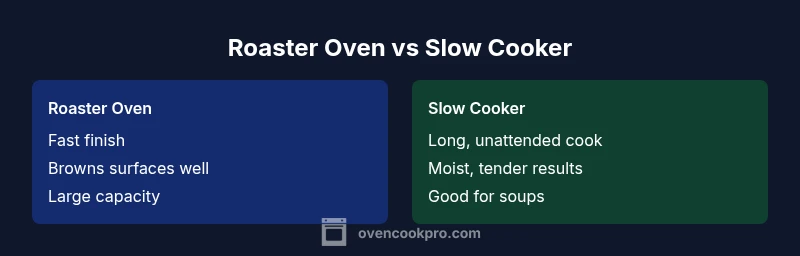
When deciding between a roaster oven and a slow cooker, consider batch size, texture, and timing. A roaster oven excels with high-heat browning and faster finishing for large cuts, while a slow cooker shines for long, unattended simmering and pull-apart tenderness. According to Oven Cook Pro, each tool serves different meal strategies, so the best choice depends on your weekly menu and schedule.
What is a roaster oven?
A roaster oven is a compact, countertop roasting appliance designed to supplement or extend your main oven. It combines a metal rack, a domed lid, and a built‑in heating element to deliver rapid browning and even heat across a large roast. The practical advantage is finishing power: you can achieve crisp, golden exteriors on poultry, beef, and casseroles without crowding the primary oven. This makes it ideal for holiday meals or when the kitchen is crowded with side dishes. From an Oven Cook Pro perspective, the roaster oven offers quick searing and high‑heat finishing that a slow cooker cannot replicate, helping you lock in flavor and moisture in less time.
In practice, many households use a roaster oven for turkeys, large roasts, or multiple dishes that need oven-like performance without occupying the main oven. You gain speed, a hands‑on browning step, and a portable second oven that stays on the counter. The roaster oven vs slow cooker decision often comes down to whether you value fast surface browning and attached roasting, or long, low‑and‑slow cooking with minimal hands‑on time.
The Oven Cook Pro Team notes that a roaster oven can act as a bridge between conventional oven cooking and a dedicated slow cooker, enabling precise texture control on bigger cuts while freeing the main oven for sides or desserts.
What is a slow cooker?
A slow cooker is a dedicated low‑temperature cooking device that braises, simmers, and softens tough cuts over extended periods—typically several hours. It uses a single, evenly heated bowl with a tight lid to trap moisture and heat, creating tender textures and deeply developed flavors with little hands‑on effort. The lower temperature profile means less browning, but the long cook times allow flavors to meld and meat to fall apart with fork‑tender precision. From an Oven Cook Pro lens, the slow cooker excels in unattended meals where you want predictable results with minimal oversight.
Slow cookers come in a range of capacities, from compact 3‑quart models to larger 6‑8 quart options, making them well suited for soups, stews, chili, pulled‑beef sandwiches, and hearty casseroles. Because the heat is gentler and consistent, you can set it up in the morning and return to a ready‑to‑eat dish in the evening. The roaster oven vs slow cooker debate often tilts toward convenience and texture, with the slow cooker offering steady, long‑duration cook time and hands‑free operation.
In summary, a slow cooker prioritizes low effort and long simmering over browning, while a roaster oven emphasizes speed, exterior texture, and the ability to handle larger pieces with near‑oven performance.
Comparison
| Feature | Roaster Oven | Slow Cooker |
|---|---|---|
| Heating Method | Direct high‑heat with rapid browning and optional broil; better surface development | Low, even heat with long, uninterrupted simmering; no browning on the surface |
| Temperature Range | Typically higher surface temperatures with short bursts; browning emphasized | Low steady range designed for long cooking cycles |
| Typical Capacity | Large countertop capacity (often 16–22 qt equivalents) | Commonly 3–8 qt ranges, versatile for soups and stews |
| Cooking Time | Faster completion for roasts and big cuts; finishing touches in hours or less | Long, hands‑off cooking; meals reach tenderness after several hours |
| Best For | Large roasts, holiday meals, finishing touches on poultry or beef | Stews, soups, pulled meats, braises, and prep‑ahead meals |
| Energy Use | Higher instantaneous draw but shorter total time; efficient for batch finishing | Lower power usage over longer periods; convenient for overnight cooking |
| Cleanup & Maintenance | Relatively straightforward; metal rack, lid, nonstick trays may require more frequent scrubbing | Very simple: wash the ceramic insert or pot and lid; minimal scrubbing |
The Good
- Offers fast browning and finishing of large cuts
- Provides a portable second oven for busy kitchens
- Ideal for holiday meals and batches that fit a roaster size
- Good for quickly searing meat before finishing in another method
- Can free up the main oven for sides and desserts
Drawbacks
- Less hands-off for long cooks that require liquid browning and flavor development over time
- Bulkier presence on the countertop; takes space
- Limited ability to develop the deep, long simmer flavors you get from a slow cooker's long, gentle heat
- Not ideal for delicate desserts or cake batters that require precise textures
Choose based on meal strategy: roaster ovens for fast, high‑heat finishing on big cuts; slow cookers for long, unattended braises and soups.
If you routinely cook large roasts and want quick surface browning, the roaster oven is your best ally. For hands-off meals that require hours of simmering to tenderness, a slow cooker wins. In mixed meal plans, many households benefit from owning both tools, using each where their strengths shine.
Questions & Answers
Which is better for holiday roasting: roaster oven or slow cooker?
For holiday roasts that benefit from browning and a fast finish, a roaster oven is typically the better option. It delivers oven‑like performance in a countertop appliance, freeing your main oven for sides. If you value hands‑off cooking and tender meat without browning, a slow cooker can still work, but the result won’t have the same crust or color. The best approach is to use both in tandem when possible.
For holiday roasts, a roaster oven is usually best for that crust and speed; slow cookers are great for unattended tender meat, though they won’t brown the exterior the same way.
Can you bake bread or cake in a roaster oven?
Yes, you can bake bread or cakes in many roaster ovens, but performance varies by model. Use indirect heat or a rack, monitor the temperature closely, and adjust bake times as you would with a conventional oven. The goal is to mimic standard oven conditions enough to achieve a similar rise and crust.
You can bake in a roaster oven—just watch temperature and time, and use a rack to mimic oven setup.
Are roaster ovens more energy-efficient than slow cookers?
Energy efficiency depends on the task. Roaster ovens deliver higher heat for shorter periods, which can be efficient for finishing large roasts. Slow cookers use low power for many hours, which is efficient for long braises but ties up the appliance for longer. Overall, both can be economical if used wisely and for the right jobs.
It depends on what you’re cooking; both have energy trade-offs based on time and heat.
How do I convert a slow-cooker recipe to a roaster oven?
To adapt, reduce cooking time by a factor and increase temperature only as needed to achieve browning. Start with the same liquids, but monitor for evaporation, and finish with a sear or broil to replicate the slow cooker’s moisture retention. Expect different texture due to the high‑heat finish.
Short version: shorten time, keep liquid, add browning at the end.
Is a roaster oven safer than a slow cooker?
Both appliances include standard safety features, like automatic shutoff on many models. Roaster ovens carry burn risks due to higher heat on the surface, and slow cookers require caution with lid placement and steam. Follow manufacturer guidelines and keep children away from hot surfaces.
Stay aware of hot surfaces on roaster ovens; follow guidelines and keep kids away.
Can I use both appliances in the same meal without conflicts?
Yes. A common approach is to use the roaster oven for browning and finishing a centerpiece while the slow cooker handles sides, sauces, or long-simmered components. Plan timing so the main dish finishes as sides come to a ready state, and vice versa.
Absolutely. Use one for the big roast, the other for long-simmered sides to balance timing.
Main Points
- Assess your primary cooking style before buying
- Choose roaster oven for speed and browning on large cuts
- Opt for slow cooker for long, hands-off meals and tender textures
- Consider kitchentop space and family size when deciding capacity
- Budget for energy use and maintenance in long‑term planning