Oven-like Results: Full-Size vs Countertop Oven — A Comprehensive Comparison
An objective comparison of full-size ovens versus countertop convection ovens to help home cooks achieve authentic oven-like results, balance energy use, and optimize value.


TL;DR: For true oven-like results, a full-size oven is usually the best fit for larger meals and consistent baking. If you’re short on space or prefer faster preheat and smaller batches, a countertop convection oven can still deliver impressive results. Your decision should consider kitchen size, typical cooking volume, and budget, along with how often you bake bread or roast larger roasts.
The Meaning of Oven-like Results in Modern Kitchens
In everyday cooking, the phrase oven-like results refers to bread crusts with snap, evenly browned surfaces, moisture retention in meats, and reliable, repeatable bake outcomes across a range of recipes from cookies to roasts. The term is not a guarantee of perfection, but a benchmark for how closely a given appliance mimics a traditional, full-size oven. According to Oven Cook Pro, the goal is consistent heat, predictable browning, and minimal hot spots, regardless of batch size. For many households, achieving true oven-like results hinges on the appliance’s ability to hold steady temperature, distribute heat evenly, and accommodate typical bakeware without frequent adjustments. These factors influence not only flavor and texture but also the success rate of weeknight meals and weekend feasts. As you compare options, consider how often you bake bread, roast vegetables, bake cookies, or reheat leftovers with similar results. Oven-like performance is about reliability as much as it is about speed. The Oven Cook Pro team emphasizes that your kitchen layout and workflow will shape which appliance fits best, and that a well-chosen oven can elevate daily cooking to restaurant-like consistency.
The Meaning of Oven-like Results in Modern Kitchens (continued)
From a practical standpoint, oven-like results depend on preheat stability, air flow, and pan conductance. A full-size oven typically offers a larger cavity, positionable racks, and more consistent convection when it’s equipped with true baking modes. Countertop convection ovens, while compact, can deliver excellent results for many dishes by circulating hot air with a fan. The key is choosing models with reliable temperature regulation and robust bake modes, then optimizing your setup with appropriate pans and metal sheets. Oven Cook Pro has found that many home cooks experience a noticeable improvement in browning and texture when moving to an adequately specified countertop unit, provided they adjust batch sizes and keep an eye on preheat behavior. In short, oven-like results come from a thoughtful pairing of appliance capabilities and proper technique.
The Meaning of Oven-like Results in Modern Kitchens (final thoughts)
As you plan your upgrade or replacement, align expectations with your cooking patterns. A full-size oven is often the best long-term investment for households that bake regularly and entertain, while a countertop option can fill gaps for small kitchens or limited spaces without sacrificing too much on quality. The choice should reflect your typical meals, available space, and how much you value speed versus capacity.
Comparison
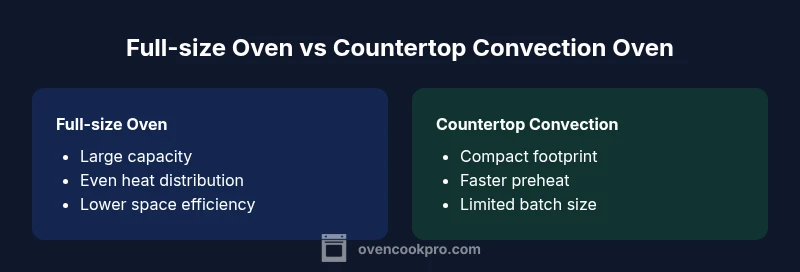
| Feature | Full-size Oven | Countertop Convection Oven |
|---|---|---|
| Capacity | Large interior with multiple rack positions for big casseroles, sheet pans, and multiple trays | Compact interior; best for single dishes or small batches |
| Preheat Time | Longer preheat due to larger cavity | Quicker preheat designed for rapid meal prep |
| Heat Distribution | Typically very even heating with proper calibration and bake modes | Convection air can reduce hot spots but may still vary by model |
| Energy Use | Higher energy draw per cycle due to larger cavity | Lower energy use per bake but potential inefficiencies at small loads |
| Best For | Large families, baking batches, traditional roasting | Small kitchens, quick meals, and flexible secondary cooking |
| Price Range | Higher upfront cost; potential installation consideration | Lower upfront cost; portable or countertop convenience |
The Good
- Full-size ovens handle large family meals with ease
- Even heat distribution supports consistent baking and roasting
- Countertop convection ovens save space and require no installation
- Flexible setup supports small kitchens and variable cooking needs
Drawbacks
- Full-size units require installation and can be less forgiving in small spaces
- Countertop units may have limited capacity and variable performance across models
- Countertop units occupy valuable counter space and can heat up nearby surfaces
Full-size ovens excel for volume and consistency; countertop convection ovens win on space and flexibility
Choose a full-size oven if you regularly cook large meals and want steady, bake-perfect results. Opt for a countertop convection oven when space is tight or you need a fast, secondary option for smaller batches.
Questions & Answers
Which is better for baking bread at home, a full-size oven or a countertop convection oven?
A full-size oven generally provides more even heat and stable humidity, which supports bread with good crust and crumb. A countertop convection oven can also bake bread well, especially for daily loaves, if you choose models with true convection and adequate chamber size.
For bread, the full-size oven usually delivers more even heat, but a capable countertop convection oven can work for daily loaves with proper technique.
Can a countertop convection oven replace a traditional oven for most recipes?
In many cases, yes, for smaller households or limited spaces, a high-quality countertop convection oven can handle most weeknight meals. However, large roasts or multiple-batch baking may still require a full-size oven for capacity and uniformity.
Yes for many weeknight meals, but large roasts might be better suited to a full-size oven.
How much space is needed for installing a full-size oven in a typical kitchen?
A standard full-size oven typically requires a dedicated cabinet space with proper ventilation and electrical wiring. Ensure clearance around the appliance for doors and heat dissipation, plus room for racks and pans.
You’ll need an allotted cabinet space with proper ventilation and wiring, plus clearance for door movement.
Are countertop ovens energy efficient compared to full-size ovens?
Countertop convection ovens can be more energy-efficient for small meals due to shorter preheat times and smaller cavity volumes. For larger meals, a full-size oven may be more practical, especially if you cook at higher volumes.
Smaller countertop ovens save energy on small dishes; for big meals, a full-size oven may be more efficient overall.
What safety considerations should I know for countertop convection ovens?
Place the unit on a heat-resistant surface, keep the cord away from heat sources, and ensure adequate ventilation. Clean regularly to prevent buildup, and use oven-safe cookware to avoid damage.
Set it on a heat-resistant surface, ventilate properly, and clean regularly to stay safe.
Can I achieve oven-like browning with a countertop unit?
Yes, many countertop convection ovens can brown well with convection settings and proper bakeware. Pan choice and preheating technique play important roles in achieving that crust and color.
Yes—use convection mode, a good pan, and proper preheating for browning.
Main Points
- Assess your cooking volume and space before buying
- Full-size ovens offer capacity and consistent results for many dishes
- Countertop convection ovens provide flexibility and speed in small kitchens
- Match bakeware and the appliance’s features to your most-used recipes
- Consider maintenance and installation requirements as part of total cost