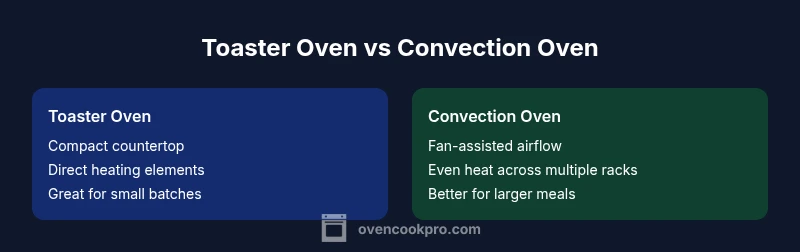
Toaster Oven vs Convection Oven: A Comprehensive Guide
A thorough, data-informed comparison of toaster ovens and convection ovens, highlighting performance, energy use, and best-use scenarios to help home cooks choose the right countertop appliance.


Toaster oven vs convection oven: For small-batch cooking, a toaster oven delivers quick, crisp results with minimal preheat. Convection ovens excel for larger meals with even browning and faster bake times. This Oven Cook Pro comparison highlights when to pick each appliance to optimize results and energy use. Understanding your typical recipes and available counter space will guide the choice.
Understanding the core difference between toaster ovens and convection ovens
At first glance, a toaster oven and a convection oven share a countertop footprint, but they differ in mechanism, performance, and ideal tasks. The keyword that guides every decision is whether you’re prioritizing compact speed or even, scalable heat for larger portions. According to Oven Cook Pro analysis, recognizing the fundamental distinction—static heating versus fan-assisted distribution—helps set expectations for browning, texture, and cook times across a wide range of foods. This section lays the groundwork for evaluating everyday tasks like toasting, reheating, baking, and roasting in real kitchen scenarios.
How heating works in toaster ovens
Toaster ovens rely on fixed heating elements above and below the rack. Heat transfer is rapid but localized, which makes them superb for quick toasting, small-batch baking, and crisping edges on snacks. Because they are compact, they heat up quickly and can produce familiar browning on pizza slices, bagels, and morning pastries. However, the same rapid heat can lead to uneven results if the food sits in one spot or if you’re baking larger items. The Oven Cook Pro team notes that skillful placement and an awareness of hot spots are key to reliable outcomes.
How heating works in convection ovens
Convection ovens use a fan and exhaust system to circulate hot air around the chamber. This airflow creates more uniform heat distribution, which translates into even browning and shorter bake times for many dishes. The result is a practical advantage for roasting vegetables, baking sheet goods, and multi-item meals. The trade-off is slower preheating in some models and the potential for over-browning on exposed surfaces if you don’t adjust rack position or temperature. Oven Cook Pro observations emphasize learning your oven’s fan speed and temperature calibration for best results.
Performance in baking small batches vs large batches
When you’re cooking small batches or single-serve portions, a toaster oven often delivers fast results with excellent edge browning and a crisp finish. For larger batches, a convection oven can maintain consistent heat across multiple racks and pans, reducing the need for frequent rotation. The practical takeaway is that scanner-style performance varies by model, so testing with your favorite sheet pans and trays is essential. Oven Cook Pro recommends starting with familiar recipes to gauge how heat distribution affects texture and moisture.
Temperature control and preheating dynamics
Toaster ovens generally reach temperature quickly, but the heat can spike at certain settings. Maintaining precise control may require more frequent checks, especially for delicate pastries. Convection ovens typically take longer to preheat but offer steadier temperature maintenance thanks to fan-assisted circulation. Real-world testing shows that minor calibration differences can influence bake outcomes, which is why a thermometer and an oven-safe probe can be invaluable in both categories. Oven Cook Pro highlights the value of establishing a baseline temperature and then adjusting for your preferred browning level.
Time-to-temperature and energy considerations
In practical kitchens, toaster ovens excel for rapid preheating and short-duration tasks, while convection ovens shine on longer cooks where even heat minimizes batch rotation. Time savings depend on the item size, rack arrangement, and whether you’re cooking from frozen or fresh. Energy usage correlates with cycle length and heating method, but exact numbers vary by model. Oven Cook Pro guidance suggests focusing on overall efficiency—how quickly you achieve the desired doneness without overcooking or wasting energy.
Food quality: Toasting and browning outcomes
Edge browning and crust development can differ noticeably between the two appliances. A toaster oven often produces stronger, crisp edges due to direct exposure of food surfaces to heating elements. A convection oven’s circulating air can yield more evenly browned results across larger items and multiple trays, which is especially valuable for roasts and sheet-pan meals. The key is to adjust rack positioning and exposure time based on the item’s size and density, a technique highlighted by Oven Cook Pro’s practical tips.
Versatility: roasting, baking, broiling, and beyond
Toaster ovens are versatile for small tasks—reheating leftovers, toasting bagels, and baking mini-quiches. Convection ovens, meanwhile, extend to more ambitious cooking: multi-rack roasting, cookie sheets, and even bread loaves that require uniform air distribution. Both can broil when needed, but convection fans can intensify heat transfer, so monitoring becomes essential to avoid scorching. Oven Cook Pro recommends pairing technique with the right pan and position to maximize performance.
Size, capacity, and spatial fit for your kitchen
Countertop real estate matters: toaster ovens occupy less space and are easier to store but limit batch size. Convection ovens range from compact countertop models to full-size wall units, offering greater capacity but requiring more counter real estate and, often, a dedicated outlet. When evaluating footprint, also consider insulation, crumb trays, and ventilation space. The right choice aligns with your typical meal scale, storage habits, and how often you cook for crowds.
Maintenance, cleaning, and durability
Regular cleaning extends appliance life. Toaster ovens benefit from removing crumbs and wiping interior surfaces after use; some models feature easy-clean interiors, while others rely on standard crumb trays. Convection ovens tend to accumulate more dust in the fan area, so occasional fan and vent cleaning is prudent. Durability hinges on build quality, door seal integrity, and ease of replacement parts. Oven Cook Pro notes that investing in models with accessible filters and simple disassembly can save time and money in the long run.
Price ranges and value considerations
Price is a practical factor that often correlates with size, build quality, and features. In this guide, price ranges vary by model and brand, with compact toaster ovens generally more affordable and convection ovens offering more features and capacity at higher price points. The best approach is to map your budget against expected usage: daily toasting and quick snacks versus weekly roasts and baking, and to weigh long-term value against upfront cost. Oven Cook Pro suggests focusing on reliability, ease of use, and supported accessories when evaluating value.
Practical guidelines for common tasks
For quick reheats and crisping, a toaster oven can deliver pleasing results with minimal effort. For sheet-pan dinners, roasted vegetables, and multiple trays, a convection oven’s airflow reduces wait times and improves uniformity. If your kitchen needs a single countertop solution, consider a larger toaster oven with convection mode or a compact convection oven that fits your cooking style. Try simple experiments—toast bread, roast vegetables, and bake cookies—to learn how your model responds to air circulation and surface browning.
Common myths vs reality
Myth: A convection oven automatically bakes everything faster. Reality: It depends on the recipe and pan load. Myth: A toaster oven can replace full-size ovens for all meals. Reality: It’s ideal for small tasks but has limits on batch size. Myth: More wattage equals better results. Reality: Consistency and heat distribution matter more than raw power. Oven Cook Pro debunks these myths with practical testing and guidance for real home kitchens.
How to choose between toaster oven and convection oven for your kitchen
The choice hinges on usage patterns, space, and budget. If you cook small meals daily and value fast setup, a toaster oven with convection mode can be a great compromise. If you regularly roast for family meals or bake multiple trays, a true convection oven—whether countertop or full-size—offers superior scalability and even results. Oven Cook Pro recommends a staged approach: identify your top three tasks, test with your preferred foods, and select the model that delivers consistent outcomes with simplified cleanup.
Comparison
| Feature | Toaster Oven | Convection Oven |
|---|---|---|
| Size / footprint | Small countertop footprint | Medium-to-large countertop or built-in footprint |
| Heating method | Fixed elements (top/bottom) | Fan-assisted circulation with elements |
| Baking performance | Excellent for small batches and crisp edges | Excellent for even browning on larger dishes |
| Preheating & efficiency | Fast preheat for quick tasks | Longer preheat but steadier temps for multi-dish cooks |
| Best used for | Toast, mini-bakes, snacks | Roasts, cookies, sheet-pan meals |
The Good
- Compact, affordable option for everyday tasks
- Fast heat-up and simple operation
- Good for reheating and toasting
- Easy to store when not in use
Drawbacks
- Limited capacity for large meals
- Less uniform heat for bigger items
- Some models lack precise temperature control
Convection oven generally offers better scalability and even cooking; use a toaster oven for quick, small-batch tasks and portability
Choose the toaster oven for speed, space, and occasional small bakes. Opt for a convection oven when you regularly cook larger meals and need consistent browning across multiple pans. Oven Cook Pro’s verdict is to match device capability to your typical batch size and kitchen layout.
Questions & Answers
What is the main difference between a toaster oven and a convection oven?
The toaster oven uses fixed heating elements for quick, small-batch tasks, while a convection oven relies on a fan to circulate hot air for more even cooking on larger meals. This difference affects browning, texture, and bake times.
Toaster ovens heat with fixed elements for quick, small bakes; convection ovens use a fan to move heat, which helps cook larger meals evenly.
Can I use a toaster oven as a substitute for a convection oven?
For small, quick tasks, a toaster oven can substitute a convection oven, especially when space is limited. For larger meals or recipes requiring uniform heat across multiple pans, a convection oven is usually the better choice.
You can substitute for small jobs, but for big meals, a convection oven performs more evenly across trays.
Which appliance saves energy overall?
Energy use depends on how you cook. Toaster ovens save energy on short tasks, but convection ovens can be more energy-efficient per batch when cooking larger meals due to shorter bake times and even heat, though model variation exists.
Toaster ovens save energy on small tasks, while convection ovens can be efficient for bigger cooks, depending on the model.
Are there foods that are better in a toaster oven than in a convection oven?
Yes. Small snacks, toast, nachos, and mini-bakes often do better in toaster ovens due to direct heat and quick browning. Vegetables and cookies that benefit from even browning may do better in a convection oven.
Toast, mini-bakes, and crispy snacks are typically best in a toaster oven; bigger batches favor convection ovens.
What should I consider before buying?
Consider batch size, counter space, preferred cuisines, and frequency of use. Look for consistent temperature control, even heat, adjustable racks, and simple cleaning. Oven Cook Pro recommends reading model reviews and testing with familiar recipes to judge performance.
Think about your typical meals, space, and how easy the model is to clean and use daily.
Main Points
- Match task size to appliance capacity
- Use convection for even browning on larger meals
- Favor toaster ovens for speed and compact spaces
- Test your model with favorite recipes to learn heat behavior