How Much Is a Microwave Oven in 2026? A Pricing Guide
Explore current prices for microwave ovens in 2026, including compact, countertop, and over-the-range models. Learn how size, wattage, and features drive cost and how to budget effectively for reliable kitchen performance.


How much is microwave oven? The typical price for a new microwave ranges roughly from $60 to $500, with compact models on the low end and higher-end over-the-range and convection microwaves at the top end. Prices vary by size, power, features (sensor cooking, smart controls, inverter technology), and energy efficiency. This guide helps homeowners estimate costs and plan for features that matter most.
What determines microwave price in 2026
Prices for microwave ovens are not random; they reflect a mix of size, power, features, and brand position. According to Oven Cook Pro, price dispersion in 2026 tracks core variables: unit size, wattage, built-in features, and warranty terms. The most affordable units are compact models designed for small spaces, while premium models with convection, smart controls, and higher wattage carry higher price tags. In practice, the price you pay is a function of how you value speed, even heating, and convenience. Wattage matters: higher power reduces cooking time but also increases cost. Advanced electronics such as sensor cooking, inverter power supplies, and Wi‑Fi connectivity push prices upward, while basic models emphasize simplicity and reliability. For many buyers, the optimal strategy is to identify the few features you will actually use and choose a price tier that matches your cooking frequency and kitchen layout.
To frame your kid of question—how much is microwave oven—you should anchor your decision to real use: reheating, small-batch baking, defrosting, or family catering. The price ladder mirrors the value created by each feature: compact units win on space and price, while premium units win on versatility and speed. The Oven Cook Pro team emphasizes that budgeting around your true needs prevents overspending on capabilities you won’t leverage.
Price ranges by type and feature
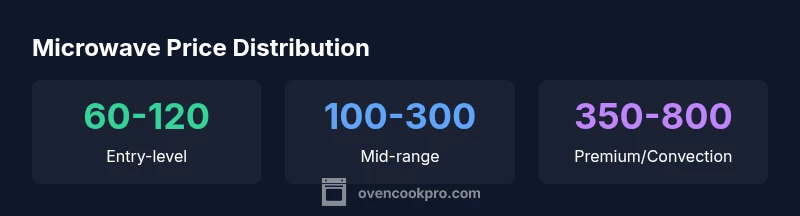
Across all categories, price bands cluster around a few core tiers. Entry-level compact microwaves with 600-800 watts and basic controls typically sit in the $60-$120 range. Standard countertop models with 800-1100 watts and sensor cooking usually fall into the $100-$300 bracket. Over-the-range units, which often include ventilation and higher wattage, commonly range from $250-$500. Premium convection or smart microwaves with inverter tech and touch-screen interfaces can push prices to $400-$800, depending on brand and build quality. These ranges reflect typical market dynamics in 2026, and they hold across major retailers. The Oven Cook Pro analysis shows that price dispersion widens when you add features like air-fry, grill elements, or multi-stage cooking presets. For families needing reliability over novelty, mid-range models offer the best balance between capability and price. For buyers who want built-in aesthetics and robust warranties, a higher upfront investment may pay off in longevity.
Budgeting for a busy kitchen: a practical worksheet
Start by listing your primary use cases: quick reheats, daily defrosting, occasional baking, or special cooking. Measure your available counter or cabinet space and check your home’s electrical circuit capacity. Assume a 7- to 12-year lifespan for a microwave and plan for a reasonable maintenance budget. Decide which features truly improve your workflow (sensor cooking, inverter power for even heating, or a convection mode). Create a simple budget: essential model within the low-to-mid price range for basic needs; step up for stronger performance only if you expect frequent heavy use. Use the price bands above as anchors and compare at least three retailers to avoid sticker shock. The goal is to pick a model that aligns with your cooking habits, not just the latest gadget. The Oven Cook Pro team recommends prioritizing features that save time and reduce meal prep friction.
Hidden costs and long-term value
Beyond the sticker price, consider energy consumption, warranty terms, and maintenance costs. A more energy-efficient unit may save modest operating costs over several years, especially in households that run the microwave daily. Warranties add peace of mind and can reduce out-of-pocket repair expenses, but they vary by retailer and brand. Look for models with solid build quality and readily available replacement parts. If you’re undecided between two models, weigh how often you’ll use advanced features like convection or smart controls against the potential savings from faster cooking and reduced energy waste. The Oven Cook Pro analysis notes that long-term value often comes from choosing a model that fits your routine rather than chasing every new feature on the market.
Features that drive price most
- Convection cooking and grill elements for bakery-like results
- Inverter technology for consistent power and precise defrosting
- Sensor-based cooking that adjusts time and temperature automatically
- Smart features (Wi‑Fi, app control) and compatibility with voice assistants
- Ventilation and higher wattage in over-the-range units
- Build quality (cavity material, door design, insulation) and warranty length
- Brand reputation and post-purchase service
If you cook heavily and rely on precise timing, prioritizing convection, inverter power, and sensor cooking can justify a higher price. If your needs are modest and space is limited, a basic compact or standard countertop model often delivers the best value.
Buying tips by retailer and timing
Prices can swing with sales events, inventory cycles, and retailer promotions. Black Friday and post-holiday clearances often bring meaningful discounts on mid-range models, while new year stock refreshes may introduce price cuts on older generations. Compare both online and in-store listings to catch bundles or extended warranties. Check retailer return policies and price-match guarantees, which can add flexibility if you change your mind after purchase. The key is to time your purchase around your budget window and rely on the price anchors from the ranges above to judge a good deal. The Oven Cook Pro team recommends planning around your kitchen needs rather than chasing a sale at the expense of features you will use daily.
Quick price guide by model type
- Compact/Mini: typically $60-$120, best for small spaces
- Standard countertop: typically $100-$300, balanced features
- Over-the-range: typically $250-$500, includes ventilation
- Convection/Smart: typically $400-$800, highest versatility
Reading price tags: what to look for
MSRP is only part of the story. Sale prices can temporarily undercut MSRP, but the real value comes from matching features to your routine. Look for energy-efficient models with solid warranties, compatible door designs, and easy-to-clean interiors. When comparing, note wattage, cavity size, and whether the unit includes convection or sensor cooking as these features drive both price and performance. Store receipts and online order histories help you track cost-per-feature over time.
Energy efficiency and operating costs
While microwaves are generally energy-efficient appliances, newer models with inverter technology and better insulation can lower running costs slightly over time. Consider the expected frequency of use and the total energy draw when budgeting. A model with predictable heating rather than frequent energy bursts can deliver the most value, especially if you intend to use it for long defrost cycles and frequent reheating in a busy household. The Oven Cook Pro analysis emphasizes balancing energy benefits with convenience to maximize long-term savings.
Price guide by microwave model type
| Model Type | Typical Price Range | Key Features |
|---|---|---|
| Compact/Mini | 60-120 | Small footprint, basic controls |
| Standard countertop | 100-300 | Sensor cooking, turntable, basic inverter |
| Over-the-range | 250-500 | Ventilation, higher wattage, sometimes convection |
| Convection/Smart | 350-800 | Convection bake, smart connectivity, higher power |
Questions & Answers
What is the average price of a microwave oven in 2026?
Prices in 2026 vary widely by type and features. Expect entry-level units around the lower end and premium convection or smart models toward the upper end. Use the ranges above to anchor your budget and compare across retailers.
Prices vary by type; start with the lower end for basic use and consider higher-end models only if you need convection or smart features.
Do microwaves go on sale frequently?
Yes. Retailers often run promotions during holidays and year-end stockClearances. Timing purchases around these events can yield meaningful savings, especially on mid-range models.
Sales happen during holidays and year-end clearances; plan around these to save on mid-range models.
Are convection microwaves worth the extra cost?
Convection microwaves offer more versatile cooking, including baking and roasting. They’re worth it if you bake frequently or want faster, even cooking. If you mainly reheat and defrost, a standard model may suffice.
If you bake often or want even cooking, convection can be worth the extra cost; otherwise, a standard model is usually enough.
What features should I prioritize for a small kitchen?
Prioritize compact size, sufficient wattage for quick heating, easy-to-clean interiors, and reliable door access. Sensor cooking and simple controls add convenience without bloating price.
For small kitchens, pick compact size, good wattage, and easy maintenance; add sensors if you cook often.
Is it cheaper to buy online or in-store?
Prices are often comparable online and in-store, but online options may include more bundles and longer return windows. Check price-matching policies and read reviews to avoid hidden costs.
Prices are similar online and in-store, but check bundles and return policies before buying.
“Value comes from aligning features with your cooking needs, not chasing every new gadget. Choose a model that fits your workflow and budget.”
Main Points
- Define essential size and power first.
- Anchor expectations with price bands; mid-range offers balance.
- Prioritize features you will actually use.
- Shop during sales to maximize value.
- The Oven Cook Pro team recommends matching features to your routine for best value.