Speed Oven vs Microwave: A Thorough Comparison
Compare speed ovens and microwaves to decide which fits your kitchen. Learn how they cook, when to use each, energy needs, and real-world tips for faster, crisper results.


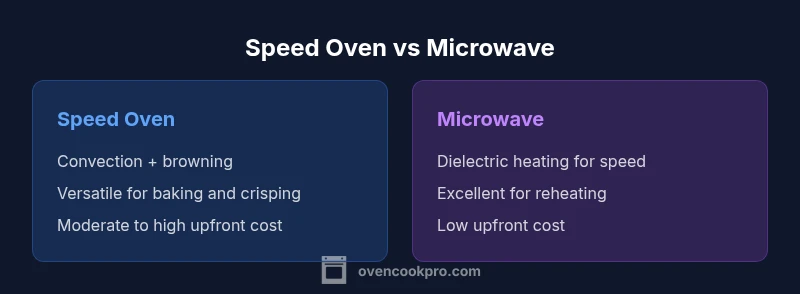
Speed ovens blend microwave heating with convection and browning, while microwaves rely on dielectric heating for rapid reheating. In practice, a speed oven often delivers crisper textures and even cooking for a wider range of foods, but it may take longer to preheat and costs more upfront. For ultra-fast reheating, a microwave remains unbeatable.
What is a speed oven vs microwave?
In the home kitchen, many cooks compare speed oven vs microwave to decide which appliance best fits their needs. A speed oven is a multi-function unit that blends microwave energy with convection heating (and often browning) to simulate baking, roasting, and crisping in a compact footprint. A standalone microwave relies on dielectric heating to move energy into food, heating it quickly but without browning or dry-crisp textures by default. The speed oven’s advantage is versatility: you can reheat, bake, toast, and crisp in a single device, sometimes with sensors that adjust time and temperature. A microwave, by contrast, excels at fast, convenient reheating and simple cooking tasks with minimal preheating. Ownership decisions hinge on how much you value browning, batch size, counter space, and upfront cost. Across models, expect variations in wattage, available cooking modes, and preheat behavior. The catch? speed ovens often require more careful cookware choices and can carry a higher price tag, while microwaves remain the simplest, most affordable path to ultra-fast heating. For many homes, speed oven vs microwave is about balancing speed with texture and versatility rather than picking one universally better option.
How the cooking methods differ in practice
Microwave energy directly excites water molecules in food, which heats the interior quickly but can leave edges soggy or uneven. Convection (a hallmark of speed ovens) circulates hot air around the food, promoting browning and more uniform cooking. Many speed ovens pair convection with browning functions (broil/grill) and some micro-waves for rapid start-to-finish tasks. The practical difference shows up in textures: reheated pizza may stay soft in a microwave but can become crisp in a speed oven; baked snacks bake evenly in a speed oven, while a microwave may leave soft edges. The speed oven also opens possibilities for small-batch baking, roasted vegetables, and even light roasting of proteins. In short, speed ovens are hybrids designed to cover more cooking tasks with one appliance, whereas microwaves excel at speed and simplicity for straightforward reheating.
Real-world use cases: everyday tasks
For leftovers, a speed oven can recapture crisp crusts on pizza or fry-like textures on reheated fried foods, thanks to its browning capability. If you frequently bake small batches, a speed oven provides a compact alternative to a full-size oven, delivering even heat without heating the entire kitchen. Quick weeknight meals—like reheating casseroles or cooking lean proteins—benefit from the speed oven’s hybrid approach. When you need ultra-fast reheating with minimal fuss, the microwave still shines. The key is to match the task to the tool: texture-focused tasks and small bakes favor speed ovens; rapid reheating and simple prep favor microwaves. Consider your typical meals, space, and tolerance for a slightly higher upfront cost when weighing speed oven vs microwave.
Energy, space, and cost considerations
Energy use varies by mode. A microwave typically uses less energy for short tasks, but a speed oven may offer energy savings per meal when replacing multiple appliances (since you’re consolidating). Space matters: speed ovens are larger and may require more counter or cabinet space, while microwaves stay compact and can often be integrated into a cabinet. Upfront cost often reflects versatility: speed ovens tend to be more expensive than standalone microwaves, but they can replace several appliances and appeal to cooks who value browning and baking in a compact footprint. Reliability and service coverage matter too; check warranty length and repair costs for both options.
Beyond price, consider preheat time, sensor accuracy, and the availability of cooking modes. If your kitchen prioritizes speed with minimal fuss, a microwave will keep things simple; if you want baking-like results, browning, and versatile cooking in a single device, a speed oven becomes worth evaluating.
How to choose between them: a decision checklist
Use this checklist to decide quickly:
- List your top tasks (reheating, baking, browning, defrosting).
- Estimate countertop space and whether you want an integrated or standalone unit.
- Compare upfront costs and long-term value (consider replacing multiple devices).
- Check available cooking modes and whether sensors adapt timing well for your foods.
- Consider kitchen workflow: do you often cook in bulk or need quick meals?
- Read model reviews focusing on reliability and customer service. If you prioritize crispy textures and baking-like results, lean toward a speed oven; if you prize ultra-fast reheating and lowest price, a microwave may be best.
A well-informed choice balances texture, speed, space, and budget.
Common myths and pitfalls
Myth: Speed ovens always cost more than microwaves. Truth: they can be more expensive upfront, but they may replace several devices and save space. Myth: You can’t bake effectively in a speed oven. Truth: many speed ovens handle baking tasks well, though outcomes depend on model and cookware. Pitfall: Overreliance on one feature. Some foods benefit from a dedicated appliance approach (like a true convection setting for large roasts). Myth: Preheating is always required for speed ovens. Truth: many models offer no-preheat or quick-heat options for specific modes. Myth: All speed ovens cook identically. Truth: performance varies with wattage, sensors, and build quality; read reviews and test with your favorite recipes.
Practical tips to maximize performance
- Use cookware that fits the appliance’s features to avoid energy waste. Cast iron or metal bakeware may need to be used only if the speed oven supports it.
- Preheat selectively: some tasks benefit from a quick start, others from a gentle bake.
- Exploit browning modes for crisp textures on snacks and leftovers.
- Layer food properly to ensure even air circulation; avoid overcrowding.
- Calibrate expectations for defrosting; microwaves defrost quickly, but speed ovens offer more even thawing with better texture outcomes.
- Clean and maintain sensors and fans; buildup can degrade cooking performance.
Comparison
| Feature | Speed Oven | Microwave |
|---|---|---|
| Cooking approach | Convection + microwave + browning | Dielectric heating only |
| Best for browning | Yes, with convection browning | No |
| Reheating speed | Fast, but depends on mode | Very fast |
| Texture versatility | High, handles baking, crisping | Limited to reheating and soft textures |
| Upfront cost range | Moderate to high | Low to moderate |
| Footprint | Larger or built-in options | Compact, countertop |
The Good
- Consolidates multiple functions in a single appliance
- Offers browning and crisping for more versatile cooking
- Can replace a traditional oven for small-batch baking
- Saves time on certain cooking tasks when used well
- Flexible placement options in some models
Drawbacks
- Higher upfront cost than a standalone microwave
- Requires counter space and appropriate electrical capacity
- Performance varies by model and sensor accuracy
- Longer preheat times for full convection baking in some cases
Speed ovens excel in versatility and texture; microwaves win on pure speed.
Choose a speed oven if you want browning, baking-like results, and a wider range of tasks. Choose a microwave if your priority is ultra-fast reheating and simple setup with minimal investment.
Questions & Answers
What is a speed oven?
A speed oven blends microwave and convection heating to cook with moisture control, browning, and faster reheating than conventional ovens. It’s designed to perform many tasks—reheating, baking, toasting, and crisping—within a compact footprint.
A speed oven combines microwave and convection for versatile cooking, including browning. It’s a hybrid that can replace several appliances in a smaller space.
Is a speed oven worth the extra cost?
Whether a speed oven is worth the investment depends on your cooking habits and space. If you frequently bake small batches or want crisp textures without a full-size oven, the added versatility justifies the cost for many households.
If you bake small batches or want crisp textures in a compact kitchen, a speed oven often justifies its higher price due to its versatility.
Can a speed oven replace a traditional oven?
A speed oven can substitute for a traditional oven in many daily tasks, especially for small-batch baking and quick meals. Large roasts and bulk baking may still benefit from a full-size oven.
It can replace a traditional oven for many daily tasks, but for large roasts, a full-size oven might still be preferable.
Do speed ovens use microwaves?
Yes. Speed ovens use microwave energy in combination with convection and browning features to speed cooking and improve texture.
Yes—speed ovens use microwaves together with convection for faster, versatile cooking.
Which is faster for reheating leftovers?
Microwaves typically reheat leftovers faster in pure microwave mode, but speed ovens can reheat more evenly and restore texture with their convection/browning options.
Microwaves are fastest for simple reheating, but speed ovens give better texture and even heating.
Do speed ovens brown like convection ovens?
Speed ovens can brown and crisp foods similarly to convection ovens when using the browning or grill functions, though results depend on model and cookware.
Yes, many speed ovens brown well using their browning modes, though results vary by model.
Main Points
- Evaluate tasks before buying: browning vs fast reheating
- Consider space: speed ovens are larger but replace more devices
- Weigh upfront cost against long-term value
- Leverage convection for crisp textures when possible