Oven vs Broiler: An Analytical Guide for Home Cooks
A practical, analytical guide to oven vs broiler: how heat is delivered, when to bake, roast, or broil, and how to optimize results in a home kitchen.


Oven vs broiler compares two high-heat kitchen tools that serve different roles. The oven provides even, surrounding heat ideal for baking, roasting, and long cooks, while the broiler delivers intense, direct heat from above for rapid browning or finishing. Knowing when to use each can save time and improve texture, flavor, and outcomes.
What the oven vs broiler really means for home cooks
The phrase oven vs broiler highlights two essential, but distinct, heat sources in most kitchens. An oven is a chamber that surrounds food with hot air generated by heating elements (and often a fan in convection models). The broiler, by contrast, is a powerful, direct heat source located at the top of the oven cavity or inside the unit, designed to sear and finish surfaces quickly. Understanding this distinction helps you choose the right tool for the task—whether you’re baking cookies that need even heat or finishing a steak with a crusty exterior. According to Oven Cook Pro, using the correct mode reduces cooking time and prevents overcooking, especially when dealing with variable pan sizes and food thickness. Throughout this guide you’ll see practical examples and clear decision criteria you can apply in your own kitchen.
Understanding the fundamental difference in heat delivery
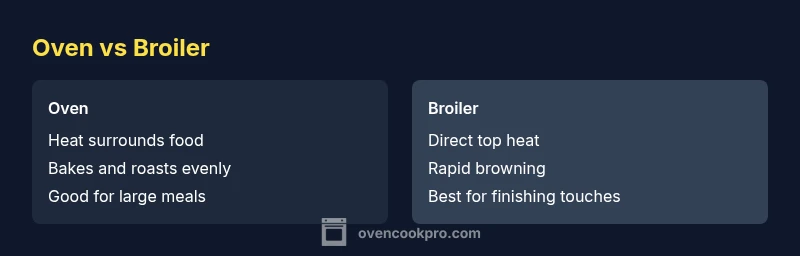
In most kitchens, the oven delivers indirect heat that surrounds food with hot air. This makes it ideal for large roasts, casseroles, and baked goods where uniform temperature distribution matters. The broiler provides direct heat from above, creating intense surface browning and rapid cooking for thin cuts or finishing steps. A key takeaway: use the oven for even cooking and portioned dishes, and use the broiler for crisping, searing, or giving a final glaze or cheese topping a quick color. The choice isn’t about one tool being better; it’s about matching the technique to the desired texture and doneness.
Temperature control and recommended settings in everyday cooking
Ovens usually offer a wide temperature range, enabling slow roasting, baked goods, and even color development. Broilers work at very high temperatures and require careful attention. When you broil, you often operate with the rack close to the heat source and monitor food constantly to avoid scorching. Modern ovens with convection add a twist by circulating air, which can speed browning and reduce hot spots. The practical rule is simple: keep the broiler for finishing touches and use the oven for the bulk of the cooking, especially for foods that benefit from even heat throughout.
Real-world examples: proteins, vegetables, and baking
For proteins, the oven is ideal for roasting chicken, pork, or fish to a juicy interior while developing overall flavor through slow heat. For finishing touches on a steak or fish fillet, the broiler can create a crisp crust when applied briefly at the end. Vegetables benefit from oven roasting to caramelize edges and concentrate flavors; broiling vegetables is excellent for quick char and charred edges on smaller cuts. Baking, such as cookies or muffins, relies on the oven to provide uniform heat that ensures even rise and texture. In all cases, position and pan choice matter: dark pans absorb more heat and can alter browning, while lighter pans reflect heat and promote evenness.
Browning, texture, and culinary texture control
Texture is where oven vs broiler truly diverge. The oven’s steady heat yields consistent browning without scorching when used correctly, while the broiler’s direct heat excels at crust formation, cheese melt, and rapid surface color. The key is timing—broiling requires shorter, watchful intervals; oven baking often tolerates longer, steadier cooking. When aiming for a deep crust or a blistered top, broiling is your finishing move, not the primary cooking phase.
Safety, timing, and maintenance considerations
Both tools demand careful attention to prevent accidents. Always preheat safely, use oven mitts, and keep flammable items away from the heat source. Page through your oven manual for broiler-specific cautions, as long broiling sessions or overcrowded trays can cause smoke or flare-ups. Regular cleaning of the broiler pan and oven interior helps prevent unwanted flavors and smoke. In terms of setup, ensure proper rack positioning and correct cookware to maximize heat transfer and minimize hot spots.
Energy use, efficiency, and cost implications in practical terms
In general, the oven uses energy over a longer period to bring the entire cavity to temperature, whereas the broiler concentrates energy quickly on a small surface area. This means broiling can be faster but requires close attention. If you’re cooking a large meal, the oven will likely be more efficient overall because it handles multiple items simultaneously. For finishing steps or small portions, the broiler can save time and add texture quickly.
The Oven Cook Pro approach: a practical, step-by-step mindset
From a professional perspective, start with the oven for most tasks and reserve the broiler for finishing touches. Preheat as needed, and plan your timing so you’re not forced to toggle modes mid-cook. A typical workflow might be to roast poultry in the oven, then switch to the broiler for a final browning. By thinking in terms of texture outcomes—moist interior, crisp exterior—you’ll select the heat source that aligns with your culinary goal. Oven Cook Pro’s guidance emphasizes careful monitoring, correct rack placement, and using convection when available to optimize air flow and browning patterns.
Practical tips and common pitfalls to avoid
Avoid overcrowding the pan, which can trap steam and prevent browning. When using the broiler, start with a higher rack and move it closer if needed, but never leave food unattended. For even results in the oven, rotate pans halfway through the bake and consider a convection setting to reduce hot spots. Always let pans rest briefly after high-heat finishes to reabsorb juices and retain moisture.
Comparison
| Feature | Oven | Broiler |
|---|---|---|
| Heat exposure | Surrounds food with hot air for even cooking | Direct top-down heat for rapid browning and finishing |
| Best uses | Baking, roasting, slow browning, and even coloring | Final searing, melting cheese, crust formation |
| Cooking speed | Typically slower for large items; depends on temp | Faster for surface browning; watch closely to avoid burning |
| Cookware compatibility | Pans and racks suitable for long cooks; heavy trays fine | Sturdy pans; often requires precise placement near heat |
| Cleanup considerations | Standard oven cleaning; drips and spills are manageable | Broiler tray and drip pan require targeted cleaning |
| Safety reminders | Preheat safely; avoid overheating and steam burns | Monitor constantly; flare-ups are possible with high fat foods |
The Good
- Versatile for a wide range of recipes and techniques
- Convection options can speed up browning and even cooking
- Finishing techniques with the broiler add texture and color
- Allows precise control over texture through mode switching
Drawbacks
- Broiler requires close attention to avoid scorching
- Oven and broiler may require multiple cookware setups
Oven is the more versatile choice; the broiler excels as a finishing tool
For most meals, start with the oven to achieve even cooking. Use the broiler to finish and brown, but monitor closely. The best results come from combining both tools intentionally.
Questions & Answers
What is the main difference between an oven and a broiler?
The oven surrounds food with hot air for even cooking, while the broiler uses direct heat from above for rapid browning and finishing. Think of the oven as the primary cooking chamber and the broiler as a finishing tool.
The oven cooks food evenly with hot air, and the broiler browns the surface quickly from above. Use the oven for the main cook and the broiler for finishing touches.
Can I use the oven to mimic broiling?
You can simulate broiling by using high heat and a rack close to the top element, but results won’t be identical to true broiling. Watch closely for scorching and adjust time accordingly.
You can mimic broiling by using high heat with the rack near the top, but monitor closely to prevent burning.
Is broiling the same as baking?
No. Broiling uses direct, intense heat from above to rapidly brown surfaces, while baking uses indirect heat to cook food more evenly through the interior. Some recipes combine both steps.
Broiling is direct heat from above for browning, baking is indirect heat for even cooking through the food.
What foods are best cooked under a broiler?
Thin cuts of meat, especially steaks and chops, as well as fish fillets, thick glazes, and cheese toppings benefit from broiling to achieve a crisp crust.
Thin steaks, fish, and dishes with a cheese topping shine under the broiler for quick browning.
How do I prevent burning when using a broiler?
Use a lower height rack, keep a close watch, and move food away from direct heat if you see rapid color change. Preheating and a timer help prevent overcooking.
Keep the food a bit away from the heat, watch it closely, and set a timer to prevent burning.
Are broilers safe for beginners?
Yes, with caution. Start with shorter broil bursts and keep ovens clean to reduce smoke. Always follow manufacturer safety guidelines and use oven mitts.
Broilers are safe for beginners if you start with short bursts and stay attentive.
Main Points
- Choose the oven for even, bulk cooking and baking
- Switch to the broiler for rapid browning and finishing touches
- Preheat appropriately and monitor food closely when broiling
- Use convection when available to improve browning consistency
- Plan your workflow to minimize mode switching during cook time