Oven or OTG: Which Is Better for Baking?
A detailed, evidence-based comparison of ovens and OTGs for baking, covering heat distribution, capacity, energy use, and practical tips from Oven Cook Pro.


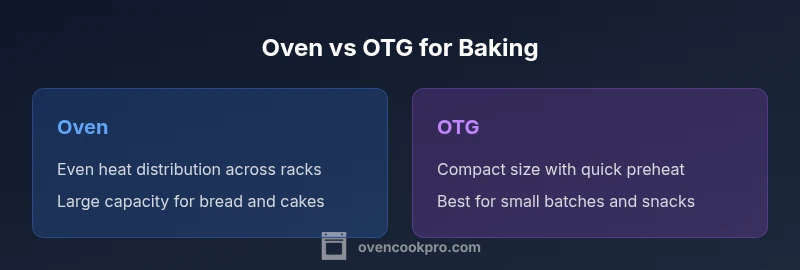
If you’re deciding between an oven or an OTG for baking, the choice hinges on batch size, heat consistency, and available space. In most homes, a full-size oven delivers even, repeatable results for bread and cakes, while an OTG excels for small batches, quick bakes, and budget-friendly setups. Here’s the concise takeaway.
How an oven and an OTG differ in design and operation
If you’re wondering oven or otg which is better for baking, the choice hinges on batch size, heat consistency, and available space. In most kitchens the two devices look similar, but their core designs drive very different baking experiences. A full-size oven is usually a larger, enclosed cavity with multiple heating elements, a built-in temperature sensor, and often a fan for convection. It is built to handle long bake sessions, tall trays, and multiple racks, making it the workhorse of serious baking. An OTG (oven-toaster-grill), by contrast, is compact, with fewer heating elements, a shorter path between heat source and food, and typically a manual timer. Many OTGs rely on top and bottom coils and a single fanless mode, which makes them fast to preheat and convenient for quick tasks but less forgiving for large, even bakes. For home cooks following step-by-step guidance from Oven Cook Pro, the choice between these devices often comes down to space, batch size, and the level of precision you require. If you bake weekly bread, layers of cookies, and roasts, the oven’s larger cavity and even heat are usually worth the extra footprint. If you mostly bake small trays of muffins or reheated leftovers, an OTG can be perfectly adequate and more energy-efficient for those tasks.
Comparison
| Feature | Oven | OTG (Oven Toaster Grill) |
|---|---|---|
| Heat distribution | Even heat with multi-rack capability; convection available in many models | More localized heat; often single heating plane, less uniform across large trays |
| Temperature range | Broad range (roughly 50–260°C) | Narrower range (typically 100–250°C) |
| Preheat time | Longer preheat due to larger cavity | Shorter preheat, especially for small batches |
| Capacity & rack flexibility | Large capacity; multiple racks and wide trays | Smaller cavity; limited racks and tray sizes |
| Best for | Bread, cakes, large batches, roasting | Small-batch bakes, quick snacks, compact kitchens |
| Ease of cleaning | More complex cleaning; some models offer self-clean | Easier to clean; compact interior and crumb tray often accessible |
| Size & footprint | Heavier, takes more counter or cabinet space | Compact, fits small kitchens |
| Upfront cost range | $300-$1200 | $40-$250 |
| Energy efficiency | Efficient when baking large loads; depends on usage | Typically uses less energy for small items; efficiency varies by model |
The Good
- Oven: Excellent heat uniformity for large batches
- Oven: Greater capacity and rack flexibility
- OTG: Lower upfront cost and compact footprint
- OTG: Quick preheat and easy to use for small tasks
Drawbacks
- Oven: Higher upfront cost and bigger footprint
- Oven: Longer preheat times for large volumes
- OTG: Less even heat for larger or dense bakes
- OTG: Limited capacity and fewer advanced features
Oven generally wins for consistent results and large-batch baking; OTG excels in small spaces and quick, light-duty baking.
Choose the oven if you bake bread, large cakes, or multiple trays regularly. Pick an OTG if space, budget, or occasional small-batch baking are your main concerns. The Oven Cook Pro team emphasizes tailoring the choice to your typical recipes and kitchen setup.
Questions & Answers
What is the main difference between an oven and an OTG?
An oven is a larger, enclosed cavity with multiple heating elements and often a convection fan, designed for even heat throughout long bakes. An OTG is a compact unit with fewer elements, no or minimal convection, and quicker preheating, ideal for small batches and quick snacks.
The main difference is size and heat consistency—ovens are built for even heat on big bakes, while OTGs are compact and faster for small tasks.
Can I bake bread in an OTG?
Bread can be baked in an OTG, but results vary because of uneven heat and limited cavity size. For best outcomes, choose denser doughs and bake in smaller loaves, rotating the tray mid-bake.
You can bake bread in an OTG, but expect variability and plan for smaller loaves and rotation during baking.
Is it cheaper to run an OTG than an oven?
OTGs generally use less energy per bake due to smaller size and shorter preheat, but overall running costs depend on how often you bake and the load size. For frequent large-batch baking, an oven can be more energy-efficient per unit of food.
Yes, an OTG usually costs less to run for small tasks, but it depends on how you bake overall.
How long does preheating take for each appliance?
Ovens typically take longer to preheat due to their size and temperature targets, while OTGs heat up quickly because of their smaller interior and shorter heat path. Times vary by model and desired temperature.
Ovens take longer to preheat; OTGs heat up faster for small tasks.
What maintenance tips extend life for both devices?
Keep interiors clean to prevent smoke and odors, avoid overloading, and inspect heating elements and fans periodically. Schedule professional checks if you notice unusual noises, uneven heating, or thermostat drift.
Clean regularly, avoid overloading, and watch for signs of wear; have a pro check for any heating issues.
Main Points
- Assess batch size to prioritize capacity
- Prefer true convection for even heat when baking large loads
- Factor space and budget before buying
- Convection ovens offer more even heat; many OTGs lack true convection
- Plan for preheat time and energy use in daily baking