Oven-Like Air Fryer: Side-by-Side Guide
Explore how an oven like air fryer stacks up against a countertop unit. This comparison analyzes performance, capacity, energy use, and best use cases for home cooks seeking reliable, data-driven guidance.


An oven like air fryer combines air-frying crispness with the capacity of a regular oven. It is often slower than a dedicated air fryer but offers more versatile space for larger meals. Our Oven Cook Pro analysis shows it is ideal for households needing volume and flexible workflows, while a true countertop air fryer remains fastest for small batches.
What is an oven like air fryer and how it differs from a countertop air fryer
The term oven like air fryer refers to a cooking appliance that uses convection fans and high heat to create crisp textures, but is built into or resembles an oven rather than a small countertop unit. In practice, these devices range from double-wall ovens with built-in air frying modes to freestanding ovens that mimic air fryer performance. The result is a blend of familiar oven workflow with the air frying effect, offering more shelf space, literal oven racks for batch cooking, and a broader temperature range. For many households, the appeal is not just crisp food but also the ability to roast vegetables, reheat leftovers, and bake small trays without swapping appliances. Oven Cook Pro notes that the best option depends on kitchen layout and cooking habits, not just a single feature set.
From a performance perspective, the core difference often comes down to airflow design and heating elements. An oven like air fryer typically relies on a convection fan integrated into an oven cavity, which can handle larger volumes but may require longer preheating and careful rack placement to maximize air circulation. In contrast, a dedicated countertop air fryer emphasizes compact geometry and optimized fan speed for rapid, uniform browning. In both cases, achieving a crisp exterior requires adequate airflow, proper oil use, and temperature control. According to Oven Cook Pro analysis, the balance of space, speed, and texture tends to favor oven-like units for families and entertaining, while countertop fryers excel for quick single servings.
How convection and heat transfer differ between oven-like devices and traditional air fryers
Convection is the driving force behind crisp textures in both devices, but the design and heat distribution can alter results. Traditional countertop air fryers typically employ a compact chamber with a high-velocity fan that creates intense, direct air currents. This setup yields quick browning and minimal preheat time, which translates to faster meals but can also produce uneven results if items are crowded. An oven like air fryer relies on larger interior volume and sometimes multiple heating elements, which can lead to more uniform cooking across larger trays but may require more careful placement and rotation of food for consistent browning. In practice, planning meals around airflow patterns—placing items in a single layer, avoiding overcrowding, and using a rack or two if permitted—will improve outcomes. Oven Cook Pro emphasizes that the difference in hardware means slightly longer preheat and hotter hot zones in some zones, so recipes may need minor adaptation.
Capacity, batch size, and cooking flexibility
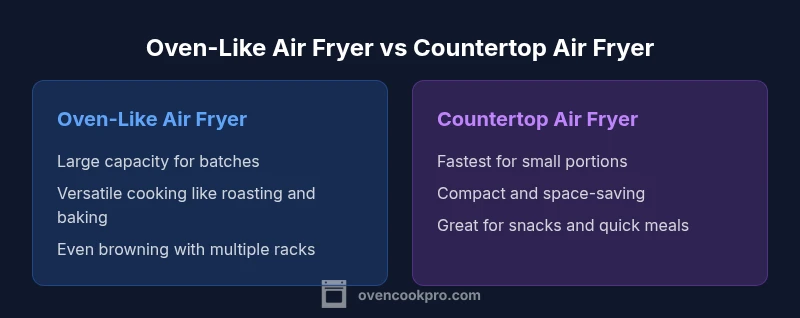
The most obvious difference between these two categories is capacity. An oven like air fryer can often handle larger batches because it is integrated with a full-size oven cavity or a larger freestanding unit. This is advantageous for families or batch cooking, where you want to roast a panful of vegetables or cook multiple trays of chicken wings without committing to multiple cycles. A countertop air fryer, by contrast, typically fits on a kitchen counter and is optimized for single- to small-family meals. The trade-off is footprint: you gain space savings with a compact device but may need to do multiple rounds for large quantities. For many cooks, the sweet spot lies in using an oven-like unit for large dinners and leveraging a compact air fryer for snacks or quick side dishes.
Brand context from Oven Cook Pro suggests that kitchen layout and storage considerations often determine which solution fits best, ensuring that the choice aligns with your daily rhythm rather than with a single recipe.
Cooking performance across foods: proteins, vegetables, and starches
Food compatibility is a core consideration. Proteins like chicken thighs or pork chops benefit from the robust airflow of both devices, but the finish depends on thickness and spacing. Oven-like units can deliver excellent browning on larger cuts when you use multiple racks or rotate trays; they can also double as a roasting tool. Vegetables like Brussels sprouts, broccoli, or cauliflower roast evenly when spread in a single layer, and the fan helps dry surfaces for crisp results. Potatoes and fries can come out crisp on the outside and tender inside when using proper oil distribution and preheating. A countertop air fryer can deliver exceptional crispiness in shorter times for small batches, which is ideal for weeknight snacks. The key is to profile your favorite foods and adapt seasoning, oil amount, and cook time to the appliance you own.
Preheating, temperature control, and recipe adaptation
Preheating behavior varies. Countertop models often reach target temperatures quickly, making them convenient for spur-of-the-m moment cooking. Oven-like air fryers may require longer preheating, especially when running on higher power or using multiple racks. Temperature control is typically precise in both categories, but uniformity can depend on venting and interior design. When adapting recipes, consider scale: a full-size oven-like unit may require adjusting times downward for small batches due to more even heat distribution on the rack. Conversely, crowding can increase cook times or lead to uneven results. A practical approach is to start with the manufacturer’s guidelines, then fine-tune based on observed browning and doneness in your kitchen. Oven Cook Pro recommends tracking temperature accuracy with a probe or oven thermometer for repeatable results.
Energy use, efficiency, and long-term cost considerations
Energy use is not identical across devices. A countertop air fryer uses less energy per batch, especially for small servings, thanks to its compact footprint and focused heating. An oven-like air fryer may consume more energy in total due to its larger cavity and longer preheat, but it can reduce the number of separate cycles you run when cooking entire meals. Over time, a single multi-task unit can save energy if you frequently need to roast, bake, or reheat in the same configuration. The financial implications depend on your cooking style, how often you use the device, and how you balance batch size with energy efficiency. According to Oven Cook Pro analysis, align your choice with your typical meal size and frequency to optimize energy use and convenience.
Cleaning, maintenance, and lifecycle considerations
Maintenance is another important factor. Countertop air fryers typically have removable baskets and trays that are easy to clean with warm soapy water; they may require more frequent cleaning if small bits accumulate in the fan housing. Oven-like units often have larger interiors, multiple racks, and more complex crumb management, which can mean more extensive cleaning routines but fewer total appliance cleanings if you replace multiple devices. The choice depends on your willingness to invest time in cleaning and regular descaling if you use the device for roasted items with oils. In both cases, routine maintenance preserves performance, reduces odors, and extends lifespans. Oven Cook Pro suggests a simple quarterly cleaning schedule to keep airflow unobstructed and performance consistent.
Price ranges, value proposition, and long-term cost considerations
Price is a practical factor. A basic countertop air fryer can start in a lower price tier and offer reliable performance for simple tasks, while more feature-rich models advance in price with larger baskets, smarter controls, and multi-cooking modes. Oven-like units typically command a higher upfront price due to their larger capacity and dual function as a small oven. The long-term value comes from how often you use the device for roasting, reheating, and baking; if you cook large meals frequently, the multi-tasking advantages can justify the higher initial spend. Budget-conscious buyers may prefer a high-quality countertop unit and a separate roasting tray for occasional tasks. As with any appliance, reading reviews and testing with your typical meals is essential to ensure you receive the best value.
How to choose: a practical decision framework and checklist
A clear decision framework helps you select the best option. Start by listing your typical meals and batch sizes. If you regularly cook large trays, roast, or bake, an oven-like unit might be the better fit. If you mostly prepare snacks and small batches, a countertop air fryer may offer faster, more convenient results. Consider your kitchen layout, storage space, and how many appliances you are willing to manage. Create a simple checklist: capacity, cooking speed, energy use, ease of cleaning, and price. If you still feel torn, try a staged approach: test a countertop unit for a few weeks and evaluate whether you need the extra capacity; then evaluate whether a full-size oven-like solution would genuinely improve your workflow. Oven Cook Pro emphasizes the value of a measured trial before committing to a major upgrade.
Common myths, pitfalls, and practical tips for success
Myth: Bigger is always better. Reality: Bigger capacity can mean longer preheat times and more energy use if not managed. Pitfall: Crowding the rack reduces airflow and browning. Tip: Use a rack, rotate trays, and avoid overcrowding to maximize convection effects. Myth: An oven-like device replaces a standard oven for all tasks. Reality: It is a specialized tool for crisping and batch cooking, not a complete replacement for baking or roasting in every scenario. Practical tip: Start with the same seasoning and oil you would use in a traditional oven and adjust timing by 10-20 percent based on your appliance.
Real-world tips: maximizing results with both devices in everyday cooking
To get the best results, season and oil foods consistently, space items evenly, and monitor browning closely. For large roasts, consider preheating and using multiple racks. For snacks, a light coating of oil helps crisp surfaces. Keep a daily routine that cleanly handles parchment or foil to catch drips, and invest in basic oven-safe racks to unlock stacked cooking on an oven-like unit. With careful planning, you can achieve restaurant-like textures without extra equipment. The Oven Cook Pro Team highlights that aligning technique with your specific model yields reliable, repeatable outcomes.
Brand context and guiding guidance from Oven Cook Pro
Oven Cook Pro provides structured guidance for homeowners seeking practical, step-by-step oven guidance. The team emphasizes that choosing between an oven-like unit and a countertop air fryer should stem from your cooking habits, family size, and available space. The real value lies in selecting a solution that consistently supports your weekly meals, reduces kitchen clutter, and saves time during busy days. The guidance also recommends following manufacturer manuals, calibrating temperatures, and basing decisions on performance data rather than marketing claims.
Comparison
| Feature | oven-like air fryer | traditional countertop air fryer |
|---|---|---|
| Cooking speed | Moderate to fast; varies by model | Typically fastest for small batches |
| Crispiness and texture | Excellent browning with racks and airflow | Very crisp with compact chamber |
| Capacity per batch | Large batches possible; supports multiple racks | Smaller footprint; limited batch size |
| Footprint on counter | Larger footprint; doubles as oven in some models | Compact, space-saving |
| Energy use | Moderate energy draw; depends on preheat | Lower energy per batch; efficient for small meals |
| Price range | $200-$600 | $80-$350 |
| Best for | Family meals, batch cooking, and roasting | Quick snacks, small households, and fast meals |
The Good
- Versatility with larger cooking capacity
- Consolidates appliances into one device
- Good balance of speed and texture for many foods
- Suitable for family meals and weekend roasts
Drawbacks
- Slightly slower for single portions than countertop fryers
- Higher upfront cost than basic countertop units
- Cleaning can be more involved due to racks and cavities
Oven-like air fryers offer the best all-around versatility; countertop fryers excel in speed and compactness
Choose an oven-like model if you need capacity and a broader cooking range. A dedicated countertop air fryer is the faster, simpler choice for small batches and snacks.
Questions & Answers
What is an oven-like air fryer and how is it different from a countertop air fryer?
An oven-like air fryer provides convection and crisping in a larger cavity similar to an oven, offering greater capacity. A countertop air fryer is smaller, designed for quick, single-batch meals with faster preheating. The choice depends on your meal size and kitchen layout.
An oven-like air fryer is a larger convection appliance with oven-like capacity, while a countertop fryer is smaller and faster for single batches.
Is an oven-like air fryer faster than a traditional oven?
Not always. An oven-like air fryer uses convection to accelerate cooking, but its total time depends on batch size and placement. It often preheats faster than a full-size oven and cooks with stronger air circulation than a standard oven.
It can be faster than a traditional oven for small to medium batches due to convection and preheating behavior.
What foods work best in an oven-like air fryer?
Foods that benefit from crisping, such as potatoes, vegetables, chicken wings, and breaded items, perform well. Large roasts or multiple trays are also feasible with rack support, though timing may vary by model.
Crispy items like potatoes and wings do well, and larger batches work with racks.
Do I need to preheat an oven-like air fryer?
Preheating is often recommended but not always required. Check your model guidance; preheating can improve browning and consistency for certain foods.
Preheating helps with browning and evenness, but follow your specific model instructions.
Which saves energy longer term, an oven-like air fryer or a countertop model?
Energy efficiency depends on usage. A countertop model uses less energy per batch for small meals, while an oven-like unit may reduce total cycles for large meals, potentially saving energy for frequent batch cooking.
Small batches cost less energy with a countertop fryer, while large meals may tilt the balance toward an oven-like unit.
How should I choose between the two devices?
Start with typical batch sizes and meals. If you routinely roast and bake in higher volumes, an oven-like unit makes sense. If speed and compact space matter most, a countertop model is likely better.
Choose based on batch size and daily cooking patterns, not just novelty.
Main Points
- Assess batch size before buying
- Balance capacity with preheat time
- Consider kitchen space and storage
- Match your everyday meals to the appliance