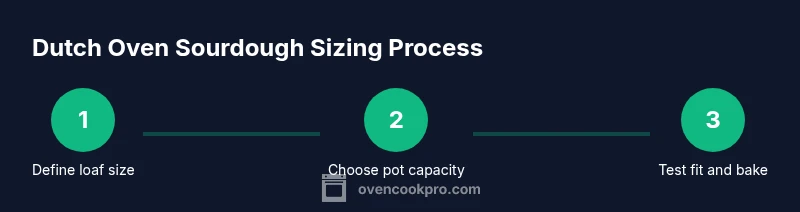
How Big of a Dutch Oven for Sourdough: A Size Guide
Discover the ideal Dutch oven size for sourdough, how loaf dimensions relate to pot capacity, and tips to choose 4–6 quart models for crusty, even loaves.


To bake sourdough reliably, choose a Dutch oven in the 4–6 quart range. A typical 8–10 inch boule fits comfortably in a 4–5 quart pot, while larger 6 quart models accommodate bigger loaves and batards. Match pot diameter to your loaf and ensure your oven has clearance for the lid and handles.
Understanding why size matters for sourdough
If you’re wondering how big of a dutch oven for sourdough, the answer starts with loaf size and bake goals. The size of your pot influences how much room the dough has to expand, how steam is trapped, and how heat is transferred to the crust. According to Oven Cook Pro, pot size not only shapes crust development but also affects crumb structure and oven spring. A too-small pot can pinch the loaf, yielding a denser crumb and restricted rise; a too-large vessel may hinder steam concentration and create a thinner crust. In practice, most home bakers aim for a pot that fits a loaf with some room to spare for steam to circulate. Remember, your oven’s interior clearance matters too—your pot needs to fit with space for the lid and handles without bumping into racks or walls. This is precisely why size choice matters before you even mix the dough. Oven Cook Pro analysis shows that starting with a sensible size is the fastest path to consistent results across bake day.
Key takeaway: the right Dutch oven size sets your loaf’s dimensions, steam retention, and crust quality from the first bake.
Typical Dutch oven sizes for sourdough
Most home bakers reach for one of three common capacities: 4-quart, 5-quart, or 6-quart. A 4-quart (about 3.8 L) pot is a popular compromise for smaller households and compact ovens, easily handling an 8–10 inch round loaf. A 5-quart option provides a touch more headroom—great for slightly larger boules or batards that measure around 9–11 inches in diameter. The 6-quart (roughly 5.7 L) model is the go-to choice when your goal is versatility: one pot that can handle larger loaves or two smaller loaves with adequate steam. When choosing, consider your typical loaf shape (boule vs. batard) and how much room you want for expansion during the final proof. In practice, many bakers find a 5-quart pot to be the sweet spot, balancing loaf size, steam concentration, and ease of use. For a larger family or specialty bread, a 6-quart pot becomes a valuable workhorse.
Practical note: expect an 8–10 inch diameter loaf in a 4–5 quart pot, and you’ll likely be comfortable with most common sourdough recipes. If your recipe yields taller domes, you may prefer the extra space of a 6-quart vessel to avoid crowding the dough.
How diameter and capacity translate to bake results
The internal diameter of your Dutch oven largely determines the maximum loaf width you can maintain without touching the sides. A snug fit helps create dramatic oven spring because steam is trapped around the dough’s surface, promoting a blistered, blistering crust. When the loaf is too large for the pot, it can push the dough against the lid, impeding expansion and flattening the top. Conversely, a very large pot can dilute steam around a smaller loaf, potentially delaying crust formation and leaving a pale surface. Capacity also affects heat distribution; larger pots retain heat longer, which can influence bake times and crust behavior. If you routinely bake tall, domed loaves, you’ll appreciate extra headroom in a 6-quart pot, where the loaf can rise without crowding. Remember to account for your oven’s preheat behavior as well—preheating a large Dutch oven ensures a strong initial crust.
Smart rule of thumb: match your loaf diameter to the pot’s inner diameter, leaving about 1 inch (2.5 cm) of breathing room around the dough for optimal steam and rise. This principle helps you achieve uniform crust color and a well-open crumb.
Practical sizing rules of thumb
Here are concrete guidelines to help you pick the right size without guessing:
- For most home bakers producing loaves around 0.9–1.1 kg (2–2.4 lb), a 4–5 quart Dutch oven is ideal. It accommodates an 8–10 inch round loaf with space for steam and expansion.
- If you frequently bake larger boules or batards, step up to a 6-quart pot. It provides extra breathing room for bigger diameters and taller domes, improving oven spring.
- If you bake for a small household and have a compact oven, a 4-quart model offers excellent results with better heat concentration and shorter preheat times.
- When in doubt, choose the middle ground: a 5-quart vessel often delivers the most versatility across multiple loaf shapes.
- Consider your lid design: a snug lid trap helps retain steam, but you’ll want if you occasionally bake without the lid for crust variation.
Tip: measure your preferred loaf’s expected diameter and compare it to the pot’s inner diameter to ensure comfortable fit. This helps prevent surprises on bake day.
Practical baking considerations when using different sizes
Size isn’t the only factor—baking technique matters too. A smaller pot concentrates heat more quickly on the crust and concentrates steam, which can yield a crisper crust if the dough is the right size. A larger pot provides extra room for the bread’s expansion but can require longer preheat and bake times to achieve the same crust color. Preheating is essential for all sizes; a preheated Dutch oven creates a burst of oven spring by delivering immediate heat and steam when the dough is placed inside. If you’re using a larger pot, you may need to extend bake time by a few minutes and monitor the crust color to avoid over-browning. Hydration and dough strength also interact with pot size: wetter dough tends to spread more, so a smaller pot with a tight fit can help maintain shape, while a larger pot may require careful scoring and shaping to prevent flattening. In all cases, a good bake starts with planning the right size, ensuring clearance for rack and lid, and preheating the vessel for consistent results.
Oven Cook Pro tip: always check your oven clearance before loading a hot Dutch oven. A crowded oven disrupts air flow and can hinder even cooking.
How to test and adjust if your loaf is too big or too small
Testing is how you refine your size choice over time. Start with a recipe that yields a loaf within the 8–10 inch range and observe how it fits in your chosen pot. If the loaf looks crowded or the lid sits tightly against the dough, it’s a sign you may need a larger capacity. Conversely, if the loaf has room to spread and the crust lacks oven spring, you might be using a pot that’s too large for the dough’s volume. Keep a log of loaf diameter, height, and crust color across different batches; this record helps you map which Dutch oven sizes align with your typical dough hydration and loaf shape. When in doubt, a test bake using a 5-quart pot with a standard hydration dough can establish a baseline. If you find you’re consistently reaching the edge of the pot, consider moving to a larger vessel or adjusting the dough shape to better suit your pan. Finally, always ensure your dough is properly proofed—overproofed dough can spill over a too-small pot regardless of size.
Field-tested note: Even distribution of steam depends on pot size, loaf diameter, and preheating quality. A well-chosen size removes one layer of guesswork from sourdough baking.
Tools & Materials
- Dutch oven (4–6 quart, cast iron with lid)(Prefer a smooth interior and a well-fitting lid. A lighter 4-quart model is easier to maneuver; a 6-quart model offers greater flexibility.)
- Oven mitts or heat-resistant gloves(Used for handling the hot Dutch oven safely during transfer and lid removal.)
- Digital kitchen scale or measuring cups(Helpful for standard dough hydration calculations and recipe scaling.)
- Parchment paper(Eases transferring dough into the hot pot if you’re unsure about handling wet dough.)
- Silicone spatula or dough scraper(Assists with shaping and transferring dough cleanly.)
Steps
Estimated time: 30-40 minutes
- 1
Define loaf size goal
Decide the typical loaf diameter you want to bake (for example, 8–10 inches). This sets the minimum pot interior you’ll need and guides your choice between 4–5 quart versus 6 quart. Consider family size and how many servings you want from each bake.
Tip: Write down your target loaf diameter for quick reference when shopping. - 2
Check oven clearance
Measure your oven’s interior height and the clearance around racks to ensure a chosen Dutch oven will fit with the lid on. If your stove or range limits height, a shorter handle or lighter pot may be necessary.
Tip: Always account for the lid height and any protruding handles before purchasing. - 3
Match diameter to pot interior
Compare the loaf diameter to the pot’s internal diameter, leaving about 1 inch of space for steam. A snug fit improves oven spring, while too-tight proximity can scuttle rising.
Tip: Aim for at least 1 inch clearance all around for best steam retention. - 4
Compare common capacities
If you bake a single loaf most days, a 4–5 quart pot is versatile. For multiple loaves or larger shapes, a 6-quart pot provides extra room without crowding.
Tip: A 5-quart pot often hits the sweet spot for many home bakers. - 5
Plan for steam and preheating
Preheat the empty Dutch oven with its lid on for 15–20 minutes before loading dough. This creates a steam-rich environment that supports a blistered crust and even bake.
Tip: Preheating is your friend: it jump-starts crust formation and evenness. - 6
Test bake and refine
Bake a standard loaf in your chosen size, compare the crust, crumb, and loaf height to your expectations. If results don’t align, adjust the size choice for future bakes and log the outcomes.
Tip: Keep a simple bake log to track which size works best for your dough and oven.
Questions & Answers
Do I need a cast iron Dutch oven to bake sourdough?
While cast iron is the traditional choice for its heat retention, you can also use enameled or ceramic vessels that are oven-safe and provide good steam. The key is a tight-fitting lid and even heat distribution to create a blistered crust.
Cast iron is ideal for sourdough, but enameled or other oven-safe options with a good lid can work well too. The main requirement is even heat and steam retention.
Is 4 quarts enough for a standard sourdough loaf?
For most standard-size loaves (around 8–10 inches in diameter), a 4-quart pot is sufficient. If you consistently bake larger loaves or use higher hydration dough, a 5–6 quart pot gives more headroom for expansion.
A 4-quart pot works for typical loaf sizes, but bigger loaves benefit from a 5 or 6-quart option.
Can I bake sourdough without a Dutch oven?
Yes, you can bake sourdough on a stone or sheet pan, but the Dutch oven method provides steam that helps with oven spring and crust. If you don’t have one, you can simulate steam with a hot pan in the oven or a splash of water in a tray.
You can bake without a Dutch oven, but it’s tougher to get a great crust without steam.
Should I preheat the Dutch oven with the dough inside?
No—preheat the pot empty, then carefully load the dough. Placing dough into a hot, empty pot helps preserve the dough’s shape and maximize the initial steam. If you need parchment, place the dough on parchment and slide it in.
Preheat the pot empty, then load the dough. This preserves shape and steam.
What sizes are most versatile for sourdough?
A 5-quart Dutch oven is widely regarded as versatile for various loaf shapes and hydration levels. A 4-quart is great for smaller households, while 6-quart handles larger loaves or multiple loaves.
Five quarts is a good all-around size for most bakers.
How do I clean a Dutch oven after sourdough?
Rinse with warm water, avoid using harsh cleaners, and dry thoroughly to prevent rust. For enameled interiors, use a non-abrasive sponge. If needed, a light coat of oil can help protect cast iron.
Rinse, dry well, and store dry; avoid harsh cleaners on cast iron.
Watch Video
Main Points
- Define loaf size before selecting pot.
- 4–6 quart pots cover most sourdough needs.
- Match loaf diameter to pot interior with 1 inch clearance.
- Preheat the pot for best crust and spring.
- Test-bake and log outcomes to refine future choices.