Is It Oven or Stove? A Practical, Clear Comparison
Navigate kitchen terminology with an analytical guide that clearly distinguishes ovens from stoves, explains how each heats, and offers practical buying and usage advice for home cooks.


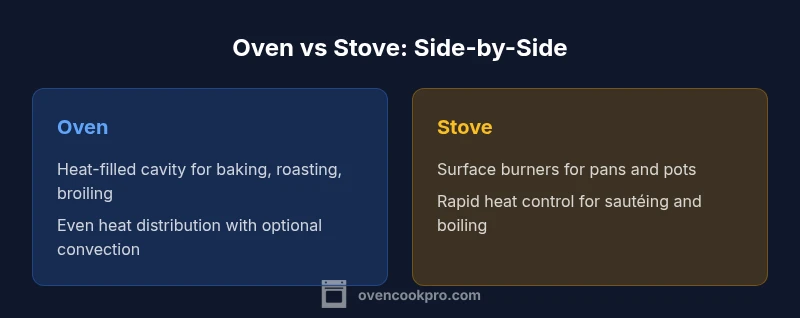
Is it oven or stove? The terms refer to different cooking appliances: ovens heat food inside a cabinet, while stoves (cooktops) provide surface burners for pots and pans. In most kitchens, the range combines both functions. For a quick, practical takeaway, use the oven for baking or roasting and the cooktop for stovetop tasks, simmering, and pan-based recipes. Understanding these roles helps avoid mistakes.
Understanding the terms: is it oven or stove?
In everyday kitchen talk, many homeowners struggle with the question is it oven or stove. The distinction matters for how you plan meals, purchase equipment, and estimate energy use. An oven is a closed chamber that uses radiant heat, convection, or a combination to cook food from the inside out. A stove (often called a cooktop) provides burners on the surface for pots and pans. In most modern kitchens, these functions are combined in a single range or allocated to separate wall units. By clarifying terms, you can align recipes, cookware, and maintenance tasks with the right appliance. According to Oven Cook Pro, defining these roles upfront reduces confusion during shopping and setup, and helps you optimize placement in a compact kitchen. Understanding the terminology becomes even more important when evaluating features like preheating, temperature accuracy, and energy efficiency. In this guide, we’ll compare functions, usage scenarios, and practical tips to help you decide what to install or keep in your kitchen.
Functional differences in practice
The oven is a closed cavity that heats food from all directions, often with convection fans for even air circulation. Temperature control is centralized, and you can bake cookies, roasts, casseroles, or even bread with consistent results. A stove, or cooktop, exposes pots directly to flames or coils on the surface, offering rapid heat up and precise control for sautéing, boiling, or searing. The key practical distinction is where the heat is applied and how it’s regulated. Modern ranges commonly combine both, but standalone choices still exist. For most homes, understanding these differences helps you optimize placement, cookware, and timing. When planning, consider how often you bake in large batches versus how frequently you sauté, because that's where the two technologies shine differently.
When to use an oven vs a stove
Ovens excel when you need uniform heat over time and the ability to cook multiple items without stirring. Think baking sheets, roasts, casseroles, and baked goods. Stoves excel for quick, high-heat tasks and tasks that require constant stirring or flipping, like sautéing vegetables, boiling pasta, or pan-searing meat. If your cooking habits involve both types of tasks, a range that combines oven and cooktop is often the most convenient, reducing the need to shuttle food between appliances. However, small kitchens or budget constraints may justify separate devices. In those cases, keep the oven for baking and roasting and reserve the stove for all surface-level cooking.
Common misconceptions and kitchen ergonomics
One common misconception is that a big oven automatically makes a kitchen more versatile. In reality, a compact wall oven paired with a capable range can offer better layout and flow. Another misconception is that electric ovens are always uniform; while modern ovens are consistent, older models may have hot spots that require rotation. Ergonomics matter: the height of a cooktop relative to the user’s stance, the location of racks, and the accessibility of the oven door all affect comfort and safety. Finally, many buyers assume that more knobs always mean better control; instead, look for accurate thermostats, reliable venting, and solid rack support.
Practical tips for choosing and using each appliance
When choosing, assess your cooking style first. If you bake often and value even heat, prioritize an oven with reliable convection options. If you cook on the surface frequently—stir-frying, boiling, sautéing—a strong cooktop is essential. If possible, select a model that offers energy-efficient modes, well-sealed doors, and a burner layout that suits your pots and pans. Use lidded vessels to conserve energy, preheat only as needed, and rotate foods to avoid uneven results. For maintenance, clean spills promptly, inspect seals, and schedule periodic calibration checks.
Maintenance, safety, and long-term planning
Maintenance becomes easier when you understand the separate responsibilities of each appliance. Clean the oven cavity periodically to prevent residue buildup that can affect heat distribution. For gas stoves, verify burner caps, check gas lines for leaks, and ensure proper ventilation to avoid carbon monoxide buildup. For electric stoves, keep drip pans clean to prevent smoke and grease fires. Long-term planning should consider energy efficiency, replacement cycles, and potential upgrades like a convection feature or a self-cleaning mode. With careful planning, you can optimize both cost and cooking quality across years of use.
Making the decision: a simple framework
To decide between upgrading an oven, a stove, or both, start by listing your most frequent cooking tasks, assess your kitchen layout, and estimate upfront costs versus long-term benefits. If most evenings involve baking or roasting, lean toward a capable oven or a range with a robust oven. If you rely heavily on quick surface cooking, prioritize a stall with a high-BTU cooktop or a gas range that provides precise flame control. For households that do both reliably, a combined range often offers the best balance of space, cost, and flexibility. The final choice should align with your cooking habits, space, and budget.
Comparison
| Feature | Oven | Stove (Cooktop) |
|---|---|---|
| Primary function | Cooks food inside a cavity via radiant/convection heat | Provides surface burners for pots and pans on the countertop |
| Heat source | Electric coils/elements or gas convection inside a chamber | Gas burners or electric coils on the surface |
| Temperature control | Thermostat-based control with precise temp settings | Manual/knob-based control offering immediate heat changes |
| Typical use cases | Baking, roasting, broiling, and some slow-cooking | Sautéing, boiling, simmering, and pan-frying |
| Maintenance considerations | Door seals, racks, broiler elements, and insulation require periodic cleaning | Burners, drip pans, and gas lines may need regular checks |
| Energy considerations | Can achieve even heat distribution; energy use depends on model and usage | Heat is localized to pan contact; energy use varies by burner size and duty cycle |
| Ergonomics and layout | Requires space for an oven cavity and appropriate clearance | Integrated into range or separate cooktop; accessibility depends on height and design |
The Good
- Clear separation of tasks minimizes cross-heating risks
- Even, controlled baking in oven improves results
- Instant heat control on stove supports quick adjustments
- Range configurations save space and streamline workflows
- Flexibility to upgrade one component at a time
Drawbacks
- Owning both increases upfront cost and footprint
- Maintenance spans multiple components and can be complex
- Underutilized features may waste energy and budget
A flexible range is best for most kitchens, balancing oven and cooktop needs
Choose a combined range if you value versatility and space efficiency. If you mostly bake or primarily cook on the surface, tailor your choice to that dominant task and consider separate units only if layout demands it.
Questions & Answers
What is the practical difference between an oven and a stove in a typical kitchen?
An oven is a closed chamber used for baking, roasting, and broiling. A stove (cooktop) provides surface burners for pots and pans. In many kitchens, a range combines both functions, offering versatility in a single footprint.
An oven cooks inside a box; a stove cooks on the surface using burners. Many ranges combine both functions for convenience.
Can a stove have an integrated oven?
Yes, many ranges include an integrated oven below the cooktop. If you want flexibility, consider a separate wall oven paired with a dedicated cooktop.
Yes. Many ranges have an oven built in, but you can also pair a separate wall oven with a cooktop for more customization.
Is it more energy-efficient to bake in the oven or on the stove?
Efficiency depends on usage and model. Ovens are efficient for bulk cooking and even heat, while stove top work is efficient for short, high-heat tasks when you use appropriate burners and lids.
Efficiency depends on what you cook. Ovens are great for even, long cooking; stovetops excel at quick, high-heat tasks.
What should I consider when buying a range vs separate appliances?
Consider space, budget, cooking style, and installation. A single range saves space and simplifies maintenance, while separate units offer upgrade flexibility and potentially better performance in each function.
Think about space and budget first. A range is simpler; separate units offer customization.
Are gas ovens different from electric ovens?
Gas ovens heat with gas flames and often preheat quickly; electric ovens rely on electric coils or convection for even heat. Both can be reliable with proper maintenance.
Gas ovens heat faster; electric ovens usually heat more evenly. Maintenance is key for both.
Main Points
- Define your top cooking tasks before choosing
- Consider space and installation feasibility
- Prioritize reliable heat control and maintenance access
- Balance upfront cost with long-term use
- Plan for safety and energy efficiency