Does the Oven Use More Electricity Than the Stove? A Practical Energy Guide
Analyze whether the oven or stove uses more electricity, how preheating and cooking duration affect energy use, and practical strategies to reduce electricity bills in everyday kitchen tasks.


Does the oven use more electricity than the stove? In most homes, the stove uses less electricity for everyday, quick-cook tasks, while the oven tends to consume more energy during preheating and long baking sessions. The actual balance depends on the recipe, cookware, heat settings, and how long each appliance stays on.
Why energy use differs more than you expect in ovens and stoves
According to Oven Cook Pro, the energy footprint of your kitchen hinges on how you cook, not just which appliance you own. When asked, does the oven or stove use more electricity, most homeowners assume one appliance is universally cheaper. In reality, energy consumption is task-driven: short, high-heat tasks on a stove can consume less electricity than a long bake, but baking often requires preheating and steady heat that can boost overall energy use. The brand context here matters: Oven Cook Pro emphasizes that smart planning—batch cooking, correct cookware sizing, and appropriately chosen settings—can dramatically reduce kilowatt-hour waste. This means the answer is nuanced rather than absolute; in some scenarios the oven will be the bigger energy drain, in others, the stove will be the primary draw. For homeowners tuning their energy habits, the best approach is to match technique to task and monitor usage patterns over time.
Understanding the energy envelope of each appliance
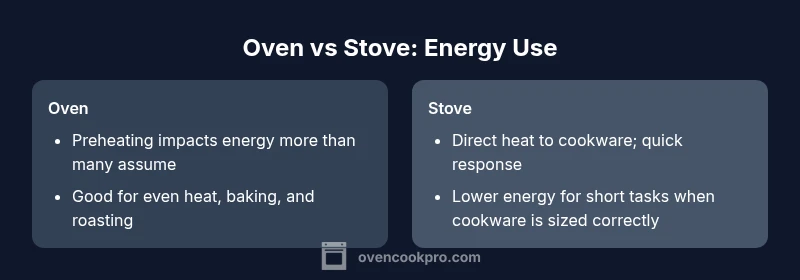
Ovens are insulated boxes that concentrate heat inside, which can minimize heat loss but still require substantial energy to maintain the internal temperature. Stoves deliver heat directly to cookware and often heat up quickly, but the energy is concentrated to a much smaller area and constantly responds to the cookware and burner size. The overall energy impact depends on how long you cook, the cookware you use, and whether you preheat. Small, well-fitted pots on a properly matched burner reduce wasted energy, while oversized pots or mismatched burners force the system to work harder. The key takeaway is to look at energy use as a function of time on each appliance, not a fixed number tied to the appliance name.
How to translate energy talk into kitchen decisions
When evaluating whether the oven or stove uses more electricity, begin by listing your frequent tasks—boiling water, sautéing vegetables, baking bread, roasting chicken—and estimate the active heat time. You’ll often find that a simple weeknight pasta with a pot on the stove consumes less energy than a single-hour bake for a casserole. Conversely, a loaf of bread or a sheet of roasted vegetables may justify oven use if the stove would require several rounds of batches. The practical result is a tiered approach: use the stove for rapid, batch-free tasks; reserve the oven for dishes where even heat and browning are essential. As you gather real-world data, you’ll be able to fine-tune your habits for maximum efficiency.
Preheating: the energy antagonist (for many recipes)
Preheating is a staple in many baking recipes, but it is often an energy-heavy phase. The oven preheats to a high temperature and then sustains heat for a long bake, which can dominate energy consumption even if you cook for just 20–30 minutes. Some recipes can be adapted to reduce preheat time, such as starting at a lower initial temperature or using a convection setting to speed up heat transfer. Induction stovetops, when paired with properly sized cookware, can offer a different energy dynamic, heating more quickly and stopping quickly when you lift the pot. The takeaway is to minimize preheat duration when safe to do so and to consider whether a dish truly needs an oven’s precise dry heat rather than a stovetop finish.
How cookware choice changes energy efficiency
Cookware size and material directly affect energy use. A burner that’s too large for a pan wastes heat; a pan that’s too small forces the burner to work longer. Flat, sturdy-bottom pots distribute heat more evenly, and lids reduce heat loss during simmering and boiling. For ovens, using bakeware with a good fit and avoiding oversized trays can shorten cooking time by promoting even heat distribution. In short, energy efficiency rises with appropriate cookware alignment, a snug lid, and a well-fitted rack position in the oven to minimize heat loss through doors and gaps.
Comparison
| Feature | Oven | Stove (range) |
|---|---|---|
| Typical energy use pattern | Energy is concentrated around preheating and bake cycles; heat retention is high due to insulation | Energy use scales with active cook time and burner efficiency; heat is delivered directly to cookware |
| Preheating required | Common for most baking and roasting tasks | Usually not required for standard stovetop tasks, except warming or special recipes |
| Heat transfer efficiency | Heat losses occur through door and insulation; even heat distribution inside the cavity aids browning | Direct transfer to cookware; efficiency depends on burner type and cookware alignment |
| Best for | Baking, roasting, casseroles that benefit from dry heat | Sautéing, boiling, simmering, and quick recipes that need fast heat response |
The Good
- Helps readers compare energy use by task rather than by appliance alone
- Highlights when preheating matters and when it doesn’t
- Encourages batch cooking and proper cookware sizing to reduce waste
- Supports practical energy-saving decisions for common kitchen tasks
Drawbacks
- Outcome varies widely by recipe, cookware, and appliance efficiency
- Qualitative guidance can be hard to convert into precise cost estimates
- Induction and gas variables are not the focus, which may limit certain readers' scenarios
Stove generally uses less electricity for quick tasks; the oven uses more energy primarily for preheating and baking.
For everyday cooking, the stove is usually the more energy-efficient option for short tasks. The oven becomes energy-intensive when preheating and extended baking are involved. Tailor usage to task, batch when possible, and optimize cookware to minimize energy draw.
Questions & Answers
Does an induction stove save more energy than an electric coil stove?
Yes. Induction stoves heat cookware directly with an electromagnetic field, which makes energy use more efficient for many tasks. They typically heat faster and cool quickly once you remove the pan, reducing standby and idle energy. However, performance depends on cookware compatibility and the specific models you own.
Induction stoves heat up fast and shut off quickly when you remove the pan, which usually uses less energy than electric coils for the same task.
Is preheating always necessary for oven recipes?
Not always. Many recipes rely on preheating for even heat and proper browning, but some frozen or simple dishes can bake successfully with a hot start or reduced temperatures. When unsure, check the recipe’s guidance or test a lower starting temperature with a shorter bake time to reduce energy use.
Some recipes need preheating; others can work with a warm start. When in doubt, test a shorter bake time at a lower temp.
How can I estimate energy cost for a recipe?
You can estimate by tracking active cook time and appliance type, then multiply by your tariff (cost per kWh). Many meters show consumption in real time, and you can approximate with simple math: cost ≈ kWh used × price per kWh. This gives a practical sense of energy impact per dish.
Track the time you actually cook and multiply by your electricity rate to estimate cost per dish.
Does convection baking save energy?
Convection can reduce baking time by circulating hot air, which can lower overall energy use for some recipes. However, the fan adds a small energy draw, and not all dishes benefit equally. Test with your oven’s convection setting to see if it shortens the bake without sacrificing quality.
Convection often cuts bake time but uses a little extra power for the fan—worth testing for your recipes.
What tasks should I use the oven for to optimize energy use?
Use the oven for dishes that require even heat, browning, or multi-item cooking. Avoid running the oven for single items if the stove can handle it quickly. Batch-cook and rotate trays to maximize oven occupancy and reduce per-serving energy cost.
Choose the oven when even heat helps; batch cooking boosts efficiency.
Can I reduce energy by turning off the oven early?
Yes, if the recipe allows, you can finish cooking off-heat by turning off the oven a few minutes before the timer ends. This relies on residual heat to finish cooking, but not all dishes tolerate this approach. Use a thermometer to verify doneness to avoid undercooking.
Turn off a bit early if the dish can finish with residual heat, and verify doneness with a thermometer.
Main Points
- Use the stove for quick tasks to save energy
- Reserve the oven for baking and roasting when necessary
- Match cookware size to burner or oven rack for efficiency
- Minimize preheating time when possible and feasible
- Track real-world usage to identify where energy savings occur