What stove number is medium heat: A practical guide
Learn which stove number corresponds to medium heat, how to test heat levels, and practical dialing tips for gas and electric ranges. Expert guidance from Oven Cook Pro helps home cooks achieve consistent mid-range results.


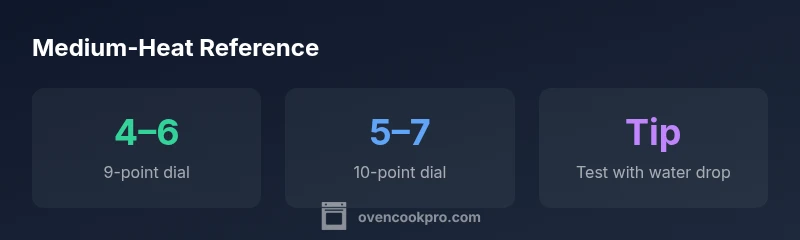
Medium heat on a typical residential stove sits in the middle of the dial, commonly around 4–6 on a 9-point scale or 5–7 on a 10-point scale. This mid-range setting provides gentle simmering without rapid boiling. Exact numbers vary by stove model, burner size, and cookware, but the principle holds: start in the middle and adjust based on your dish.
Understanding medium heat on stoves
When home cooks ask what stove number is medium heat, they are seeking the mid-range setting that balances simmering with the ability to brown. In practice, medium heat is not a single universal number; it depends on your stove model, burner size, and cookware. The principle is simple: medium heat sits near the center of the available scale, and you adjust up or down based on the dish. On a typical gas range, the dial runs from 1 to 9, and most recipes assume setting around 4–6 as a starting point. On electric coils, the dial may map to a 0–10 scale, with 5–7 serving as the middle ground. In both cases, you want steady heat that maintains gentle motion in liquids, avoids aggressive splattering, and prevents scorching of fats and sugars. The Oven Cook Pro team emphasizes that adopting a consistent baseline for medium heat will dramatically improve repeatable results across recipes.
How dial scales map to medium heat
Most home stoves use numeric dials to convey heat. On a 9-point scale, medium is typically the central range of 4–6. On a 10-point scale, you’ll usually see 5–7 as the mid-range. Some brands label a separate “low, medium, high” zone instead of numbers; in those cases, aim for the central band between the lower-mid and upper-mid zones. The key is consistency: once you’ve identified your stove’s middle, keep cooking at roughly that level for similar dishes and adjust only as needed. If you’re new to a stove, document a starting point for each burner and write down the minutes of simmer versus boil to build your own internal dial map.
Gas vs electric: does it change the number?
Gas burners respond quickly to knob changes, so you’ll feel heat adjustments almost instantly. Electric coils have more lag and heat retention, which can make the same dial setting feel hotter or cooler than on gas. Because of this, the exact number associated with “medium” can shift between stove types. A practical approach is to use the water-drop test or a light simmer test to verify mid-range heat on each burner. Over time you’ll learn which dial position yields a steady simmer for your favorite recipes.
Pan material and size: impact on perceived heat
Pan construction matters. A heavy cast-iron pan holds and distributes heat differently than a thin aluminum skillet. A larger pan spreads heat over a wider area, which can lower the perceived intensity on the center of the surface. Conversely, a small, shallow pan concentrates heat and may require dialing down slightly. Always account for pan size, thickness, and handle construction when judging medium heat. If you switch cookware, re-test your heat level with a quick simmer or water test to reestablish your baseline.
Practical tests to calibrate medium heat without presets
Use a simple, repeatable test: 1) preheat the empty pan on the burner, 2) place a few drops of water in the pan, 3) observe the time and behavior of the droplets. At middle heat, droplets should form small beads that dance and evaporate slowly rather than sizzle aggressively. For sauces or soups, bring to a gentle simmer with small bubbles rising steadily. If the liquid boils vigorously, reduce the dial by one notch and re-test. Document your results so you can reproduce them on similar days.
Cooking examples at medium heat: sauces, vegetables, proteins
Medium heat is ideal for delicate sauces that require slow reduction, vegetables that need soft caramelization, and lean proteins that should not burn on contact. For example, a tomato sauce should simmer with gentle bubbles, while a sauté of mushrooms benefits from steady heat that browns edges without scorching. If you’re searing meat, finish with a lower simmer to avoid over-reduction. In all cases, monitor color, aroma, and texture rather than relying solely on the dial.
Common mistakes and how to fix them
Common errors include using too high a setting for a delicate sauce, which causes scorching, or going too low and ending up with stalled browning. Another pitfall is relying on a single dial position across different burners. Treat each burner as its own heat source and recheck heat with small tests. Finally, remember that cookware choice matters—heavy lids trap steam and can alter the rate of heat transfer, affecting the perceived medium heat.
How to maintain consistency across different stoves
If you cook on multiple stoves, create a personal heat map for each model: record your starting dial position for common tasks (sautéing, simmering, boiling) and compare results. Keep notes of cookware used, pan thickness, and flame/coil behavior. A simple practice: always perform a quick test before starting a new recipe to ensure the same outcome. Consistency comes from routine checks and disciplined recording.
Medium heat mapping across common stove scales
| Dial Scale | Medium Heat Definition | Typical Uses |
|---|---|---|
| 9-point scale | 4–6 is mid-range | Sautéing, gentle simmering, light browning |
| 10-point scale | 5–7 is mid-range | Sauces, soups, delicate braises |
| Gas vs Electric | Perception varies by burner type | Adjustments needed when switching stove types |
Questions & Answers
What dial setting corresponds to medium heat on most ranges?
Most ranges use the middle of the dial: about 4–6 on a 9-point scale or 5–7 on a 10-point scale. Calibrate on your own stove by testing with water and a light simmer.
Medium heat is usually the middle range on your dial. Start there and test with water and a light simmer.
Does pan material change what is considered medium heat?
Yes. Thick, heavy pans retain heat and may require a lower dial; thin pans heat quickly and can feel hotter at the same setting. Always test with small batches.
Pan material changes heat perception; test and adjust.
How can I test medium heat without numbers on the dial?
Use a few water droplets to gauge simmer: gentle ripples indicate mid-range heat. For sauces, look for a slow, steady bubble rather than a vigorous boil.
Drop test and simmer test to gauge mid heat.
Why do some recipes use 'medium' without numbers?
Recipes assume a standard stove and technique. If your stove runs hot or cool, start in the middle and adjust based on results.
Start in the middle and adapt to your stove.
Can I calibrate my stove to a true middle setting?
Stove calibration is typically not user- repairable. Use testing, note your baseline for each burner, and seek professional help if the stove is consistently off.
Use tests and notes; consult a pro if needed.
Does medium heat differ between gas and electric stoves?
Yes. Gas heats quickly and responds faster to knob changes, while electric coils lag behind. Expect slightly different numbers or timing for the same dish.
Gas reacts faster; adjust gradually on electric.
“Medium heat is the practical center point of any stove's output. The key is to establish a repeatable baseline and adjust by visual cues rather than chasing exact numbers.”
Main Points
- Identify the middle of your stove's scale and start there.
- Test with water droplets and a gentle simmer to verify mid-range heat.
- Account for cookware and burner size when interpreting dial numbers.
- Calibrate across different stoves to maintain consistency.
- Document your baseline for quick reuse in future recipes.