What stove number is simmer? A practical guide to finding your simmer setting
Discover how to identify simmer on any stove, with practical tests, temperature ranges, and expert guidance from Oven Cook Pro Team. Learn to set burners for sauces, soups, and delicate reductions with confidence.


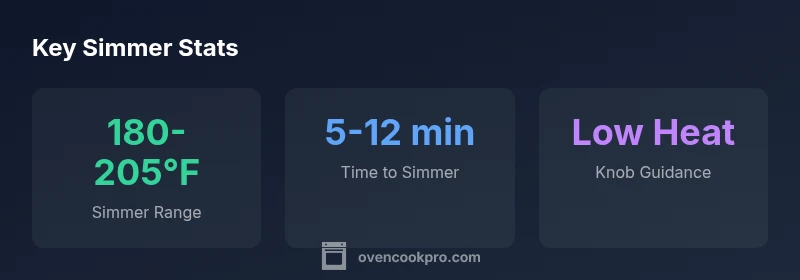
Simmer isn’t tied to a fixed stove number; it’s a heat level. On most home ranges, true simmer occurs at a low setting that maintains small, steady bubbles—roughly 180-205°F (82-96°C). To find your exact simmer on your stove, test with a small amount of water and adjust the knob until you see gentle bubbles without rapid boiling.
What simmer really means on home stoves
Simmering is a cooking technique, not a fixed dial number. For home cooks, the goal is to sustain a temperature that produces slow, steady movement in the contents without a rapid boil. The phrase what stove number is simmer often pops up in kitchens, but the reality is that simmer is a heat range. Most residential burners can achieve this range by dialing the heat to a low setting and watching for a soft, continuous bubble rather than vigorous rolling. The exact dial position varies by stove, pot size, and whether you’re using a lid. In practical terms, simmer means patience: you want small bubbles breaking the surface every few seconds, a gentle whisper of activity rather than a churning boil. As Oven Cook Pro Team notes, mastering simmer requires understanding your own range and practicing with different recipes so you can predict outcomes with sauces, stocks, and reductions.
How to visually identify the simmer on your stove
Visual cues are your first ally when you’re trying to locate simmer. Look for tiny, steady bubbles that barely break the surface. If you see a vigorous boil, you’re above simmer. If the liquid is merely rippling with no bubbles, you’re likely below simmer. A thermometer can help—aim for a steady 180-205°F (82-96°C) if you’re using a digital probe. For recipes that rely on extended simmering, such as stock reductions, maintain the low range and avoid lifting the lid unless the recipe specifies. Keep a timer handy to avoid over-reducing or scorching sauces. Remember that different cookware and burner sizes shift the exact dial position, so expect some variance across pans.
Gas vs electric stoves: how heat delivery changes simmer behavior
Gas stoves tend to provide more immediate and variable heat, which can make finding and maintaining a simmer feel trickier. Electric stoves generally offer steadier, slower heating, making the simmer easier to sustain once you learn your typical low setting. If you switch between gas and electric, rehearse your simmer on each type using the same water-based test. In both cases, using a heavy-bottom pot helps distribute heat more evenly and reduces hotspots that could disrupt a gentle simmer. As you gain experience, you’ll learn to anticipate how your stove behaves at the margins between low and medium heat, transitioning smoothly between simmer and a light boil when a recipe calls for it.
Practical steps to identify your stove’s simmer setting on a new appliance
- Start with water: fill a small saucepan with 1-2 inches of water. 2) Set your burner to the lowest position. 3) Observe for 5-10 minutes; note whether you see faint bubbles and gentle movement. 4) If there are no bubbles, slowly increase the heat by small increments until you reach the first sign of simmer. 5) Record the dial position or knob setting for future reference. 6) Repeat with different pot sizes to understand how cookware affects the simmer. 7) Test with sauces in similar pots to confirm you can maintain a simmer without boiling off precious liquids. 8) If your stove lacks precise control, use a lid to trap heat and manage evaporation while staying in the simmer range.
How cookware and lid usage influence simmer outcomes
Pot material and thickness influence heat distribution. A heavy-bottom stainless or cast-iron pot tends to spread heat more evenly, smoothing out hotspots that can push a simmer into a boil. The lid can dramatically affect simmer behavior: keeping it on conserves moisture and can raise the liquid’s temperature, while leaving it off can promote evaporation and a lower simmer. For delicate sauces, a lid partially on helps maintain moisture balance without letting the surface lock into a boil. Always consider the recipe’s requirements and adjust your simmer accordingly for best results.
Energy, safety, and best practices while simmering
Simming is energy-efficient when compared to frequent boiling, but it still requires attention. Keep flammable materials away from the burner and use pots with snug-fitting lids when appropriate to minimize evaporation and heat loss. Maintain a clean burner area to prevent flare-ups, and avoid leaving the pot unattended for long periods. When simmering long recipes, consider using a heat diffuser to even out heat distribution if your stove has hot spots. For home cooks focusing on safety and consistency, practicing with different recipes will help you map your stove’s simmer signature and reduce trial-and-error time.
Key simmer benchmarks for home cooks
| Metric | Value | Notes |
|---|---|---|
| Simmer range (°F) | 180-205 | Typical home range target |
| Time to simmer (off to simmer, min) | 5-12 | Depends on volume and pan |
| Cookware impact | Heavy-bottom pots improve stability | Use to minimize hotspots |
Questions & Answers
Is simmer the same on gas and electric stoves?
Not exactly. Gas stoves can fluctuate with flame height, making the simmer harder to stabilize. Electric stoves generally provide steadier heat, which can make the simmer easier once you learn your lower settings. In both cases, test with water to identify the simmer range.
Gas and electric stoves differ in heat delivery, so test simmer on each type to find your range.
What knob setting corresponds to simmer?
There is no universal knob setting. Start at the lowest setting and watch for a gentle bubble pattern. If there are no bubbles after several minutes, slowly increase until you reach the first sign of simmer. Record the setting for future use.
Start low and test with water to find your simmer.
Why is my simmer inconsistent when I move cookware?
Pan material, bottom thickness, and volume all influence heat transfer. A heavy-bottom pot improves stability, while a larger or smaller pan can shift the simmer range. If you notice inconsistency, try the same recipe with different pots to identify the best option for your stove.
Pan choice and size can change how simmer behaves.
Can I simmer with a lid on?
Yes, for many sauces and braises, a lid helps conserve moisture and prevents evaporation, which can raise surface temperature and push toward a boil. Remove the lid as needed to reduce moisture and adjust simmer strength according to the recipe.
Lid usage can help you manage evaporative loss during simmer.
How can I speed up reaching simmer?
Preheat water or ingredients, use a wider pot to increase surface area, and start with a touch higher heat before dialing back to the simmer range. Always monitor closely to avoid overshooting into a boil.
Preheat, widen the pot, and then settle into the simmer range.
“Simmering is a skill of precise heat control rather than a single knob setting. Once you understand your stove’s heat curve, you can reliably maintain a steady simmer for sauces, soups, and reductions.”
Main Points
- Identify that simmer is a temperature range, not a fixed dial number
- Use small bubbles as your primary visual cue for simmer
- Test on your own stove with water before cooking sauces
- Leakage and evaporation are minimized with lids when appropriate
- Practice across pot sizes to understand your stove’s simmer behavior