What Size Oven for Family of 4: A Practical Guide
Learn how to pick the right oven size for a family of four with practical measurements, capacity insights, and expert buying guidance from Oven Cook Pro.


Choosing the right oven size for a family of four balances space, cooking habits, and future needs. Start with a standard 24-inch single oven as a baseline; if you bake a lot or host large meals, consider a 27- or 30-inch model or a second oven. Convection can boost capacity without extra space.
Understanding why oven size matters for family cooking
For a family of four, the size of the oven affects how many dishes you can cook at the same time, how evenly they bake, and how quickly you can get a meal on the table. The right oven size helps you plan roasts, sheet-pan dinners, and desserts without constant rearranging or long preheat times. According to Oven Cook Pro, most households find a baseline comfortable with a standard 24-inch single oven, which fits typical sheet pans and standard roasting pans while leaving room for a couple of side dishes. If your cooking pattern includes frequent large roasts, multiple trays, or holiday meals, you’ll gain more flexibility from a larger single oven (27- or 30-inch) or even a second oven. Convection features can further extend usable capacity by circulating hot air more evenly, reducing the need to crowd pans. When evaluating size, also consider door swing clearance, the depth available under cabinets, and whether a wall oven or range with an integrated oven better suits your kitchen layout. This initial assessment sets the foundation for choosing a size that balances everyday meals with occasional peak cooking.
Common width categories and what they mean in the kitchen
Oven width is the most visible way to judge capacity, but real usable space depends on interior layout, rack spacing, and venting. A standard 24-inch oven is common in many homes and typically fits two full-sized baking sheets with room to spare for a couple of side dishes. A 27-inch model expands cavity height and can accommodate more pans or larger roasts without crowding. A 30-inch unit offers still more interior volume and is often paired with convection to boost efficiency. For households that regularly host big gatherings or cook several dishes simultaneously, a double-oven or a wall-oven setup can deliver true multi-tasking power. In all cases, check the exterior footprint, door swing, and cabinet clearance to ensure you’re not stepping over space limitations during daily use.
How to map your family cooking load to an oven size
Start by listing typical meals for a week and noting the number of pans or sheets you would use at once. If you frequently bake cookies, casseroles, and vegetables on multiple racks, a larger cavity or a second oven can save time. For roasts or whole birds, plan enough interior space for a large dish plus a couple of side dishes. Use this heuristic: two full-size baking sheets on separate racks equal a practical test for a 24-inch oven; add a third rack for larger families only if you regularly exceed two pans. Convection models can help you fit more on each rack thanks to improved air circulation. Finally, consider future needs such as holiday cooking or accommodating teenagers’ baking projects. The goal is to avoid crowding and ensure even heat distribution across all trays.
Convection and features that affect usable capacity
Convection ovens push hot air with a fan, which can reduce overall cooking time and improve browning on multiple dishes. When the oven is properly vented and empty, convection can effectively increase usable capacity by letting you place pans closer together without uneven results. Not all ovens labeled as convection truly match the interior volume, and some models have restricted inner height due to insulation or broiler placement. If your kitchen is small, a convection-capable 24- or 27-inch model can often outperform a larger non-convection unit. Also look for features like multiple cooking modes, delayed start, and precise temperature control, which help use capacity efficiently across different meals.
Maximizing capacity with rack and pan arrangement
Maximizing oven capacity is less about the oven size and more about how you place pans. Use two staggered racks to minimize overlap and rotate trays halfway through. Place larger pans on the bottom rack and reserve the top for delicate items or desserts; use a shallow baking sheet on the middle rack for quick reheats. If your model includes a convection option, give bold foods (roasts) more space and place lighter items (breads) on upper racks to prevent heat from pooling in one area. Clean the oven interior before big cooking days to avoid spray or residue affecting heat distribution. Finally, consider using baking stones or insulating mats to protect delicate pans and improve heat transfer efficiency.
Real-world scenarios: roasting, baking multiple trays, and special meals
Imagine preparing a Sunday family dinner with a large roast, mashed potatoes, vegetables, and a dessert. A larger single-oven setup may let you run the roast on one rack and bake vegetables on the other, while a separate dessert tray finishes in the residual heat. On busy weekdays, a 24- or 27-inch oven with two racks can manage two sheet pans for weeknight dinners, leaving room for a quick dessert. For holiday baking, the extra interior height and the option to use two trays of cookies or rolls can be a real time saver. These examples illustrate how a well-chosen size supports both everyday meals and occasional crowd-pleasers.
Energy use, maintenance, and long-term value
Larger ovens generally come with higher energy demands, but they can also reduce total cooking time and the number of batches you run, which may offset some energy use. Consider models with energy-saving modes, well-sealed doors, and efficient insulation to keep operating costs reasonable. Maintenance matters too: plan simple cleanings, inspect door seals, and replace worn gaskets to preserve heat efficiency. A reliable oven that suits your family’s cooking rhythm will pay off over years of routine meals and holiday feasts, making it a worthy investment for a home cook’s toolkit.
How to measure your kitchen and plan for installation
Before shopping, take precise measurements: width, height, and depth of the opening; space for ventilation around the oven; and the location of electrical or gas hookups. Write down the required clearances for door swing and handle clearance when standing in the kitchen. Check whether your kitchen cabinet configuration will accommodate a built-in or freestanding unit, and whether you need a separate wall-oven installation. If you’re replacing an older oven, confirm the new unit will fit into the existing space and ports without modification. It’s wise to involve a qualified installer early in the process to verify hookups and ensure safe operation and compliance with local codes.
Budgeting and compromise: finding a balance between size, price, and space
When budgeting, think about the trade-offs between size, features, and installation complexity. A baseline 24-inch unit with convection may offer excellent value for a family of four, while a larger 27- or 30-inch option or a dual-oven setup can provide room for growth. Don’t overlook installation costs, delivery, and removal of an old unit. If space is tight, a wall-oven or combination range might deliver similar capacity without sacrificing floor space. The objective is to choose a configuration that fits your kitchen now and remains flexible for future cooking patterns and family milestones.
Tools & Materials
- Measuring tape(At least 60 inches long; measure width, height, and depth clearance.)
- Notebook or tablet(Record measurements, cabinet clearances, and outlet locations.)
- Pencil or pen(Jot measurements and layout notes for easy reference.)
- Calculator(Estimate clearances and plan fit with margins.)
- Level(Check for level installation and cabinet alignment.)
- Flashlight(Inspect dark corners and cabinet recesses during measurement.)
Steps
Estimated time: 2-6 weeks
- 1
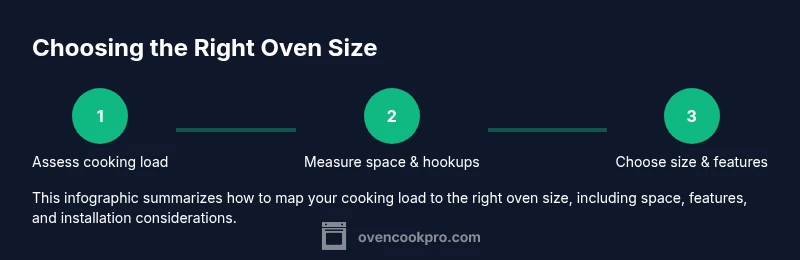
Assess cooking load and patterns
List weekly meals, note average pan counts, and identify peak cooking days. This reveals how many trays you typically use at once and whether you need speed or capacity.
Tip: Document at least two weekday meals and one weekend meal to spot recurring needs. - 2
Measure your space and hookups
Measure opening width, height, depth, and clearance around doors. Locate electrical or gas connections and any ventilation constraints that affect installation.
Tip: Take pictures of the current outlet box and cabinet interiors for reference. - 3
Set baseline size options
Identify feasible widths (e.g., 24-, 27-, 30-inch) and whether you need a single, double, or wall oven. Note exterior footprint and door swing.
Tip: Consult cabinet manufacturers or installer for exact clearance diagrams. - 4
Evaluate features vs. capacity
Decide if convection, multiple cooking modes, and energy-saving features matter for your routines and if they justify a larger or more expensive unit.
Tip: Convection can reduce batch count and improve browning on multiple trays. - 5
Check installation needs
Confirm electrical amperage, gas line requirements, and venting. Plan for professional installation to ensure safety and compliance.
Tip: Get a written installation quote before ordering equipment. - 6
Consider disposal and delivery
Arrange removal of the old unit and confirm delivery timing, hoisting, and placement in the kitchen to minimize disruption.
Tip: Ask the seller about packaging and haul-away options. - 7
Review warranties and service
Check parts coverage, service intervals, and what maintenance tasks you’ll perform yourself.
Tip: Register the appliance and keep receipts for future service. - 8
Plan a test run
After installation, perform a basic bake test and temperature calibration to ensure even heat distribution.
Tip: Run a simple tray of cookies or vegetables to confirm rack spacing works.
Questions & Answers
What size oven should a family of four start with?
A standard 24-inch oven is a solid baseline for most families of four. If you frequently cook large meals or bake multiple trays, consider a larger unit or a second oven to maintain efficiency.
Start with a 24-inch oven; upgrade if you often cook large meals or bake multiple trays at once.
Is a convection oven worth it for a small family?
Convection helps heat circulate more evenly and can allow smaller cavities to perform like larger ones. It often saves time and can improve browning on multiple dishes.
Convection can boost capacity and save time, making it worth considering for small families.
When is a double oven worthwhile for a family of four?
A double oven is helpful if you regularly cook several dishes at different temperatures or host large gatherings. It provides true multi-tasking capacity.
If you cook multiple dishes at different temps often, a double oven can be very useful.
What measurements should I take before buying?
Measure width, height, and depth of the opening, plus door clearance and vent space. Also map electrical or gas hookups to ensure compatibility.
Measure the opening and hookups to ensure the new oven fits and connects safely.
How should I budget for a new oven?
Budget for the size and features that match your cooking routine, plus installation and removal of the old unit. Prices vary by size and options.
Budget according to size and features, and include installation and removal costs.
What maintenance is needed for large ovens?
Regular cleaning, inspecting door seals, and ensuring proper ventilation help uphold performance and energy efficiency.
Keep it clean, check seals, and ensure ventilation for best performance.
Watch Video
Main Points
- Measure your space before shopping.
- Start with a 24-inch baseline and upgrade if needed.
- Convection can improve capacity without increasing footprint.
- Plan professional installation for safety and codes.
- Balance size, features, and budget for long-term value.