What Oven Temperature Keeps Food Warm
Discover the best oven temperature to keep food warm safely and tenderly. Learn safe ranges, tips to prevent drying, and how to use convection vs conventional ovens for steady warmth.


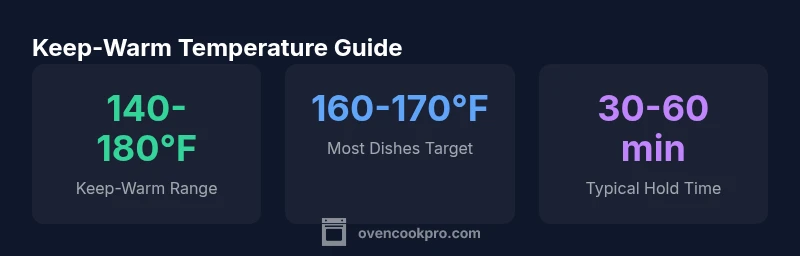
Keep-warm in an oven at a low, steady temperature to preserve texture and moisture. A safe, versatile range is 140-180°F (60-82°C), with many dishes best held around 160-170°F. Avoid higher heat that can dry out foods; use covers and shallow pans to minimize moisture loss. Consider preheating briefly and verifying with a thermometer.
Understanding why the right keep-warm temperature matters
What oven temp to keep food warm isn’t a casual choice. The temperature you select affects moisture retention, texture, color, and overall appeal. In kitchens of all sizes, home or professional, a steady, moderate warmth helps preserve sauces, prevents dryness, and reduces the risk of food safety issues that can arise when food lingers in the danger zone. By setting a deliberate warmth level, you give leftovers, casseroles, roasted meats, and side dishes a better chance to remain inviting when it’s time to plate. The key takeaway is that warmth is a balancing act: too hot and you overcook or dry out; too cool and bacteria can begin to multiply. In practical terms, this means choosing a temperature that is hot enough to stay above 140°F but gentle enough to avoid rapid moisture loss. This article will unpack safe ranges, how they apply to different foods, and actionable techniques to keep meals warm without sacrificing quality, answering what oven temp to keep food warm with a data-driven approach from Oven Cook Pro.
Safe temperature guidelines for keeping food warm
Keeping food warm safely requires staying above the temperature danger zone and using temperature control to preserve moisture. The standard minimum safe holding temperature cited by many food-safety guidelines is 140°F (60°C). At this level, most foods stay out of the danger zone long enough for service. For meats and protein-rich dishes, some cooks prefer the 155-165°F range to maintain tenderness while ensuring pathogens remain unlikely. If you’re serving starches, vegetables, or casseroles, you can often go a touch higher without drying out, typically in the 160-180°F range. Converting to Celsius, that’s about 60-82°C. In practice, the goal is a consistent warm environment that prevents cold spots and reduces moisture evaporation. To calibrate your oven, use an oven thermometer placed in the middle of a shallow pan, not near the heating element. Finally, remember that every oven has hot spots; rotating pans every 15 minutes can improve even warmth across dishes.
Temperature ranges by food type
Different foods tolerate warmth differently. Use the following ranges as a baseline, then adjust based on your dish and how long you expect to hold it.
Proteins and meats
A common target for keeping cooked meats warm is roughly 150-165°F (65-74°C). This range preserves juiciness while reducing the risk of drying out. If you’re keeping beef or pork sliced for service, you may favor the lower end; for larger roasts, the middle works well.
Vegetables and starches
Vegetables and starchy sides often tolerate higher warmth without drying as quickly, typically in the 160-180°F range. However, be mindful of wilting or texture change; covering lightly keeps color and bite intact.
Bread and pastries
Baked goods are sensitive to moisture loss. Aim for 150-170°F; longer holds can dry bread, so consider wrapping or placing a moisture barrier between slices.
Practical techniques to maintain moisture and texture
Maintaining moisture and texture while keeping food warm is a matter of heat control, moisture management, and smart layout. Use shallow, wide vessels to promote even heat distribution and prevent thick layers from overheating at the core. Keep lids or foil on most dishes to trap steam, but vent occasionally to prevent condensation from turning into sogginess. When possible, layer foods so heavier items don’t crush lighter ones, and consider a thin layer of sauce, broth, or glaze over dry proteins to help retention. For casseroles and pasta bakes, a light splash of sauce on top can act as a shield against surface drying. If you’re transporting or serving buffet-style, use warming trays or chafing dishes that maintain a gentle, consistent temperature rather than blasting heat from the bottom. Finally, evaluate your setup with a thermometer in the center of a representative dish to verify you’re within your target range.
Convection vs conventional ovens for keeping food warm
Convection ovens move air with a fan, which can reduce hot spots and shorten the time needed to reach the keep-warm target. When using convection for warmth, consider lowering the target by 10-20°F (about 5-10°C) to compensate for air movement that can dry surfaces faster. In contrast, conventional ovens rely on radiant heat and natural air flow, often requiring a slightly higher temperature to achieve the same interior warmth. For most home cooks, a convection setting is advantageous for large batches with varied items, but you should monitor moisture and texture carefully. If you’re using a conventional oven, place dishes on the middle rack and rotate halfway through to improve even warmth across pans.
Tools and setups: warming drawers, foil, pans
If you have a warming drawer, use it for steady warmth on multiple items without adding extra moisture loss. For standard ovens, shallow, wide pans promote uniform heat and reduce scorching. Use foil or a parchment lid to protect delicate items, while breads benefit from a loose tent of foil to avoid drying. In buffet scenarios, draggable warming boards with insulated blankets can help maintain even temperature without continuous oven heat. For sauces and soups, keep them in heavy-bottomed pots with lids ajar to prevent over-condensation, which can alter texture. Finally, invest in an oven-safe thermometer and position it toward the center of a representative dish to ensure you’re staying within the ideal keep-warm range.
Safety reminders: time, moisture, and food safety
The keep-warm phase is not a substitute for timely service. If possible, limit warm holds to 1-2 hours for most dishes, and be mindful of protein standards—some meats may require shorter holds or safer handling to preserve texture and safety. Moisture management remains critical: uncovered or loosely covered dishes can lose moisture rapidly, while over-covering may cause soggy textures. Regularly rotate trays to avoid cold spots and verify temperatures with a probe thermometer. If you notice rising moisture loss, wrap items with parchment, increase humidity with a shallow water tray, or switch to a lid with a vent. Finally, always re-check temperatures before serving, ensuring you maintain safe thresholds and quality across all dishes.
Quick-start workflow for keeping meals warm
- Preheat your oven to the target range (usually 140-180°F, most dishes at 160-170°F).
- Arrange dishes in shallow, evenly spaced pans to promote uniform warmth.
- Cover tightly with foil or use lids to preserve moisture, venting occasionally.
- Use an oven thermometer to verify mid-pan temperatures and rotate pans every 15 minutes.
- For sauces, keep them in covered pots at the lower end of the range and stir occasionally to maintain emulsions.
- Serve within 1-2 hours of holding whenever possible to preserve texture and safety.
Temperature guidelines for keeping foods warm
| Food Type | Keep Warm Temp Range (°F) | Recommended Hold Time |
|---|---|---|
| General leftovers | 140-165 | 1-2 hours |
| Meats and poultry | 150-165 | 30-60 minutes |
| Bread and pastries | 150-170 | 30-60 minutes |
| Vegetables and casseroles | 140-180 | 15-45 minutes |
Questions & Answers
What is the minimum keep-warm temperature for safety?
The general minimum is 140°F (60°C) to stay out of the danger zone. For some proteins, you may hold closer to 150-165°F to balance safety with texture.
Aim for at least 140°F to stay safe, and adjust within 140-165°F based on the dish.
Can I use my regular oven to keep food warm?
Yes. Use the oven’s keep-warm or lowest setting, staying within the 140-180°F range, and monitor with a thermometer to avoid over-drying.
Yes, you can use your oven for keep-warm as long as you monitor the temperature.
Does convection affect keep-warm temperature?
Convection can help even warmth but may dry surfaces if the temp is too high. Consider 10-20°F lower than conventional guidelines and check moisture.
Convection helps even heat; lower the temp a bit and keep an eye on moisture.
How long can food safely stay warm in the oven?
Most dishes are best served within 1-2 hours of warming. For extended holds, use moisture-retaining techniques and monitor texture.
Try to serve within an hour or two, and watch moisture build-up.
Should I preheat to keep-warm temperatures before adding food?
Preheating helps ensure even warmth once food is added. Preheat to the lower portion of the keep-warm range if possible.
Preheat a little, so you’re ready to go once food is in.
“The keep-warm phase is as much about moisture management as temperature. Small adjustments in heat and coverage can preserve texture across a range of dishes.”
Main Points
- Set a safe baseline of 140°F as a minimum.
- Target 160-170°F for most dishes.
- Cover foods to minimize moisture loss.
- Convection may allow lower temps; monitor moisture.
- Use a thermometer and rotate pans for even warmth.