What Oven Option for Pizza: A Practical Comparison
Explore the best oven option for pizza with a clear, data-informed comparison of conventional, convection, and outdoor ovens. Learn setup tips and how to optimize crust across scenarios.


According to Oven Cook Pro, the right oven option for pizza mainly shapes crust texture, bake speed, and topping behavior. For most homes, a conventional oven with a preheated stone or steel yields reliable results. Convection can boost crispness with proper setup, while an outdoor pizza oven delivers authentic high‑heat crust but needs space and ongoing maintenance. This quick guide helps you find the best fit for your kitchen.
Why the pizza oven choice matters
What makes the choice of oven for pizza consequential is how heat, time, and moisture interact with dough. The bottom crust forms where heat transfer is strongest, while the top browns from radiant heat and, in some cases, convection. The result is crust bite, blistering, chew, and edge coloration. The question 'what oven option for pizza' isn't just about temperature; it's about heat distribution, preheat behavior, stone versus steel thermal mass, and how you manage steam and toppings. According to Oven Cook Pro Analysis, heat retention and even distribution matter more than brand or toppings in achieving consistent results. In practical terms, if your kitchen has limited space, a good stone setup in a regular oven can beat most countertop devices; if you want crispness and speed, adjust airflow; if you have outdoor space, a dedicated pizza oven expands your range.
Core differences: Conventional vs convection vs outdoor
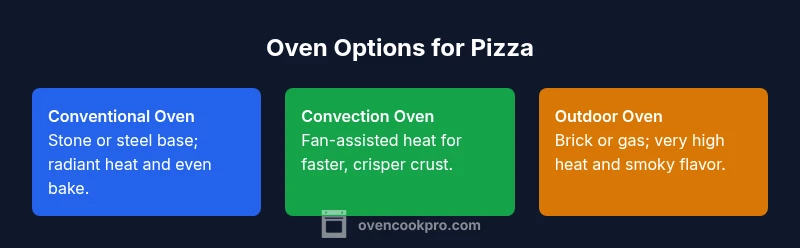
The three broad paths typically discussed for at‑home pizza are conventional ovens with stone or steel, convection ovens that move hot air with a fan, and dedicated outdoor pizza ovens that generate very high heat from brick or gas. Conventional ovens rely on radiant heat from the top and bottom to bake the crust and toppings together. Convection ovens add an internal fan to circulate hot air, which can shorten bake times and produce crisper crusts if you keep an eye on browning. Outdoor pizza ovens harness very high surface temperatures and intense radiant heat, often producing blistered edges and a smoky flavor. The tradeoffs include preheat time, space, and maintenance, but the outcome can be tailored to your preferred crust style and toppings.
How to optimize crust with each option
To optimize crust across options, start with a hot surface and a properly preheated oven. Stone and steel act as heat sinks, absorbing and releasing heat to form a firm crust bottom. If you use a conventional oven, preheat with the stone inside for at least 30 minutes to ensure an even crust base, and keep the dough thin enough to bake through before toppings burn. Convection should be used with caution: place the pizza on a level rack to avoid tipping heat away from the bottom, and consider turning the pizza halfway for even browning. Outdoor ovens demand very high heat; learn to time your bake, rotate pizzas to prevent hot spots, and monitor moisture levels. Across all options, using a high‑quality dough, proper hydration, and evenly distributed toppings helps improve results.
Practical setup: stone vs steel, rack positioning, preheat times
When choosing between stone and steel, note that stone excels at moisture management and a chewy crust, while steel heats up faster and yields a crisper, quicker bake. For conventional ovens, place the stone on the middle rack to keep the crust from overheating the toppings. Preheat the oven well in advance—ideally 30 minutes for a stone and longer if your oven runs cool. In convection mode, keep the stone on the rack nearest the bottom element to maximize bottom heat. If you opt for a steel plate, you can preheat it for a shorter time to achieve a faster sear. Outdoor ovens require even longer preheats and careful temperature management to avoid scorching the crust while ensuring the center cooks through.
Common mistakes and how to avoid them
Common missteps include under‑preheating the stone, overcrowding the oven with multiple pizzas, and using dough that is too thick for the chosen bake method. Another frequent issue is toppings that release too much moisture, leading to a soggy base. To avoid these, preheat thoroughly, keep toppings balanced, and use parchment paper or a paddle to transfer pizzas without losing heat. For convection, avoid opening the door during bake to maintain heat stability. Outdoor ovens benefit from consistent fuel management and closing the door during bake to stabilize temperatures.
Step-by-step quick-start guide
- Choose your oven option based on crust style and space. 2. Preheat with a stone or steel inside to the target temperature for at least 30 minutes. 3. Prepare a thinly stretched dough with balanced hydration. 4. Add toppings sparingly and evenly to prevent moisture overload. 5. Bake on a middle rack in conventional mode or on the stone/steel in convection mode as needed. 6. Rotate the pizza halfway through to ensure even browning. 7. Finish with a brief high‑heat blast or broil if you want extra browning on the rim. 8. Remove and let the crust rest briefly before slicing.
When to choose an outdoor pizza oven
Outdoor pizza ovens shine when you want authentic, blistered crusts at very high heat and enjoy smoky flavors. They work best for entertaining or when you regularly bake multiple pizzas in a short time. Consider how much space you have, weather exposure, and maintenance needs before committing to an outdoor unit. For most households, a well‑set conventional or convection oven remains the more practical choice, with an outdoor option reserved for enthusiasts seeking restaurant‑quality results.
Feature Comparison
| Feature | Conventional Oven with Pizza Stone/Steel | Convection Oven with Pizza Stone/Steel | Outdoor Pizza Oven (Brick or Gas) |
|---|---|---|---|
| Heat source and distribution | Indirect heat from bottom and radiant top heat | Forced hot air convection for even distribution | Radiant heat from brick/gas with strong surface temps |
| Preheat time impact | Stone/steel require thorough preheat, longer warmup | Convection requires stable airflow and longer preheat | Outdoor units demand longer preheat for peak temps |
| Crust texture results | Chewy to sturdy crust with stone mass | Crispier crust with even browning | Very blistered, charred edges at high heat |
| Max heat capability | Typically up to about 500–550°F | Often similar range, depending on model | 800°F+ typical for advanced outdoor ovens |
| Best use | Everyday pizzas, versatile toppings | Crispier crusts, faster bakes | Authentic pizzeria style, high heat |
| Ease of use & maintenance | Simple setup, low to moderate maintenance | Requires monitoring and occasional repositioning | Higher upkeep, but high payoff in crust quality |
| Price range | Low to mid-range | Mid to high range | High range |
The Good
- Widely available and easy to adopt with existing kitchen
- Stone or steel setup improves crust quality with steady heat
- Convection offers quicker bakes and crisper crusts when used right
- Outdoor ovens deliver authentic flavor and very high heat
Drawbacks
- Conventional ovens require careful stone maintenance and heat management
- Convection can lead to uneven browning if misused
- Outdoor ovens demand space, weather protection, and higher upfront cost
Conventional oven with stone is the default choice for most homes; convection is best for a crisp crust, and outdoor ovens excel when you want authentic, high-heat results.
For most kitchens, start with a preheated stone in a conventional oven. Move to convection if you want extra crust crispness, and consider an outdoor oven only if space and maintenance are not constraints.
Questions & Answers
What is the best oven option for pizza for a home cook?
For most home cooks, a conventional oven with a stone or steel is the best starting point due to reliability and ease of use. Convection can add crispness if you manage heat correctly, and an outdoor oven is ideal for enthusiasts with the space and time to maintain it.
For most homes, start with a conventional oven and a stone. Convection helps with extra crispness, and outdoor ovens are great for enthusiasts with space.
Do I need a baking stone or steel for pizza?
A baking stone or steel acts as a heat reservoir that creates a strong, hot base. Stone is forgiving for moisture and yields a chewier crust, while steel heats quickly and produces a crisper bottom. Both improve oven performance compared with bare racks.
A stone or steel helps the crust; stone is forgiving, steel bakes faster and crisper.
Is a convection oven better for pizza than a conventional oven?
Convection can improve browning and reduce bake time, but it can also dry toppings if not managed. It works best when you keep an eye on heat distribution and use a stone or steel to protect the crust.
Convection can help browning, but watch moisture and bake time.
Can I make pizza in a toaster oven?
A small toaster oven can make pizza, especially with a compact stone or steel if size allows. Expect slower heat transfer and a smaller crust, but it can be effective for personal pizzas or limited spaces.
Yes, you can, especially for small personal pizzas, with a compact stone.
How hot should I preheat for pizza?
Preheat to a high temperature suitable for your oven type, typically in the range where your stone or steel reaches a consistent heat. Preheating is essential for a crisp bottom and even bake.
Preheat well to ensure a crisp, even bake.
Main Points
- Choose conventional with stone for reliable crusts
- Preheat thoroughly for best results
- Convection is great for crispness with care
- Outdoor ovens suit enthusiasts with space
- Practice with one method before upgrading