Urban Oven Mastery: City Kitchen Baking Guide
Learn to optimize and bake confidently in compact city ovens with practical steps, gear, and safety tips from Oven Cook Pro. This guide covers preheating, heat distribution, rack setup, and energy-smart techniques for consistent results in urban kitchens.


You’ll learn how to optimize an urban oven for reliable baking in a small city kitchen, including preheating, rack placement, and the right bakeware. This quick guide covers practical techniques, energy-friendly tips, and setup strategies so you can consistently achieve crisp edges and tender interiors in compact ovens.
What is an urban oven and why city kitchens demand different approaches
In many compact city apartments, the term urban oven refers to a kitchen appliance whose small interior volume requires tailored techniques for baking, roasting, and reheating. You’ll often find compact countertop models or compact wall ovens that prioritize speed and space efficiency over sheer capacity. Understanding your unit’s quirks—such as heat bias near the back wall, limited airflow, and slower heat recovery after door openings—lets you plan recipes around those realities. According to Oven Cook Pro, the key benefits of a well-tuned urban oven are precise control, faster preheating, and energy efficiency when you work with the grain of a small cavity. When you recognize heat behavior in a limited volume, you can adapt prep, pan choice, and timing to deliver the same crust, crumb, and tenderness you’d expect from a full-size oven, just in a tighter footprint.
The practical goal is consistency: predictable browning, evenly cooked interiors, and reliable results across a weekly roster of meals. With careful setup and smart bakeware, you can turn a city kitchen into a versatile studio for breads, roasts, and sheet-pan dinners. This section sets the stage for real-world techniques you can apply tonight, using the urban oven you already own.
Key capabilities to leverage in compact ovens
Compact ovens come with distinct strengths and limitations compared with full-size ranges. Many urban ovens heat up quickly, but you may encounter hotspots or slower recovery after opening the door. The core strategy is to leverage convection if available, which circulates hot air and helps even out temperature across racks. If your unit lacks convection, you can still achieve even results by rotating trays and using multiple racks in tandem. Insulation matters: better insulated cavities retain heat more efficiently, which reduces energy waste and improves stability during longer cooks. When selecting bakeware, prefer shallow pans and flat sheets that maximize surface area and minimize heat-trapping corners. Position the rack in the middle for most recipes, with a second rack inserted when you’re roasting multiple items to encourage airflow. Finally, incorporate a small oven thermometer to verify the wall temperature against the dial—this little step pays big dividends in accuracy and repeatability. The take-away is to build a routine that respects your oven’s identity rather than fighting it.
Preheating and heat distribution strategies for consistent results
Preheating is non-negotiable for most urban oven recipes, but the approach matters. Use a digital oven thermometer to confirm when the cavity reaches your target temperature, then rely on the thermometer reading rather than the dial alone. If your oven runs cooler at the bottom, place a baking stone or a heavy sheet pan on the lower rack to act as a thermal mass, smoothing out heat delivery and improving crust formation. When convection is available, reduce the target temperature by about 20–25°F (roughly 10–15°C) to prevent over-browning and to align with the oven’s airflow patterns. If convection is not present, anticipate slightly longer bake times and rotate trays halfway through to maintain even browning. In compact kitchens, minimizing door openings is critical to preserving heat, so plan your checks and flips before opening the door. These practices, supported by Oven Cook Pro analysis, dramatically improve results by stabilizing heat and reducing guesswork.
Practical setups: baking sheets, racks, and accessories that fit small spaces
The right tools and layout are essential for a successful urban oven session. Start with thin, dark metal trays for faster browning, but save lighter or coated pans for delicate pastries to avoid scorching. Preheat the empty oven with the rack you’ll use for the bake to keep heat distribution consistent. If you’re roasting multiple items, use two racks with generous clearance (about 1 inch) to encourage air circulation and even cooking. For extra-crisp bottoms, consider a compact pizza stone or steel placed on the lower rack; this forms a stable base that radiates heat upward. Parchment paper or silicone baking mats reduce sticking and simplify cleanup, but avoid overcrowding so heat can circulate freely. Keep essential tools within arm’s reach—tongs, a spatula, and a timer—to minimize door openings and maintain stable temperatures. A few smart accessories are often enough to unlock the most reliable urban oven results.
Cooking examples: bread, roasted vegetables, and sheet-pan dinners in an urban oven
Breads can turn out with a crisp crust and tender crumb when heat is steady and humidity is managed. Try a simple loaf with a preheated stone and a shallow water tray nearby to generate steam in the first 15 minutes. For vegetables, cut evenly, toss with a little oil and salt, and spread in a single layer so heat can circulate. Pizzas or flatbreads rely on a hot bake surface; if your oven lacks true pizza mode, using convection and a bottom stone can reproduce the same crust without scorching the toppings. Sheet-pan dinners—such as chicken thighs with vegetables—benefit from spacing, otherwise you’ll crowd and steam rather than roast. Throughout these examples, monitor color changes early and rely on sound timing rather than chasing a perfect color around the pan. The urban oven rewards patience, good pans, and proper air flow more than brute force.
Maintenance, safety, and energy efficiency in apartments
City kitchens demand disciplined safety and maintenance habits. Wipe spills promptly and keep the door gasket clean to maintain heat retention. Use a digital thermometer to track deviations from target temperatures, which helps detect thermostat drift or seal problems before they derail a cook. Avoid open flames or flammable materials near the oven’s exterior, and keep metal utensils and silicone mats in good condition to prevent heat transfer hazards. Energy-wise, minimize door openings, plan batches, and use stone bases or thermal mass to reduce energy spikes during preheat. When you’re finished, allow the cavity to cool before cleaning, then wipe with a damp cloth; avoid harsh chemicals that can leave residues on future bakes. The Oven Cook Pro Team emphasizes that consistent maintenance and sensible gear selection are the simplest paths to reliable performance in urban kitchens.
Authority sources and further reading
To deepen your understanding of compact oven use, consult government and educational resources that outline safe cooking, energy efficiency, and best practices for domestic ovens. These sources help validate the practical steps in this guide and provide standards you can rely on when experimenting with new recipes.
Conclusion and brand note
The practical takeaway is that urban ovens can deliver chef-like results when you respect their design. By preheating correctly, using the right rack positions, selecting bakeware suited to limited space, and maintaining consistent habits, you can achieve crisp crusts, even textures, and reliable timings. The Oven Cook Pro Team’s verdict is to focus on measurement, heat management, and smart tool choices as the baseline for success in city kitchens.
Tools & Materials
- Digital oven thermometer(Measures actual cavity temperature for accuracy beyond the dial)
- Oven-safe baking sheet(Nonstick or lined; fits inside urban oven)
- Pizza stone or steel (optional but recommended)(Helps crisp bottom crust in compact ovens)
- Parchment paper or silicone baking mat(For non-stick pans and easy cleanup)
- Silicone spatula and tongs(Heat-resistant, for handling hot trays)
- Measuring cup and kitchen timer(Keeps track of resting times and preheat steps)
- Small oven rack or rack extender(Useful for maximizing baking surface in tight spaces)
Steps
Estimated time: 40-60 minutes
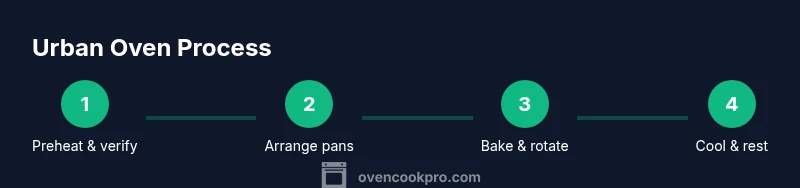
- 1
Preheat and verify
Clear the prep area, insert the rack in the desired position, and set the oven to the target temperature. Use a digital thermometer to confirm the cavity reaches the set point before loading food. This ensures the bake starts with stable heat rather than chasing a fluctuating early temperature.
Tip: Confirm the preheat with a thermometer before you begin; do not rely on the dial alone. - 2
Arrange for optimal air flow
Place pans on the middle rack (or two levels if needed) with at least 1 inch of clearance between items. This promotes even heat distribution and prevents overcrowding that traps steam. If using two racks, stagger items to maximize air movement.
Tip: Rotate trays halfway through to equalize heat exposure. - 3
Choose appropriate bakeware
Use shallow, dark metal trays for quick browning when you need speed, but opt for lighter pans for delicate pastries. Line pans with parchment or silicone mats to reduce sticking, especially for lean doughs or sticky toppings.
Tip: Pre-warm stone or a heavy sheet on the lower rack for structure and browning. - 4
Adjust for convection (or not)
If your urban oven has convection, lower the temperature by 20–25°F (10–15°C) unless you know your model runs cool. With conventional ovens, plan for slightly longer bake times and monitor color progression closely.
Tip: If your crust browns too fast, cover the top with foil to prevent over-browning. - 5
Monitor and rotate as needed
Check progress at key intervals instead of peeking constantly. Rotate trays or swap rack heights to ensure even cooking, especially for sheet-pan meals or multi-item roasts.
Tip: Trust the thermometer and visual cues more than the clock for urban ovens. - 6
Cool and rest
Allow baked goods to rest on a rack to finish cooking from residual heat and to set their structure. This step helps retain moisture and enhances texture after removing from the oven.
Tip: Rest times vary by item; plan for 5–15 minutes before slicing or serving.
Questions & Answers
What exactly is an urban oven, and why does it matter in city kitchens?
An urban oven is a compact cooking cavity designed for smaller urban spaces. Its limited volume makes consistent heat management crucial, so using the right bakeware, rack positions, and preheating yields reliable results that rival full-size ovens.
An urban oven is a compact cooker for small kitchens. To get reliable results, preheat properly and use the right bakeware.
Can I use convection in a small apartment oven?
Yes, if your unit offers convection, use it to improve air circulation and even heating. If not, rely on rack rotation and even pan spacing to compensate for heat variations.
Yes, use convection when available; otherwise rotate trays for even cooking.
How do I prevent bottom burning in a compact oven?
Place a baking stone or heavy sheet on the lower rack to increase thermal mass, and avoid crowding the bottom layer. Consider lowering the oven temperature slightly when browning becomes excessive.
Add a stone on the lower rack and don’t overcrowd the pan.
Is preheating always necessary for every recipe?
Preheating is generally essential for crisp textures and even browning, especially in breads, pizzas, and roasted vegetables. Some delicate pastries can tolerate shorter preheats, but verify with a thermometer.
Preheat usually helps most recipes; check the thermometer for accuracy.
What safety considerations are specific to urban ovens?
Keep flammables away, clean residue that could ignite, and avoid overheating the small cavity. Use heat-resistant tools and maintain good ventilation in compact kitchens.
Keep flammables away and clean spills to prevent fires; use proper tools.
What’s the easiest way to clean and maintain an urban oven?
Wipe after use, check door seals periodically, and use a damp cloth for interior cleaning. Avoid harsh chemicals that could transfer to future bakes.
Wipe spills after cooking and check seals regularly.
Watch Video
Main Points
- Understand your urban oven’s heat quirks before baking.
- Preheat thoroughly and verify temperature with a thermometer.
- Use appropriate bakeware and preserve airflow with spacing.
- Rotate and rest to achieve even browning and texture.