Single Oven vs Double Oven: A Complete Guide
A comprehensive, objective comparison of single ovens and double ovens, covering space, cost, energy, and cooking flexibility to help homeowners choose the right setup.


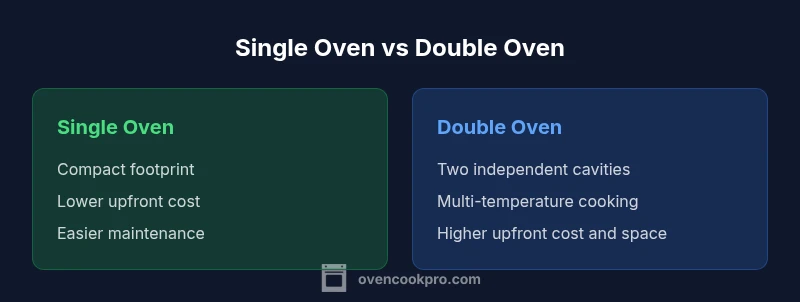
Choosing between a single oven and a double oven comes down to kitchen size, how you cook, and how often you entertain. A single oven suits compact homes and everyday meals, while a double oven adds independent temperatures for multitasking during roasts and desserts. For a comprehensive comparison, consult the detailed sections and the chart below. The choice affects cost, space planning, and future-proofing your kitchen.
Overview: The Single Oven vs Double Oven Decision
When evaluating the single oven vs double oven decision, homeowners weigh space, cost, cooking cadence, and how often they host. In most kitchens, the oven is the workhorse that determines workflow as much as it does flavor. According to Oven Cook Pro, the most meaningful distinctions hinge on capacity, scheduling flexibility, and installation footprint. A single oven typically covers everyday cooking, roasts, and desserts with a familiar set of features and familiar controls. A double oven adds a second cavity and independent temperature controls, enabling simultaneous baking at different temperatures and faster multi-dish service during holidays. For households that bake and roast in parallel, the extra cavity can dramatically reduce wait times between courses. However, you pay for that flexibility in cabinet space, upfront cost, and potential maintenance. The goal of this guide is to help you map your typical week of meals to the oven configuration that balances convenience, energy use, and budget.
How to read this guide
This comparison uses clear criteria—capacity, space, energy, and workflow—to help you translate your cooking habits into an informed decision. We’ll show you practical scenarios, break down trade-offs, and provide a structured buying guide so you can select the model that fits your kitchen and life.
Comparison
| Feature | Single Oven | Double Oven |
|---|---|---|
| Total capacity | Lower capacity in a single unit | Higher combined capacity with two cavities |
| Size footprint | Typically smaller footprint | Typically wider and taller |
| Temperature flexibility | One primary heat zone | Two independent heat zones |
| Cooking speed/multi-dish | Single-cavity cooking only | Two cavities enable multitasking |
| Upfront cost | Lower upfront cost | Higher upfront cost |
| Maintenance | Fewer components | More components to service |
The Good
- Flexible cooking for large gatherings when using a double oven
- Better scheduling ability for multiple courses and temperatures
- Suitable for households who frequently entertain or bake at scale
- Compact single-oven setups save space and cost
Drawbacks
- Double ovens are more expensive and require more space
- Maintenance and service complexity increases with two cavities
- Energy use can rise if both cavities are used frequently
- Installation may require cabinet modifications in some layouts
Double ovens win for versatility; singles win for space and budget.
Choose double ovens if you routinely cook multiple dishes at different temperatures or host large gatherings. If your kitchen is small or budget-sensitive, a high-quality single oven with good insulation and rack flexibility can cover most routines.
Questions & Answers
What is the main difference between a single oven and a double oven?
The main difference is that a single oven provides one cooking cavity, while a double oven provides two independent cavities for simultaneous cooking at different temperatures. This affects scheduling, capacity, and potential space requirements.
A single oven has one cavity; a double oven has two, so you can cook two things at different temps at the same time.
Is a double oven worth it for a small kitchen?
For very small kitchens, the extra width and height may not be worth it unless you truly need multi-temperature cooking. Consider a single oven with a warming drawer or a compact double-wall unit.
In tiny kitchens, a single oven is often better unless you need two temperatures regularly.
Can a single oven perform two temperatures at once?
Usually not with a standard single oven; some models offer dual-zone cooking on two racks but the heat is generally shared. Plan around rack placement and warming modes if available.
Usually not two temps at once in a standard single oven.
What installation considerations matter?
Ensure cabinet space, ventilation, and electrical or gas readiness. Double ovens may require professional installation and possibly cabinet modifications.
Professional install is common for double ovens due to space and wiring needs.
Do double ovens cost more to run?
Energy use depends on load; two cavities can raise energy if both are used, but with smart scheduling the difference can be modest and manageable.
Two ovens can use more energy if both run, but planning helps.
Are there alternatives to a full double oven?
Yes—consider wall ovens, combination microwave/convection units, or a high-capacity single oven with a warming drawer.
Other options include wall ovens or microwave-convection combos.
Main Points
- Assess your cooking cadence and entertaining needs.
- Measure kitchen space and cabinet compatibility.
- Evaluate upfront cost against feature gains.
- Check convection performance and rack flexibility.
- Plan for installation and clearance requirements.