Is an Oven the Same as a Range? Understanding Kitchen Appliance Configurations
Explore whether an oven is the same as a range, why the distinction matters for kitchen layout, and how to choose between integrated ranges and separate wall ovens for your home kitchen.


Is an oven the same as a range? Not exactly. An oven is a heating chamber used for baking and roasting, while a range combines a cooktop with an integrated oven in one freestanding unit. The distinction matters for layout, installation, and cooking strategies. According to Oven Cook Pro, understanding these definitions helps homeowners plan space efficiently and choose appliances that fit their cooking style and budget. For many homes, a range offers all-in-one convenience, but a separate wall oven paired with a standalone cooktop can provide greater layout flexibility and upgrading potential.
Is an oven the same as a range? Key definitions
Is an oven the same as a range in everyday kitchen talk? Not exactly. An oven is a dedicated compartment designed to bake, roast, and broil foods with precise temperature control. A range, by contrast, is a single freestanding appliance that includes a cooktop (gas or electric) and an oven in one chassis. This difference matters for installation, kitchen workflow, and how you plan future upgrades. As the Oven Cook Pro team notes, many home cooks default to a range because of its compact footprint and simplified maintenance, but the choice should align with how you cook and how your kitchen is laid out. The question is not just about nomenclature—it’s about optimizing space, energy use, and cooking versatility.
Comparison
| Feature | Range (oven + cooktop) | Standalone wall oven + separate cooktop |
|---|---|---|
| Definition | All-in-one appliance with built-in oven and cooktop | Separate oven unit installed in cabinetry with a separate cooktop elsewhere |
| Installation complexity | One appliance to install and service | Two appliances to install and potentially two service channels |
| Space requirements | Typically a single footprint in the kitchen | |
| Flexibility | Limited standalone layout changes; constrained by one unit | |
| Upgrade paths | Easy to replace the unit as a whole | |
| Best use case | Small to mid-sized kitchens; cost-conscious shoppers |
The Good
- All-in-one design reduces counter clutter and simplifies installation
- Typically lower upfront cost than modular setups
- Unified controls and aesthetics for a cohesive kitchen
- Easier to find matching finishes and components in a single brand
Drawbacks
- Less flexibility to upgrade oven or cooktop independently
- Potentially smaller oven capacity and fewer customization options
- Repairing a single unit can disrupt both cooking zones
- May offer fewer specialized features compared to modular setups
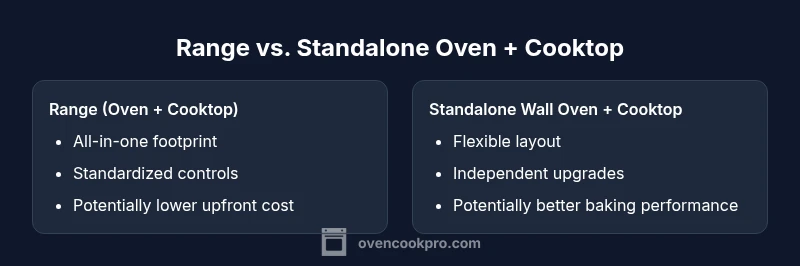
Ranges offer better value and a streamlined footprint for most homes, while separate wall ovens with independent cooktops excel in layout flexibility and upgrade potential
Choose a range if you want all-in-one convenience and a lower upfront commitment. Opt for a standalone wall oven plus cooktop when you need layout freedom or plan to upgrade parts independently over time.
Questions & Answers
Is a range the same as a wall oven?
No. A range combines a cooktop and an oven in a single freestanding unit, while a wall oven is a separate appliance installed in cabinetry, typically paired with a separate cooktop. The choice affects layout, ventilation, and upgrade paths.
No—the range is an all-in-one unit, and a wall oven is installed separately with a separate cooktop.
What should I consider when choosing between a range and a separate oven?
Consider kitchen layout, space, and how you cook most often. If you bake frequently and want maximum flexibility, a separate wall oven plus cooktop can be advantageous. For compact spaces and simpler maintenance, a single range is usually sufficient.
Think about space, baking needs, and upgrade plans when deciding.
Are gas ranges different from electric ranges?
Yes. Gas ranges typically offer quicker heat response and better control for certain cooking styles, while electric ranges provide steady heat and, with convection, even results for baking. The choice influences energy use, ventilation needs, and performance.
Gas gives fast response; electric offers steadier heat for baking.
Can I upgrade a range later, or adapt to a new kitchen layout?
Upgrading a range is often simpler when it’s a single unit, but a standalone wall oven plus cooktop offers more flexibility for future layout changes or kitchen remodeling. Consider future plans and resale value.
Upgrading a stand-alone oven and cooktop can be easier if you anticipate changes.
Which is better for baking and precise temperature control?
Both can bake well, but standalone ovens often provide more consistent temperature profiles. If you bake frequently or require dedicated baking space, a wall oven plus separate cooktop may yield better long-term results.
Wall ovens can offer precise baking, especially with multiple oven options.
Do ranges use more energy than separate units?
Energy use depends on size, insulation, and usage rather than the form factor alone. A well-insulated range can be efficient; modular setups let you run only the necessary unit, which might save energy in some scenarios.
Energy impact varies; choose based on usage patterns and efficiency ratings.
Main Points
- Choose a range for compact, budget-conscious kitchens
- Consider a separate wall oven if layout flexibility matters
- Modular setups permit targeted upgrades without replacing the whole unit
- Plan for space, ventilation, and installation complexity early
- Evaluate long-term maintenance and warranty implications