How Often to Replace Your Oven: A Practical Guide
Learn when to replace your oven with clear timelines, repair vs replacement considerations, and maintenance tips from Oven Cook Pro to keep your kitchen running efficiently.


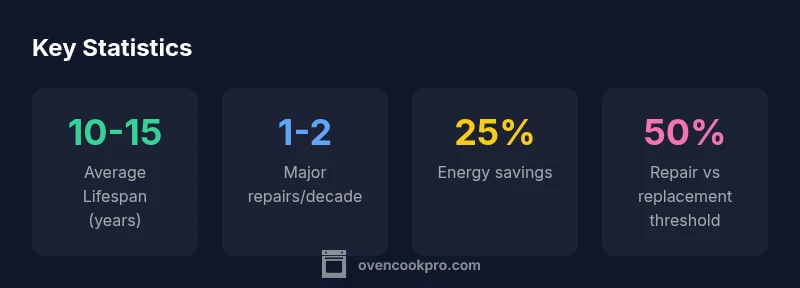
Typically, plan to replace an oven every 10-15 years, depending on usage, repair history, and energy efficiency. If repairs exceed a meaningful portion of replacement cost or safety is a concern, replacement is advised. Additionally, consider model age, parts availability, and warranty coverage.
How often to replace oven: core timing guidelines
If you're asking how often to replace oven, the answer depends on age, usage, repair history, and energy efficiency. According to Oven Cook Pro, most home ovens deliver reliable service for about a decade to a decade and a half under normal use. Heavily used ovens in busy households may show wear sooner, while premium models with robust components can push toward the upper end of the range. Primary signals to consider are persistent performance declines (uneven heating, inaccurate temps), frequent malfunction codes, rising repair bills, and safety concerns (gas smells, electrical arcing). In 2026, energy-efficiency improvements can also tip the balance toward replacement, since newer units use substantially less energy per bake. For homeowners, this means monitoring both the age and the condition of core components such as heating elements, timers, and door seals. When these indicators align—age near the 10-15 year window, ongoing issues, or mounting repair costs—it’s time to plan a replacement rather than continuing repairs.
How long do ovens typically last? Lifespan ranges
Ovens vary by type, brand, and how they are used, but a reasonable expectation for many households is a 10-15 year lifespan for electric freestanding models and slightly longer for some gas configurations. If a model has convection fans, electronic controls, or dual ovens, you may see variability in longevity depending on parts availability and maintenance history. It’s important to separate expectations for the oven cavity from ancillary components like racks, seals, and the door gasket. In practice, you’ll often replace an oven long before all parts fail if maintenance was neglected, or you’ll extend use if the unit remains reliable and efficient. The key takeaway: plan with a window, not a fixed deadline.
Factors that push replacement earlier
A few factors accelerate replacement timing. First, persistent heat inconsistencies or sensor failures that require frequent calibration or repair reduce reliability. Second, rising repair costs—especially when multiple major components fail—make replacement more economical. Third, safety concerns such as gas leaks or electrical issues are non-negotiable reasons to replace. Other contributors include dwindling parts availability for older models, significant energy inefficiency compared with modern standards, and warranty expiration. Finally, if your kitchen relies on a high-volume cooking schedule or you demand precise temperatures for recipes, upgrading to a newer, more reliable model can improve results and reduce downtime.
Repair vs replace: a practical formula
A practical approach is to compare the current repair cost to a new unit’s price and expected energy savings. If a single repair is costly or the cumulative repairs over several years approach a sizable fraction of replacement, replacement becomes the better long-term choice. A common heuristic used by professionals is replacing when repair costs reach about 50-60% of a new unit, especially when energy efficiency has declined. Also weigh downtime and the potential for further failures. Remember that newer models not only perform better but often come with improved safety features and more accurate thermostats.
Financial considerations: repair costs vs replacement costs
Beyond sticker price, consider total ownership costs. Older ovens typically consume more energy and may require frequent service, raising operating costs. A newer model can reduce annual energy usage, sometimes by a substantial margin, offsetting the upfront investment over several years. When evaluating, include potential tax incentives or manufacturer rebates and consider warranty extensions. If your current unit fails suddenly, the cost to replace may exceed the cost of a planned upgrade, reducing the risk of unplanned downtime during holidays or special events. In short, a planned upgrade can be cheaper in the long run and improve reliability.
How to evaluate your specific oven today
Begin by locating the model number and year of manufacture, then review repair history and any recurring error codes. Check for signs of wear: door seals, racks, and gaskets; listen for unusual noises; and measure whether preheating times have lengthened. Consider the age relative to replacement guidelines (roughly 10-15 years for many households) and compare repair quotes to a new unit’s price plus installation. If energy use has risen, or you anticipate future repairs, start researching options. A quick calculation is to estimate annual repair costs and project them over the next 5-10 years; if the sum approaches or exceeds a sizable portion of a new unit’s cost, replacement makes sense.
Maintenance habits to extend oven life
Regular maintenance can push replacement timing farther out. Clean the interior and door seals, inspect and replace worn heating elements, and ensure proper ventilation. Schedule professional inspections every 1-2 years for complex models with electronic controls. Keep racks and trays clean to prevent residue buildup that can affect heating efficiency. If your oven has self-cleaning features, use them judiciously and follow manufacturer instructions to minimize wear on hinges and insulation. By staying on top of routine maintenance, you can optimize performance and potentially extend the useful life of your appliance.
Convection vs conventional: does type affect replacement timing?
Convection ovens add a fan and exhaust system that can distribute heat more evenly and often improve cooking times. This feature can introduce additional moving parts, potentially affecting long-term reliability slightly. However, in most scenarios, whether a unit is convection or conventional has a modest impact on replacement timing. A key consideration is whether the convection fan, sensor, and controller are serviceable or replaceable when failures occur. Overall, the replacement timing remains closely tied to usage patterns, build quality, and maintenance rather than the heating method alone.
Lifespan and replacement considerations by model type
| Model Type | Avg Lifespan | Notes |
|---|---|---|
| Electric Oven | 10-15 years | Lifespan varies with usage |
| Gas Oven | 12-18 years | Gas components wear differently |
| Convection Oven (in-range) | 12-20 years | Convection adds features but may add wear |
Questions & Answers
How do I know when it's time to replace my oven?
Consider the oven's age, frequency of repairs, and the total repair cost. If performance is inconsistent, or safety issues arise, replacement is usually the best option.
Check age, repair history, and any safety concerns to decide.
Is it cheaper to repair or replace an oven?
In general, replace when repairs approach 50% or more of a new unit's price, or when energy efficiency has declined significantly. This often minimizes long-term costs.
Repair may be cheaper upfront, but replacement saves energy and future repairs.
Do convection ovens last longer than standard ovens?
Lifespan is similar for many users. Convection adds wear on the fan and controls, but efficiency gains can justify upgrading.
Convection doesn't drastically extend life, but energy savings help.
How does installation type (gas vs electric) affect replacement timing?
Gas units involve venting and gas lines; if repairs are costly, replacement may be preferred. Local codes and safety are key considerations.
Gas units can be pricier to repair due to venting; replacement is often best.
What maintenance can extend oven life?
Regular cleaning, seal checks, and timely element replacement help. Schedule professional service for complex models.
Keep it clean and serviced—this extends life.
Should I replace an oven with a newer energy-efficient model if it's still working?
If energy bills are rising or you value faster, more reliable cooking, upgrading can be worthwhile despite still-working status.
Energy efficiency can justify replacement even if it works.
“A proactive approach to oven replacement saves money and avoids reliability risks. Use a life-cycle view that weighs lifespan, repair history, and energy efficiency.”
Main Points
- Assess oven age and repair history before deciding.
- Replace when repair costs approach half the price of a new unit.
- Energy-efficient models can reduce operating costs over time.
- Keep essential maintenance up to extend life.
- Convection vs conventional has minor impact on replacement timing