How Often to Check Turkey in Oven: A Step-by-Step Guide
Learn how often to check turkey in oven to ensure juicy, safe results. This step-by-step guide covers thermometer checks, safe temperatures, resting, and best practices for a perfectly roasted turkey.


By the end of this guide, you’ll know how often to check turkey in oven to avoid dry meat and undercooking. You’ll learn the best intervals for thermometer checks, how to read internal temps, and when to baste or rest. Using a probe thermometer and proper timing, you’ll achieve juicy, evenly cooked turkey every time.
The Core Principle: Doneness, Safety, and Control
Understanding how often to check turkey in oven is essential for safety and moistness. According to Oven Cook Pro, precise doneness comes from real-time temperature data rather than color cues. The core principle is simple: monitor the bird with a reliable thermometer, plan for carryover heat, and stop cooking as soon as safe temps are reached. This approach minimizes dry meat and helps you avoid undercooked centers. Use a probe thermometer to read the thickest parts without opening the door. For most home roasts, that means mapping a finish window based on weight, then letting science guide your timing rather than guesswork. If you stuff the cavity, remember that stuffing can fast-track heat transfer, so plan for slightly longer overall cooking and verify both the meat and the stuffing to safe temperatures. The Oven Cook Pro Team emphasizes: a steady rhythm of checks beats irregular peeks, because every opening of the oven cools the cavity and extends total cooking time. With this mindset, you’ll achieve consistent results across different oven models.
Tailored, Safe, and Juicy: Doneness Rules of Thumb
A solid rule is to target a final internal temperature of 165°F in the thigh and a breast temperature that approaches 160–165°F, allowing carryover heat to finish the job during resting. Always measure in the thickest portion away from bone for accuracy. If your turkey is stuffed, verify that the center of the stuffing also reaches 165°F. Remember that different birds, ovens, and racks affect timing, so thermometer readings are your best guide rather than clock-time alone. Resting after removal is non-negotiable for juiciness and safe carryover heat; plan for 20–30 minutes of tented rest before carving.
Practical Doneness and Safety Points
Keep the thermometer probe in place if using a real-time sensor; if not, use an instant-read thermometer to confirm readings from multiple spots near the end. Rely on the thickest part of the thigh as the primary indicator, then confirm the breast and stuffing if present. Always wash hands and clean surfaces after handling raw poultry, and sanitize the thermometer probe between measurements to avoid cross-contamination.
Tools & Materials
- Digital instant-read thermometer(Reads fast; use in the thickest thigh/breast area)
- Oven-safe probe thermometer(Stays in roast for continuous monitoring)
- Roasting pan with rack(Elevates turkey for even heat circulation)
- Meat thermometer calibration tool (optional)(Ensures accuracy if available)
- Kitchen timer or smart clock(Keeps cadence on checks)
- Basting brush and fat baste (optional)(Only if you baste; not required for checking)
- Aluminum foil tent(Used during resting to retain heat)
Steps
Estimated time: 2 hours 30 minutes
- 1
Preheat and prepare
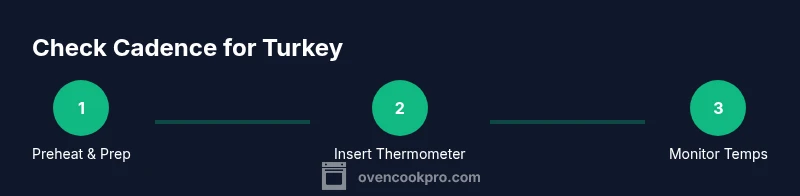
Preheat the oven to your target roasting temperature (commonly 325–350°F, depending on weight and whether the bird is stuffed). While the oven heats, pat the turkey dry and place it on a rack in the roasting pan. This ensures even heat contact and crisp skin. Make sure your thermometer probes are clean and ready for insertion.
Tip: Verify oven temperature with an independent oven thermometer in the center of the oven to avoid false readings. - 2
Position the turkey
Place the turkey breast side up on the rack with the cavity loosely filled or kept empty (unstuffed cooks more predictably). Ensure there is airflow around the bird on all sides for even roasting. If you’re using a pop-up timer, remember it’s not a reliable sole indicator and should be used alongside a thermometer.
Tip: Tie the legs together and tuck the wings to prevent uneven cooking and scorching. - 3
Insert the thermometer correctly
Insert the probe into the thickest part of the thigh, away from bone, ensuring the sensor sits in the center of the meat. If using a thermometer that also monitors the breast, place a second probe toward the thickest part of the breast but avoid touching bone or the pan. Do not let the probe touch the pan, which could skew readings.
Tip: Calibrate the thermometer if your device supports it before starting. - 4
Roast and monitor temperature
Roast the turkey and begin thermometer checks as you approach the expected finish window based on weight and oven conditions. For best results, check every 15–20 minutes in the final phase to catch the moment when the thigh hits 165°F and the breast nears 160–165°F. Avoid opening the oven door too often to minimize heat loss.
Tip: Use a timer and mark readings to track progress; smaller shifts in temp can impact carryover heat. - 5
Finish and rest
When the thigh reads 165°F and the breast is around 160–165°F, remove the turkey and tent loosely with foil. Rest for 20–30 minutes to let carryover heat finish the job and for juices to redistribute. During resting, the internal temperature can rise a few degrees, so plan to pull slightly early if you’re aiming for exactly 165°F in the thigh.
Tip: Keep the bird resting in a warm draft-free area; avoid sealing too tightly which can trap moisture. - 6
Carve and serve
Carve the turkey after resting, starting with the thigh for best moisture distribution. Slice against the grain for tenderness and serve promptly to maintain juiciness. If the turkey seems underdone in some spots, a brief reheat is possible, but rely on thermometer checks to confirm safety before serving.
Tip: Reserve a few minutes to rest the carved meat; it will reabsorb circulating juices for maximum flavor.
Questions & Answers
How often should I check the turkey in the oven?
Check temperatures regularly as you approach the finish window, typically every 15–20 minutes in the final phase. Avoid opening the oven door more often than necessary to keep heat stable.
Check the turkey every 15 to 20 minutes as you near finishing time, and avoid opening the oven door too often.
What is the safe internal temperature for turkey?
The safe internal temperature is 165°F in the thickest part of the thigh. The breast should be around 160–165°F when you pull it, allowing carryover heat to finish during rest.
Aim for 165 degrees in the thigh and 160 to 165 in the breast, then rest to finish.
Should I baste while checking the temperature?
Basting is optional and can impact browning; it does not replace thermometer checks. If you baste, do so quickly and avoid opening the oven too often.
Baste if you like, but don’t rely on it instead of thermometer checks.
Can I rely on color to tell when the turkey is done?
Color is not a reliable indicator of doneness. Rely on thermometer readings in the thigh, breast, and center of stuffing to confirm safety.
No—color isn’t reliable. Use a thermometer in key spots.
What should I do differently if my turkey is stuffed?
Stuffed turkeys take longer to reach safe temps. Verify 165°F in the stuffing center as well as the meat, and adjust total roasting time accordingly.
Stuffed birds need extra time; check the stuffing too.
Is resting always necessary?
Yes. Resting for 20–30 minutes lets juices redistribute and carryover heat finish the cooking, resulting in juicier slices and easier carving.
Resting is essential for juicy turkey.
Watch Video
Main Points
- Check temperature rather than time alone.
- Use a probe thermometer for continuous readings.
- Target 165°F in the thigh; breast warms to 160–165°F with rest.
- Rest 20–30 minutes before carving.
- Stuffed birds require extra caution and verification of stuffing temperature.