How Long to Cook Burgers in the Oven
Discover how long to cook burgers in the oven, with temps, patty sizes, and safe doneness tips. Expert guidance from Oven Cook Pro for juicy, evenly cooked burgers.


To cook burgers in the oven, bake at 375°F for about 12-15 minutes for 1/4-pound patties, and 16-20 minutes for thicker or well-done burgers. Thicker patties require more time; always verify doneness with a meat thermometer to reach 160°F. Preheat the oven and line a sheet with foil for easy cleanup. If you prefer medium doneness, pull earlier and let carryover heat finish.
Understanding Oven Temperatures for Burgers
Cooking burgers in the oven hinges on consistent heat that browns the exterior while gently cooking the interior. According to Oven Cook Pro, predictable results come from starting with the right temperature and a proper preheat. Most home ovens perform well in a range from about 350°F to 425°F (175°C to 220°C). At the lower end (around 350°F / 175°C), burgers tend to stay juicier with a gentler brown, while higher temps (400–425°F / 205–220°C) promote a crustier exterior and faster overall cook time. If you are using a convection setting, reduce the temperature by roughly 25°F (14°C) and rotate your pan halfway through to promote evenness.
Preheating is essential: give your oven about 10 minutes to reach the target temperature before the burgers go in. A wire rack placed over a foil- or parchment-lined sheet helps air circulate around each patty, which improves browning and prevents soggy bottoms from fat pooling. Finally, remember that oven performance varies; don’t rely solely on time — use an instant-read thermometer for accuracy. For safety, the USDA recommends an internal temperature of 160°F (71°C) for ground beef. Carryover heat will continue to raise the temperature, so you may remove patties a touch early if you’re aiming for just-done consistency.
When selecting temperatures, you can tailor results to your preferred setting. If your goal is a fast, crusty exterior with a slightly rarer center, you might start at 400–425°F for a shorter window and then reduce the heat toward the end. For a more uniform doneness with less browning, stick to 350–375°F and pull closer to the upper end of the time range. The key is to monitor doneness with a thermometer rather than judging by color alone, since surface browning can occur even when the center remains underdone. Oven Cook Pro’s approach emphasizes balancing time, temperature, and patty integrity to avoid dry edges or undercooked centers.
In addition to temperature, the choice of ground beef matters. An 80/20 or 85/15 ratio typically yields juicy burgers with a good crust when baked. Seasoning should be simple and can be adjusted to taste; salt and pepper are classic, while garlic powder or paprika adds a hint of warmth. If you’re cheesing burgers, plan to add cheese in the final minute or two of baking to melt without overcooking the patty. With the right temperature strategy, you’ll get well-browned exterior, evenly cooked interiors, and clean, fuss-free cleanup.
Patty Size, Thickness, and Time
Patty size and thickness are the most influential factors in oven cooking time. A standard 1/4-pound patty, roughly 3/4 inch thick, usually finishes in about 12–15 minutes at 375°F. If you prefer thicker burgers (1/2 inch to 1 inch) or larger portions (1/3 pound or more), plan for 16–20 minutes or more, depending on your oven and desired doneness. Always aim for an internal temperature of 160°F (71°C) as the safety benchmark. If you’re cooking multiple patties, space them so they aren’t touching; air needs to circulate for uniform browning. For an extra crust, you can briefly increase the heat to 400–425°F for the first 3–4 minutes, then settle into 375°F for the remainder. This two-stage approach helps form a crust while preserving interior juiciness. Remember, carryover cooking can raise the temperature by a few degrees after removal, so timing your pull just shy of 160°F allows the center to finish with residual heat. Adjustments based on patty composition—leaner meats may dry faster, while fattier blends stay juicier—are common practice in home kitchens. When you experiment, keep notes on patty weight, thickness, and oven performance to refine your personal “perfect burger” profile.
From a practical standpoint, patty formation should be uniform. If edges are thinner than the center, even heat transfer may cause overcooking at the outer ring. Gently press patties to an even thickness, avoid compressing too tightly (which can harden the texture), and refrigerate briefly before baking to help them keep shape. Firmly formed patties stand up to the oven’s heat and yield a consistent bite from edge to center. If you’re short on time, single-layer patties on a baking sheet without a rack will still bake well, but the fat won’t drain away as efficiently, which can lead to a softer crust. In short, preparation matters as much as temperature.
If you’re cooking a batch for kids or guests with varying preferences, consider labeling patties with different doneness levels on a tray so you can remove the desired portions at different times. This approach helps you deliver consistent results for everyone at the table.
Safety, Doneness, and Thermometer Tips
Food safety guidance emphasizes verifying doneness with a thermometer rather than relying solely on color or time. Ground beef should reach an internal temperature of 160°F (71°C) for safety. Oven cooking can yield carryover heat, so you may pull burgers a few degrees before hitting the target to account for residual heat. A quick tip is to insert the thermometer into the center of the patty, away from the edges, to gauge the true internal temperature. If you’re cooking cheese-topped burgers, apply cheese during the last minute or two of baking so it melts without overcooking the patty itself. For all patty sizes, avoid pressing down on the burgers while they bake; this pushes flavorful juices out and can dry the interior.
Besides the thermometer, a visual cue can help: the juices should run clear and not pink at the center when the temperature has been reached. If you’re unsure about doneness, use a second method (touch test or a second thermometer reading) to confirm. Always practice kitchen safety: use oven mitts, place the tray on a heat-safe surface, and don’t leave the oven unattended when you’re still a few minutes away from serving. If you’re cooking for a crowd, you can bake patties in shifts, keeping finished burgers warm in a low oven (around 200°F / 93°C) or tented with foil. Remember that even if you remove the patties at 160°F, the interior may achieve this temperature faster in smaller patties and slower in larger ones due to ambient heat and patty density.
Oven Cook Pro emphasizes that consistency is the key to reliable results. Temperatures matter, but timing, patty thickness, and resting after baking combine to produce a burger that’s juicy on the inside with a pleasing crust on the outside. If you want to tailor to guest preferences, consider offering a small tasting plate with buns and toppings to let guests build their preferred burger experience while you monitor doneness.
Finally, use quality buns and toppings to enhance the overall eating experience. A good bun can hold together even a hot, juicy burger; toppings like lettuce, tomato, onions, pickles, and a stable sauce can complement the burger without overwhelming its flavor. With careful attention to temperature, thickness, and doneness, oven-baked burgers can rival grilled versions for convenience and consistency.
Common Mistakes and How to Avoid Them
Baking burgers in the oven is straightforward, but a few common missteps can derail your results. Avoid overcrowding the pan; when patties are too close, they steam rather than brown, resulting in a pale crust. Use a wire rack on a foil-lined sheet or parchment-lined sheet so fat can drain away and air can circulate. Skipping preheating is another frequent mistake; preheating ensures the exterior sears quickly, forming a crust and locking in juices. If you under-season, you’ll miss flavor; even a simple salt-and-pepper blend can make a big difference, so season generously right before cooking. Overhandling the meat leads to dense, compact patties that will feel firm rather than tender. Form patties gently and avoid pressing them flat. Lastly, relying solely on time can be misleading due to oven variation; always measure temperature to confirm doneness. If you want a chewier bite or a faster cook time, adjust to a higher temperature briefly, but monitor closely to prevent burning on the outside while the inside remains underdone.
To improve consistency, create a small testing batch when you first start using your oven for burgers. This allows you to calibrate time and temperature with your specific oven model. Keeping a simple log—weight/size of patties, oven setting, time, and internal temperature—helps you reproduce your best results more quickly on subsequent cooks. If you’re cooking for guests who prefer a rare or well-done burger, you can prepare multiple trays with slight timing variations to accommodate everyone without sacrificing quality. Finally, always prioritize food safety by practicing proper handling of raw meat, washing hands and surfaces frequently, and using clean utensils to avoid cross-contamination.
Putting It All Together for Juicy Oven-Baked Burgers
With the right temperature, patty size, and doneness checks, oven-baked burgers can be consistently delicious. The key is to harmonize the heat with the patty’s thickness and fat content, monitor internal temperature, and rest briefly before serving for a juicy finish. Practice makes progress; start with standard patties, note your results, and adjust the time or temperature as needed for your oven and preferred level of doneness. This method aligns with Oven Cook Pro’s guidance on balancing time, temperature, and technique to achieve reliable, tasty results in the comfort of your own kitchen.
Tools & Materials
- Baking sheet or shallow pan(Foil or parchment lining recommended for easy cleanup)
- Wire rack (optional but preferred)(Elevates patties for even air circulation)
- Aluminum foil or parchment paper(Helps with cleanup and fat management)
- Meat thermometer(Thermometer should read 160°F internal temperature)
- Spatula or tongs(Gentle handling to avoid breaking patties)
- Oven-safe gloves or mitts(For handling hot trays safely)
- Seasoning: salt, pepper, optional spices(Classic is salt and pepper; add garlic powder, paprika if desired)
Steps
Estimated time: 25-40 minutes
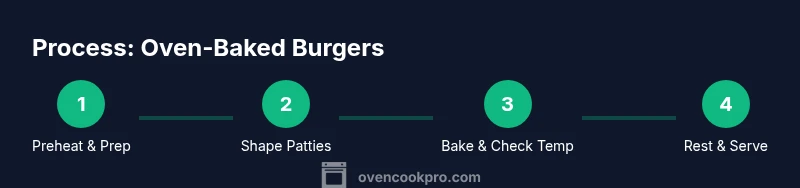
- 1
Preheat the oven and prep workspace
Set the oven to 375°F (190°C) and allow 10 minutes to reach temperature. Line a baking sheet with foil or parchment and place a wire rack if you have one. Gather patties, seasonings, and a thermometer so everything is ready for cooking.
Tip: Preheating ensures the crust forms quickly on contact with the patties. - 2
Shape patties evenly and season
Form patties approximately 3/4 inch thick, using about 1/4 pound of ground beef per patty. Season both sides generously with salt and pepper, plus any preferred spices. Avoid handling too much to keep the patties tender.
Tip: Even thickness ensures uniform cooking from edge to center. - 3
Arrange patties on rack/foil-lined sheet
Place patties on the rack or sheet with space between them for air circulation, which helps browning. If using a rack, the fat will drain away from the patties, reducing sogginess.
Tip: Spacing matters; crowded patties steam rather than brown. - 4
Bake and monitor internal temperature
Bake for 12–15 minutes for 1/4-pound patties at 375°F; add 3–5 minutes for thicker patties. Insert a meat thermometer into the center of a patty; aim for 160°F (71°C). Carryover heat may raise the temp slightly after removal.
Tip: If you want cheese, add in the last 1–2 minutes and let it melt. - 5
Rest briefly and serve
Let the burgers rest 3–5 minutes after removing from the oven to reabsorb juices. Serve on toasted buns with your favorite toppings and condiments.
Tip: Resting improves juiciness and flavor distribution.
Questions & Answers
What temperature should I bake burgers in the oven?
Common practice is 375°F (190°C) for standard patties, with 350–425°F as options depending on desired doneness and crust. Convection users should reduce the temp by about 25°F.
Bake burgers at about 375 degrees, adjusting for doneness and convection if applicable.
How does patty thickness affect cooking time?
Thicker patties require longer cooking times, while thinner patties cook faster. Plan roughly 12–15 minutes for 1/4-pound patties at 375°F, longer for thicker burgers.
Thicker patties need more time; check doneness with a thermometer.
When should I flip the burgers?
Flip halfway through baking to promote even browning on both sides and prevent one side from overcooking.
Flip once halfway through baking for even browning.
Is it safe to eat burgers cooked in the oven?
Yes. Ensure the internal temperature reaches 160°F (71°C) for ground beef. Allow for a brief rest after removal for juiciness.
Make sure they reach 160 degrees internal, then rest briefly.
Can I cook frozen burger patties in the oven?
Yes, but expect longer cooking times and ensure the patties reach 160°F internal temperature.
Yes, but you’ll need more time and careful temperature checking.
Should I rest burgers after baking?
Resting for 3–5 minutes helps redistribute juices and improves texture.
Let them rest a few minutes before serving.
Watch Video
Main Points
- Preheat, then bake patties evenly spaced for best browning.
- Patty thickness directly affects cooking time and doneness.
- Always verify 160°F internal temperature with a thermometer.
- Carryover heat continues after removal—plan to pull early if needed.
- Season simply and rest briefly for juicier results.