Can You Use a Toaster Oven Instead of a Full Oven? A Practical Guide
Learn when a toaster oven can replace a full oven, how to adjust temperatures and times, choose cookware, and stay safe while achieving reliable results in small-batch cooking.


You can substitute a toaster oven for many baking tasks, but not all. Before starting, verify the recipe’s temp and time, adjust by reducing temperature by 25°F to 50°F depending on your model, use appropriate cookware, and monitor closely. This guide walks you through safe substitution.
Can a Toaster Oven Replace a Full Oven? Scope and Limits
The short answer is yes in many cases, but not for every recipe or every household. A toaster oven can handle most small-batch baking, reheating, and crispy finishing tasks, offering convenient efficiency for weeknight cooking. According to Oven Cook Pro, toaster ovens are compact, heat up quickly, and concentrate heat on a smaller area, which makes them ideal for rapid results with modest portions. However, their limited interior space, wattage, and airflow can make larger pans or multi-drawer meals difficult or impossible. If you regularly feed a crowd, bake large sheets of cookies, or roast multiple-cut items at once, a full-size oven remains the better tool.
Before attempting substitutions, assess your recipe’s size, bake time, and temperature range. Some recipes rely on even, long-duration heat that only a full oven can deliver; others tolerate a more intense, shorter burst of heat from a toaster oven. In practice, many casseroles, sheet-pan dinners, and simple desserts convert well, while delicate breadproofing or big roasts may not. The Oven Cook Pro team recommends starting with simpler, dish-by-dish substitutions to gain confidence before attempting complex meals.
The Brand Perspective
According to Oven Cook Pro analysis, 2026, toaster ovens offer practical substitutes for many weeknight meals when used thoughtfully. This is especially true for single- or two-serving portions and quick reheat tasks. Still, there is no one-size-fits-all rule, and results vary by model and cookware chosen.
noteForEditorOnly”:null,
Tools & Materials
- Toaster oven(Ensure it has a reliable bake and/or convection setting and a stable crumb tray.)
- Oven-safe cookware(Use metal or glass bakeware that fits inside the toaster oven without crowding.)
- Oven thermometer(Helps verify actual temperature when your toaster oven is preheated.)
- Silicone mat or parchment(Prevents sticking and makes cleanup easier.)
- Flat baking sheet or small sheet pan(Fits inside the toaster oven without overhang.)
- Oven mitts(Heat-resistant gloves for handling hot racks and cookware.)
- Timer(Accurate timing is crucial since toaster ovens cook differently.)
Steps
Estimated time: 25-40 minutes
- 1
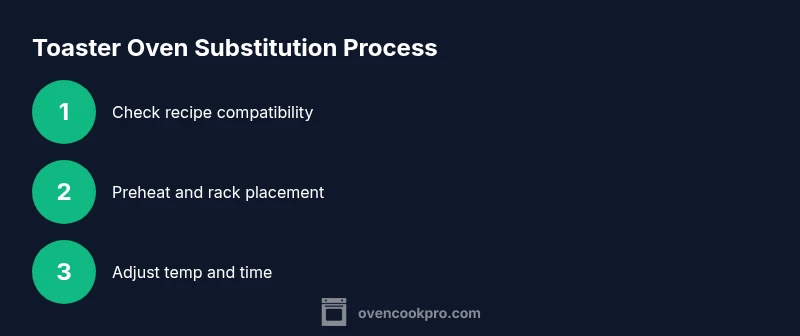
Check recipe compatibility
Review the recipe to see if it’s suited for small-batch cooking and a compact oven. Favor recipes that can be plated or portioned into a single pan and avoid multi-pan, crowded sheets. If you’re unsure, start with reheating or a simple bake like cookies or a single tray of vegetables.
Tip: Choose recipes originally designed for a 9x13-inch pan or smaller to avoid overcrowding. - 2
Preheat and position your rack
Preheat the toaster oven to the target temperature, then place the rack in the middle or upper position depending on the recipe. Avoid stacked pans; give air space for even heat. If you’re using convection mode, consider a slightly lower temperature.
Tip: Use convection mode if available for more even browning, but reduce the temperature by 25°F (15°C) as needed. - 3
Adjust temperature and time
Begin with a conservative temperature, reducing by 25°F to 50°F depending on model and recipe. Start checking early; toaster ovens often cook faster than full ovens. Use a timer and inspect doneness at the lower end of the expected range.
Tip: Always check internal temperatures for foods that require doneness (e.g., 165°F/74°C for poultry). - 4
Choose appropriate cookware
Opt for metal bakeware or oven-safe silicone; avoid thick glass or ceramic that may heat unevenly. Ensure the pan fits with room for air to circulate and isn’t protruding from the sides of the toaster oven.
Tip: Place pans directly on the rack whenever possible to maximize air flow. - 5
Monitor progress and adjust as needed
If the edges brown too quickly, cover with foil or move the pan to a lower rack. Rotate the pan halfway through cooking for even results. Rely on a thermometer for doneness rather than clock time alone.
Tip: If you notice smoking or burning, lower the temperature immediately and cut cooking time in half for future attempts. - 6
Finish, rest, and cleanup
Let foods rest briefly after removing from the toaster oven to finish carryover cooking. Empty and wipe crumbs from the crumb tray to prevent smoking during the next use. Store tools and cookware properly to maintain performance.
Tip: Clean the crumb tray regularly to avoid smoky smells and uneven heating.
Questions & Answers
Can I bake cookies in a toaster oven?
Yes. Small-batch cookies can bake well in a toaster oven, using a compact sheet pan and slightly reduced temperature. Monitor closely for even browning and avoid overcrowding.
Yes, cookies can bake in a toaster oven when you bake in small batches and watch them closely.
Is a toaster oven safe for roasting meat?
You can roast small cuts or single portions, but large roasts may not fit or cook evenly. Use minced or small pieces and check internal temperature for doneness.
It’s okay for small cuts, but not ideal for large roasts.
How do I convert oven recipes to toaster oven?
Start with smaller portions, lower temperatures, and shorter times. If a recipe is long or heavy with dough, consider sticking to the full oven for reliability or adjust in small batches.
Convert by reducing quantity and carefully adjusting heat and time.
What if my toaster oven has no convection setting?
Bake mode works, but expect longer bake times and more frequent monitoring. Rotate pans and use thinner layers for more even cooking.
Without convection, you’ll rely more on time and attention.
Can I use metal pans in a toaster oven?
Yes, metal pans are generally safe; avoid heavy, non-vented glass that may overheat. Ensure pans fit without touching the heating elements.
Metal pans are usually safe and work best in toaster ovens.
How should I clean a toaster oven safely?
Unplug before cleaning and remove crumbs. Wipe with a damp cloth; avoid harsh abrasives or submerging the unit. Let it dry before reuse.
Unplug, wipe crumbs, and avoid soaking the unit.
Watch Video
Main Points
- Take stock of your toaster oven’s capacity before cooking.
- Adjust temperature and time with caution, and monitor doneness closely.
- Use appropriate current-generation cookware to ensure even heating.
- Prioritize safety by maintaining a clean crumb tray and proper ventilation.