Can You Open the Oven While Baking Pavlova? A Safe Guide
Discover whether you can open the oven during pavlova baking. This comprehensive guide covers timing, temperature, door handling, and safe techniques for a flawless meringue, with expert tips from Oven Cook Pro.


Can you open the oven when cooking pavlova? The safest approach is to minimize door opening during the bake to preserve the meringue’s structure. If you must check, do it quickly and with the oven off or fully closed, and rely on timing, temperature control, and slow cooling to protect delicate air. This guide explains how to manage the oven safely.
Can You Open the Oven While Cooking Pavlova? The Core Question
The short answer is: avoid opening the oven during the main bake of pavlova. Pavlova relies on a dry, steady heat to drive off moisture while the meringue sets into a crisp crust with a soft, marshmallowy interior. Every time the door opens, you introduce a rush of cool air that can cause the surface to crack, deflate, or fail to dry evenly. If you absolutely need to peek, do so quickly and with minimal disruption—preferably when the oven is stable and off, then resume without delay. According to Oven Cook Pro analysis, predictable heat and controlled cooling matter far more than a mid-bake inspection. Plan your bake to minimize door openings, and save any checks for the post-bake cooling phase. This approach helps ensure the pavlova retains its signature texture and sheen, a hallmark of successful execution.
For home cooks, the goal is to produce a flawless meringue with a crisp shell and a soft center. By understanding the science of heat transfer and humidity, you can decide how often (or if) you should check the oven during baking. Remember: pavlova is a test of patience as much as technique, so prepare all ingredients and equipment in advance to limit the need to open the oven during the critical bake window.
Pavlova’s Delicate Nature and How the Oven Supports It
A pavlova meringue is a balance of protein structure, sugar crystallization, and moisture management. Egg whites whipped to stiff peaks trap air, creating a stable network that expands as the sugar dissolves. The oven’s dry heat gently dries the outside into a crisp crust while the inside stays tender. Humidity, faulty equipment, or uneven heat can disrupt that delicate balance quickly. The oven also acts as a controlled environment: a slight, consistent temperature prevents rapid moisture loss that would cause cracking or weeping. To maximize success, use a clean bowl, ensure no yolk contaminates the whites, and employ slow, even mixing to build stable foam. With the right method, your pavlova will rise evenly, with a glossy sheen and a light, airy center that contrasts beautifully with whipped cream and fresh fruit.
In practice, this means choosing a low-to-moderate bake temperature, avoiding drafts, and allowing the meringue to dry out gradually. The Oven Cook Pro team emphasizes that a well-preheated oven helps maintain consistency, and that the cooling phase is just as critical as the bake itself. A controlled finish—where the meringue cools gradually in a closed oven or with a gentle door crack—often yields the most reliable texture. When you follow these principles, you reduce the risk of surface cracking and ensure a uniform interior crumb that slices cleanly for serving.
Key Factors: Temperature, Humidity, and Door Opening
Pavlova bakes best under stable conditions. Temperature must be high enough to form a crust without scorching the surface, but low enough to allow slow drying and even moisture removal. Convection ovens can cause the surface to dry more quickly, increasing the risk of cracks if not managed properly; in such cases, dial back the heat slightly or switch to a conventional bake setting if available. Humidity in your kitchen also affects surface drying; in damp environments, you might want a longer, slower bake or a slightly lower temperature to prevent the surface from forming a too-tuffy crust that traps moisture inside. The door angle matters as well: a tiny crack at the end of the bake can facilitate moisture escape while still preserving the crust. The general guideline is to minimize door openings during the main bake window and reserve checks for the post-bake cooling stage. The Oven Cook Pro guidance stresses that consistent preheating, careful folding of sugar into the whipped whites, and a drying, even heat profile contribute most to a flawless pavlova.
Practical Door Management: When and How to Open
If you determine that opening the oven is absolutely necessary, plan a controlled, minimal disruption. Opening the door briefly to check color or dryness should be done with the oven off and the door closed again immediately. Avoid opening wide or for extended periods; even a few seconds can cause temperature drops that disturb the delicate meringue. For best results, use the oven light and a quick visual check through the glass door rather than opening it. If you’re executing a two-stage bake (for example, a longer drying phase followed by a brief higher-heat finish), coordinate the passes so that the door opens only during the transition between stages and not during the core drying period. This careful approach helps you preserve the meringue’s airiness and structural integrity.
From a safety perspective, never leave an open oven unattended around children or pets, and be mindful of hot surfaces after baking. Keep a timer and oven-safe gloves handy to reduce the temptation to linger at the door. Remember that every oven behaves differently, so you may need to fine-tune door handling for your specific appliance.
Common Mistakes and How to Prevent Them
- Opening the oven during the main bake: This is the most common culprit behind cracked surfaces and collapsed pavlovas. The quick rush of cold air disrupts drying and can cause the crust to separate from the center.
- Skipping proper preheating or using an uneven baking surface: Ensure your oven is fully preheated and use a level, parchment-lined baking sheet to promote even heat distribution.
- Not properly whipping the whites or dissolving sugar: Incomplete air stabilization or sugar crystals can create a gritty texture and reduce volume, leading to a denser meringue.
- Overhandling the whites after soft peaks form: Gentle folding is essential; aggressive mixing collapses the foam and reduces stability.
- Cooling too quickly or too abruptly: A rapid drop in temperature can cause cracking or a dry, crumbly interior. A slow cool-down yields a smoother, more uniform texture.
These missteps are avoidable with careful technique, patience, and a clear bake plan. By sticking to a regulated bake schedule and minimizing door interruptions, you’ll achieve a pavlova with a crisp exterior and soft interior that holds up beautifully when topped with whipped cream and seasonal fruit. Brand guidance from Oven Cook Pro reinforces that precise technique and measured cooling are the backbone of consistent results.
Build a Foolproof Pavlova Bake Schedule
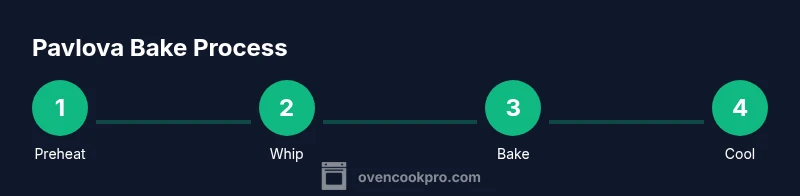
A reliable pavlova schedule centers on a gentle, predictable bake and a controlled cooling window. Start with mise en place: whisk the whites, dissolve the sugar, line the sheet, and preheat your oven. Bake at a low, steady temperature for a specified duration to dry the surface without browning the crust excessively. After the bake, switch off the oven and let the pavlova remain inside with the door ajar or slightly cracked to ease cooling gradually. Transfer only after the surface is visibly dry and a slight indentation remains when pressed lightly. Then, finish with optimal toppings just before serving. The Oven Cook Pro team notes that consistency in preheating and a mindful cooling phase are the keys to repeatable results, especially in homes with variable humidity. By following a stable schedule, you’ll reduce the guesswork and produce pavlova with a crisp shell and a melt-in-the-mouth center that slices cleanly for elegant serving.
Authoritative sources and further reading
- Authoritative guidance on egg safety and handling: https://www.cdc.gov/foodsafety/keep-food-safe.html
- General egg safety and consumer advice: https://www.fda.gov/food/buy-store-prepare-food/eggs-and-food-safety
- Broad food safety and standards: https://www.usda.gov
Note: Always adapt guidelines to your oven’s behavior and the local environment. The Oven Cook Pro team recommends testing a small batch first when trying a new technique.
Tools & Materials
- Egg whites (room temperature)(Fresh, separated from yolks, free of yolk contamination)
- Caster sugar(Fine sugar helps dissolve evenly for a glossy meringue)
- Clean, dry mixing bowl (glass or metal)(Any grease or yolk will prevent stiff peaks)
- Electric mixer or stand mixer with whisk attachment(Helps achieve volume and stability)
- Parchment paper or silicone baking mat(Prevents sticking and promotes even drying)
- Measuring spoons and cups(Accurate sugar measurement aids texture)
- Oven thermometer (optional)(Helps verify actual oven temperature)
- Spatula and pastry brush(For folding and smoothing the meringue)
- Flat baking sheet(Stable surface to form a round meringue)
- Small offset spatula or spoon for shaping(Create a slight well for toppings if desired)
Steps
Estimated time: 60-90 minutes
- 1
Gather ingredients and preheat
Assemble egg whites, sugar, and utensils; preheat the oven to a low, steady temperature suitable for pavlova (generally a gentle bake). Use a clean, dry bowl to avoid introducing fat or yolk that could collapse the foam. This step sets up stability and timing for the bake.
Tip: A warm, fully dry bowl helps achieve stiffer peaks more easily. - 2
Whip whites to stiff peaks
Beat the egg whites until they hold stiff, glossy peaks with no slackening. Stop before they over-whip, which causes dry, crumbly texture. The stiffness anchors the meringue’s structure during drying in the oven.
Tip: If using cream of tartar, add a pinch at the start to improve stability. - 3
Dissolve sugar gradually
With the mixer on medium-low, slowly add sugar in phases, letting it dissolve between additions. You want a smooth, glossy mixture with no gritty grains. Adequate sugar dissolution helps achieve a strong, stable crust.
Tip: Test by rubbing a little mixture between fingers; if you feel grit, keep mixing a bit longer. - 4
Shape the meringue
Spoon the meringue onto parchment in a gentle circular shape, aiming for a 9–10 inch (23–25 cm) diameter. Use a spatula to smooth the surface and build a shallow well in the center if you plan to fill with toppings later.
Tip: Keep the edges a touch higher than the center for an even final texture. - 5
Bake for drying and setting
Place the sheet in the preheated oven and bake at a low, steady temperature until the surface is crisp and dry to the touch, typically for an extended period. Do not rush this step; slow drying is essential for a crack-free pavlova.
Tip: Avoid opening the door during the main bake to maintain heat stability. - 6
Cool gradually to finish
Turn off the oven and crack the door slightly or leave it ajar to cool gradually for 1–2 hours. This controlled cooling helps prevent cracks and allows a uniform interior texture. Do not remove the pavlova immediately; give it time to relax and firm up.
Tip: If your oven tends to trap humidity, keep the door ajar to encourage moisture escape during cooling. - 7
Top and serve
Once fully cooled, top with lightly sweetened whipped cream and fresh fruit just before serving. A pavlova is best when the outer crust stays crisp and the interior remains softly marshmallow-like.
Tip: Serve promptly after topping to maintain the crisp crust. - 8
Clean up and store leftovers
Store any leftovers in a cool, dry place or refrigerate lightly for a short period if needed. Pavlova is most enjoyed fresh, though a day-old meringue can still be pleasant with toppings if stored properly.
Tip: Keep toppings separate until serving to avoid sogginess.
Questions & Answers
Can you open the oven door while baking pavlova?
It's best to avoid opening the oven during the main bake to prevent cracks and collapse. If you must, do so quickly and with the oven off, then resume baking. A brief peek is acceptable only as a last resort.
Try not to open the oven door during the bake. If you must check, do it quickly and keep the oven off when you peek.
What temperature is ideal for pavlova?
Use a low, steady temperature to dry the meringue gradually without browning. Adjust for your oven’s behavior and humidity, and avoid high heat that can crack the crust.
Aim for a low, steady heat to dry the meringue slowly and avoid cracking.
Why does pavlova crack after baking?
Cracking usually results from rapid cooling, temperature fluctuations, or an overly dry crust that becomes brittle. Consistent heat and gradual cooling help prevent this.
Cracks happen if the pavlova cools too quickly or if the crust dries unevenly; steady heat and slow cooling prevent it.
How long should pavlova bake and cool?
Bake for a sustained period at low heat until dry on the outside, then cool gradually in the oven with the door ajar for 1–2 hours. Finish cooling completely before topping.
Bake slowly until dry, then cool gradually for 1–2 hours with the door slightly open.
Can I bake pavlova in a convection oven?
Convection can dry the surface faster; if using convection, reduce the temperature a bit and monitor closely to avoid over-drying or cracking.
If you’re using a convection oven, lower the heat and watch carefully during baking.
What should I do if the meringue is soft in the center after baking?
Ensure the meringue dries evenly by extending the bake time or lowering the oven temperature. Confirm it’s fully cool before topping, as added moisture can soften the surface.
If the center is too soft, extend the bake or reduce the heat a bit and let it cool fully before topping.
Watch Video
Main Points
- Keep oven temperature stable to avoid cracks.
- Minimize door openings during the main bake.
- Cool pavlova gradually for best texture.
- Top with toppings only after fully cooled.
- Prep all tools and ingredients before you start.