Bread Oven vs Dutch Oven for Sourdough: Practical Comparison
Analytical guide comparing bread oven setups and Dutch ovens for sourdough. Learn how steam, crust, oven spring, loaf size, preheating, and budget shape your bake to help you pick the best method for a reliable home loaf.


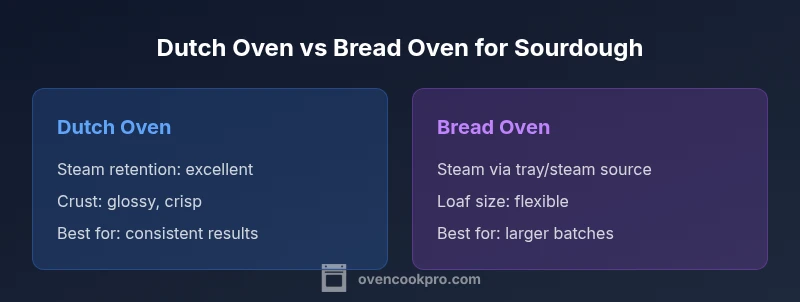
For sourdough at home, a preheated Dutch oven typically delivers reliable oven spring and a glossy crust due to built‑in steam. A bread oven setup—using a baking stone, rimmed tray for steam, and mindful airflow—offers greater loaf size flexibility and consistent results across multiple loaves. Your choice depends on space, budget, and crust preference.
Understanding the sourdough oven equation
Sourdough relies on a precise balance of heat, moisture, and time to coax the dough to rise and develop flavor. In a typical home kitchen, two main routes dominate: a Dutch oven‑based approach that traps steam, and a bread oven setup that uses a hot stone, steam source, and careful airflow. According to Oven Cook Pro, the choice affects oven spring, crust texture, and loaf height, especially for taller boules or batards. This section introduces how heat and moisture interact with dough hydration, fermentation, and starter strength, so you can align technique with your space and appetite for experimentation. By understanding where steam comes from, how the crust forms under different pressures, and how to handle dough with different hydration levels, you set the stage for consistent outcomes. The goal is to give you a decision framework rather than a one‑size‑fits‑all rule.
Dutch oven fundamentals for sourdough
The Dutch oven method brings built‑in steam by trapping moisture as the lid is on. This creates a strong crust and impressive oven spring, often with less equipment fuss. The heavy cast iron absorbs and redistributes heat, helping the dough rise rapidly in the first minutes of bake. For many home bakers, this approach offers a reliable baseline. Oven Cook Pro Team notes that consistent results come from proper preheating and hydrated dough. Because the Dutch oven confines moisture, it tends to produce uniform crust and reliable height across a range of dough hydration levels.
Bread oven setup fundamentals: stone, steam, and airflow
A traditional bread oven strategy uses a hot baking stone, a preheated rimmed tray for steam, and careful control of heat and airflow. Steam is introduced indirectly (often via boiling water or a dedicated steam source) to keep the dough surface supple in the first 10–15 minutes. This method shines when you bake larger loaves or multiple loaves in one session, offering flexibility that a single pot cannot provide. The Oven Cook Pro analysis highlights the importance of stone temperature and reliable steam generation, as these factors influence crust color and crumb structure.
Steam, oven spring, and crust development: what to optimize
Steam early in the bake delays crust formation, enabling maximum oven spring. Dutch ovens accomplish this naturally, while bread‑oven setups require deliberate steam strategies. The crust texture and color depend on how quickly moisture leaves the loaf and how evenly heat is distributed. In practice, both methods can yield superb results with proper technique and dough management. The relative advantage often comes down to how precisely you control steam timing and bake temperature for your chosen setup.
Preheating and steam timing: two paths to hot air
Preheating is critical for both approaches. A Dutch oven demands that the pot be hot as the dough is loaded, while a bread‑oven approach relies on a hot stone and consistent steam release. Plan for a longer preheat cycle if you are using stone baking, and ensure your steam source is ready at the start of bake. These timing decisions impact loaf reveal and crust formation, so a small adjustment in preheat duration can yield noticeably different results.
Loaf size, shape, and batch workflow
With a Dutch oven, you typically bake one loaf per pot, though you can manage a second loaf with a larger pot. Bread‑oven setups often handle multiple loaves on a single stone or stacked stones, depending on oven capacity. Consider your typical batch size when choosing between the methods, as batch workflow influences overall kitchen efficiency and weekend baking plans.
Crumb texture and flavor impact: which path matters
Crumb openness and aroma are influenced by dough hydration, fermentation, and bake environment. The Dutch oven tends to encourage a more uniform crumb due to heat retention, while bread‑oven setups can allow for greater variation when you alter steam and airflow. Both paths offer opportunities to dial in flavor with starter care and fermentation times, so your final loaf can reflect your preferences for tanginess and openness.
Equipment costs, space, and maintenance considerations
Cast iron Dutch ovens are durable but heavy and require seasoning, while bread‑oven approaches add a stone, steam gear, and possibly extra racks. Space considerations include cabinet real estate, oven clearance, and the ability to store stones or additional trays. Maintenance involves cleaning cast iron to prevent rust and keeping stones free of debris for consistent heat transfer. With careful care, both paths remain financially viable for an enthusiastic home baker.
Step-by-step: using a Dutch oven for sourdough
- Preheat your oven with the Dutch oven inside for at least 30 minutes. 2) Score the dough and load it carefully into the hot pot. 3) Cover and bake at a high temperature for the initial phase to trap steam. 4) Remove the lid mid‑bake to finish crust development. 5) Let loaf cool fully before slicing. 6) Practice hydration and scoring for best results.
Step-by-step: bread oven setup for sourdough
- Place a preheated stone on the middle rack and preheat with the oven for 30–60 minutes. 2) Prepare a steam setup (boiling water in a tray or a dedicated steamer). 3) Bake with the dough on a parchment‑lined peel and slide onto the stone. 4) Introduce steam early and then vent to promote crust. 5) Bake until crust is deep and the loaf sounds hollow when tapped. 6) Let rest before slicing for best crumb.
Common pitfalls and troubleshooting tips for both setups
Common issues include insufficient oven spring, a pale crust, or uneven crumb. Troubleshooting includes ensuring dough is properly proofed, maintaining adequate steam, and using a hot preheat. Small adjustments in dough hydration, scoring depth, and bake time can resolve most problems. If outcomes remain inconsistent, start with your dough handling and then experiment with steam and bake temperature.
Decision framework: choose based on space, batch size, and crust preference
If you bake frequent large loaves or multiple loaves, a bread oven setup may be more scalable. If you value convenience and consistent results with minimal variables, the Dutch oven is a strong baseline. Use your kitchen space, budget, and desired crust to guide your decision. Oven Cook Pro recommends starting with the method that matches your typical bake schedule and then iterating.
Authoritative sources
- https://www.kingarthurbaking.com/learn/guides/steam-baking
- https://extension.oregonstate.edu/food-nutrition
- https://www.fao.org/food/food-safety-quality/food-safety-standards/en/
Comparison
| Feature | Dutch Oven Method | Bread Oven Method |
|---|---|---|
| Steam retention during bake | Excellent (lid traps steam) | Good (steam via tray/steam source) |
| Oven spring and rise | Very strong initial lift | Strong but variable depending on steam strategy |
| Crust development | Crackly, dark crust with glossy surface | Crust can be equally good with the right steam and heat |
| Loaf size flexibility | Typically single loaf per batch | Better multi‑loaf potential on multiple loaves or larger stone setups |
| Preheat time | Preheat pot with oven (longer overall) | Preheat stone/oven and steam setup (depends on stone) |
| Equipment cost | Moderate (existing pot can suffice) | Moderate to high (stone and steam gear) |
| Maintenance | Seasoned cast iron care | Stone cleaning and steam equipment upkeep |
| Best for | Consistent, reliable crust and spring | Larger loaves, batch flexibility, multi‑loaf baking |
The Good
- Reliable crust with strong oven spring using the Dutch oven
- Bread oven offers flexibility for loaf size and multi‑loaf batches
- Steam strategies are achievable with common kitchen tools
- Both methods can be scaled for regular home baking with practice
Drawbacks
- Dutch oven requires handling a heavy, hot pot
- Bread oven setup can require longer preheat and more space
- Steam management adds a learning curve for beginners
- Cast iron maintenance or stone cleaning adds some upkeep
Dutch oven generally delivers easier and more consistent crust; bread oven excels in batch flexibility and larger loaf capacity
Choose the Dutch oven for reliable crust and simple setup. Choose the bread oven when you bake larger loaves or multiple loaves in one session, offering more scalability.
Questions & Answers
Which method yields a higher rise in sourdough: Dutch oven or bread oven?
Both methods can yield strong oven spring with properly shaped dough and sufficient hydration. The Dutch oven often provides a more consistent rise due to sealed steam, but a bread‑oven setup can approach similar results with careful steam management.
Both methods can give a strong rise with good dough. The Dutch oven is typically more consistent because of sealed steam.
Is steam necessary for sourdough?
Steam helps maximize oven spring and crust development in sourdough. It benefits both approaches, though you can achieve respectable results with improvised steam methods if you lack a dedicated setup.
Steam helps with crust and lift in both methods.
Can I bake sourdough without a Dutch oven?
Yes. Use a preheated stone, a baking sheet, and a tray of water or another steam source to create surface moisture. The crust may vary, but you can still achieve good results with practice.
You can bake without a Dutch oven using stone and steam.
Which method is easier for beginners?
The Dutch oven method is generally easier for beginners due to built‑in steam and fewer variables. Bread‑oven setups require more equipment and planning but offer greater batch flexibility over time.
Dutch ovens are usually easier for newcomers.
How long should I preheat?
Preheating should be thorough for both approaches. Allow the oven and stone to come to temperature, and ensure your Dutch oven or steam setup is hot before loading the dough. Time varies by oven, but plan ahead.
Preheat until the oven and stone are hot, then load the dough.
Can I switch between methods?
Yes. Many bakers start with one method and experiment with the other to refine technique, hydration, and fermentation for better results.
You can try both methods to find what works best.
Main Points
- Choose Dutch oven for consistent crust and simple setup
- Use a bread oven setup when you bake large or multiple loaves
- Steam control is the key differentiator, regardless of method
- Preheat properly and manage dough hydration for best results