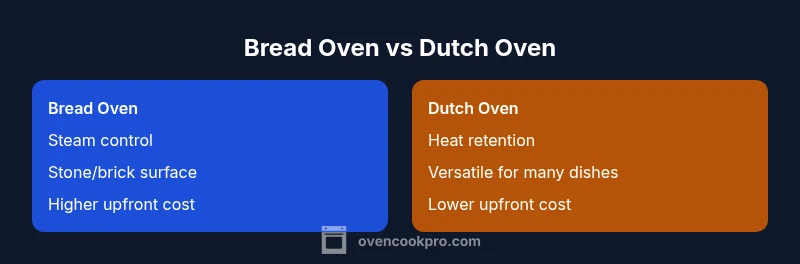
Bread Oven vs Dutch Oven: Which Is Best for Bread Baking?
A thorough, objective comparison of bread oven and Dutch oven for home bakers. Explore steam, heat, versatility, and maintenance to decide which tool matches your bread goals.


Bread oven vs Dutch oven: for bread baking, a dedicated bread oven with built‑in steam usually delivers bakery‑quality crust and oven spring, while a Dutch oven offers near‑bakery results with far less space and expense. The choice hinges on your bread goals, kitchen size, and budget: favor a focused steam system for artisan loaves or opt for a versatile, compact Dutch oven for daily baking. This comparison covers steam management, heat distribution, and practical tradeoffs to help you decide.
Bread Oven and Dutch Oven: Foundations and Function
In the realm of bread baking, two popular tools sit on the counter: a dedicated bread oven and a classic Dutch oven. A bread oven is typically engineered to deliver controlled humidity and precise heat, often with a stone, brick, or ceramic baking environment that stabilizes temperatures and generates steam through built‑in methods. A Dutch oven is a heavy cast‑iron pot with a snug lid that traps moisture and heat, creating a mini steam chamber inside. The core difference is architectural: the bread oven aims to optimize a steam‑rich atmosphere over a longer bake, while the Dutch oven relies on trapped moisture and strong metal heat retention to mimic that effect in a simpler setup. The bread oven tends to be bulkier and more expensive, but it offers a more consistent, repeatable crust and oven spring for artisan loaves. The Dutch oven, by contrast, is compact, widely available, and astonishingly effective for a wide range of breads and even other dishes. For most households, the decision boils down to space, budget, and the bread outcomes you value the most.
Oven Cook Pro’s guidance emphasizes aligning equipment with your bread goals. If you bake frequently and crave bakery‑quality crust, a dedicated bread oven can be a wise long‑term investment. If you want versatility with minimal footprint and cost, a good Dutch oven is often the smarter starting point. Understanding these baseline differences will frame the rest of the comparison and help you tailor your setup to your kitchen realities.
bread oven vs dutch oven
Comparison
| Feature | bread oven | Dutch oven |
|---|---|---|
| Heat distribution | Stabilized, stone/brick envelope designed for even crust development | Excellent heat retention with a uniform surface heating due to cast iron |
| Steam management | Built‑in steam systems or trays to provide controlled humidity | Moisture is trapped inside the pot, creating a steam environment |
| Preheating and setup | Longer preheat, more specialized equipment, needs space | Shorter prep time, broad availability, minimal gear |
| Versatility | Primarily bread-focused; optimized for crust and oven spring | Wide range of dishes beyond bread; great for quick meals |
| Cost and maintenance | Higher upfront cost; potential upkeep for stone surfaces | Lower upfront cost; simpler maintenance and seasoning for cast iron |
| Batch size and practicality | Supports large, bakery‑style loaves with steady humidity | Flexible for smaller batches and diverse loaf sizes |
| Cleanup and longevity | Careful cleaning of stone/bricks; long lifespan with proper use | Cast iron requires drying and occasional seasoning |
| Best for | Artisan loaves, high humidity control, long bake windows | Everyday baking, versatility, smaller footprint |
The Good
- Steam control and humidity management support superior crust and oven spring
- Dedicated bread ovens optimize heat stability for consistent results
- Dutch ovens are affordable, widely available, and easy to store
- Cast iron Dutch ovens are versatile for many tasks beyond bread
Drawbacks
- Bread ovens demand more space and higher upfront investment
- Dutch ovens may limit batch size for very large loaves
- Stone/brick bread ovens require maintenance and careful seasoning of the baking surface
- Dutch ovens can be heavy and may require more effort for large batches
Bread oven wins for bakery‑quality crust when space and budget permit; Dutch oven wins for versatility and value for most home bakers.
If your priority is the closest possible replication of professional bread, the bread oven is the stronger choice. If you want a flexible, compact solution with excellent crust potential, the Dutch oven is usually the best starting point and scales well with your baking goals.
Questions & Answers
What is the main difference between a bread oven and a Dutch oven?
A bread oven provides a specialized environment with built‑in steam and stable heat for bread, while a Dutch oven uses trapped moisture and heat retention in a versatile, portable pot. The former emphasizes controlled humidity; the latter emphasizes simplicity and flexibility.
Bread ovens run the show on steam and stable heat. A Dutch oven gives you flexibility with a sturdy pot that traps moisture for crusty bread.
Can a Dutch oven replace a dedicated bread oven entirely?
For many home bakers, a Dutch oven can replace a bread oven for most loaf types, especially with proper technique. However, ultra‑hydrated or highly precise steam environments may still yield superior crust in a dedicated bread oven.
A Dutch oven can cover most home needs, though a dedicated bread oven may edge out crust quality for advanced loaves.
Are there breads that only work well in a bread oven?
Some high‑hydration or bakery‑style breads benefit from the precise humidity control of bread ovens, particularly long fermentation loaves and loaves that rely on a strong oven spring. Still, many rustic breads perform well in a Dutch oven with the right technique.
Some highly hydrated breads benefit from true steam control, but many rustic loaves do fine in a Dutch oven.
Is preheating essential for both methods?
Preheating is important for both, as it ensures even heat and proper crust development. A bread oven typically requires longer preheating due to its enclosure, while a Dutch oven benefits from preheating the pot to reduce cold spots.
Yes, preheating helps both methods achieve even heat and better crust formation.
What is the maintenance difference between the two setups?
A bread oven’s stone or brick surfaces need careful cleaning and occasional resurfacing. A Dutch oven requires seasoning and drying to prevent rust, but overall maintenance is straightforward and familiar to most cooks.
Maintenance differs: stone surfaces need careful care; cast iron needs seasoning and drying.
Main Points
- Prioritize steam and enclosure for artisan loaves
- Choose Dutch oven for flexibility and budget-friendly setup
- Space and maintenance drive the long‑term value of each option
- Both tools can produce excellent crusts with proper technique
- Start with a Dutch oven if you’re unsure about long‑term bread goals