When to Use the Oven Fan: A Convection Cooking Guide
Learn exactly when to use your oven's fan (convection) setting, how it changes bake times and browning, and practical tips for breads, pastries, vegetables, and roasts. This step-by-step guide from Oven Cook Pro helps home cooks optimize flavor, texture, and efficiency.


Using the oven fan (convection) setting improves heat circulation for even browning and faster cooking. It’s ideal when baking multiple sheet pans, roasting vegetables, or when you want a crisper exterior without drying the center. For delicate pastries or foods that should stay moist, rely on standard bake. This quick guide covers when, how, and why to use the fan.
Why the oven fan matters
Convection, commonly referred to as the oven fan, moves hot air around the cavity, producing more even heat distribution than conventional baking. In practice this means surfaces brown more evenly, crusts form consistently, and distant corners reach temperature more reliably. The effect is especially noticeable when you bake on multiple racks or load several baking sheets at once. According to Oven Cook Pro, understanding how the fan alters heat flow helps home cooks predict outcomes rather than relying on trial and error. The fan also tends to shorten typical bake times for many recipes, though individual results depend on your oven and pan arrangement. If you’re new to convection, start with familiar recipes and compare results between the fan and standard bake to calibrate your expectations. Remember that moisture is managed differently: the moving air can evaporate surface moisture a bit faster, which is why adjustments in time and browning are common. This approach aligns with our broader kitchen guidance at Oven Cook Pro, ensuring you can cook confidently with or without the fan.
When to use the convection setting
Use the oven fan when you’re aiming for even browning on multiple sheet pans, when you want crisper edges on vegetables, or when you’re roasting proteins with a tasty crust. It shines for baked goods that benefit from uniform heat across a flat surface, such as sheet cakes or cookies that spread. If you’re reheating leftovers, the fan can restore texture more effectively than a standard bake, especially for items meant to be crispy. Avoid using the fan for delicate pastries or custards that rely on steady, moist heat to set correctly. In those cases, stay with conventional bake and monitor closely when you decide to switch back and forth. Our team at Oven Cook Pro suggests testing a small batch first to learn how your oven behaves with the fan on.
How to adjust recipes for fan cooking
When you switch a recipe to convection, you’re asking your oven to move heat differently. Start by using familiar temperatures and bake times as a baseline, then watch closely for doneness, since the fan can cause foods to finish earlier. Place pans in a way that avoids crowding—allow space for air to circulate on all sides. Rotate sheets if you’re baking on multiple racks to prompt even browning. If a recipe specifies moisture-intensive outcomes, you may need to guard against excessive surface dryness by covering or tenting with foil during the final stage. Ultimately, rely on your eyes and a thermometer to confirm doneness, rather than strictly following the clock.
Bakeware and rack placement with a fan
Airflow is your ally, but it also means you should mind how your pans are arranged. Use the middle rack as a default for most convection tasks, leaving at least 1 inch of space between pans and oven walls. For uniform browning on several trays, place them on two racks and stagger their positions. Heavy, dense items like roasting meats can benefit from a slightly lower rack to prevent over-browning on the surface, while lighter cookies and pastries go on a higher rack for gentle browning. Always preheat the oven with the fan running if your recipe relies on a hot start, and avoid overcrowding to prevent steaming instead of dry heat.
Common pitfalls and how to avoid them
Convection can speed things up, but it can also lead to over-browning if you aren’t careful. Start with a shorter bake time and check doneness early to prevent burning. If your top browns too quickly, rotate the pan or shield the surface with foil. Moisture can evaporate faster under a fan, potentially drying out delicate foods; for these, prefer conventional bake or cover during the final minutes. Don’t open the door too often; each opening can drop the cavity temperature and extend total cook time. Finally, ensure oven racks are clean and free of obstructions so air can circulate freely around every pan. The key is to observe, adjust, and taste as you go.
Real-world examples: breads, pastries, and roasts
Bread and pastry enthusiasts often benefit from convection because it creates a crisp crust and even crumb. When baking baguettes or rolls, a convection setting can help achieve a uniform bake across the surface. For roasts and vegetables, fans promote a seared outer layer while keeping the inside tender. In weeknight meals, convection can reduce overall cooking time on sheet-pan dinners, making it easier to cook everything together. Remember that every oven behaves differently, so start with a small test batch when trying a new recipe and compare results to your conventional bake outcomes as a personalized reference.
Safety and maintenance tips for convection use
Always use oven mitts and keep the door closed during cooking to maintain a stable environment. Ensure the fan is not obstructed by foil or oversized pans, and never attempt to modify internal components. Regularly clean racks and the interior to prevent grease buildup, which can affect airflow. If your oven has a dedicated convection mode with a separate preheat setting, follow the owner’s manual for any caveats about preheating duration or peak temperatures. For best results, use a thermometer to verify that your target internal temperature is reached, particularly when cooking larger cuts of meat or dense loaves. The Oven Cook Pro team emphasizes safety and consistency as foundational to mastering convection in home kitchens.
Authoritative sources and practical references
For further reading, consult reputable sources on convection cooking and oven maintenance. U.S. Department of Energy provides practical guidelines on energy-efficient cooking with convection. Cornell University Extension offers tips on rack placement and moisture management when using a fan-assisted oven. For consumer-focused explanations and tested recipes, major publications such as Consumer Reports provide balanced viewpoints on when to use convection and how to adapt your favorite dishes. The Oven Cook Pro team recommends cross-referencing these sources with your specific oven manual to tailor the approach to your equipment.
How to diagnose issues when results don’t match expectations
If your results seem off, first confirm you used the convection setting and preheated if required by the recipe. Check pan spacing and rotate trays to ensure even heat exposure. Review your oven’s calibration, as some units run hotter or cooler than labeled. Finally, measure doneness with a thermometer and adjust future bake times accordingly. By methodically comparing convection versus standard bake outcomes, you’ll build a reliable personal guide that improves with every trial.
Tools & Materials
- Convection-capable oven(Ensure the fan and heating elements are functioning; verify the convection option in the control panel.)
- Digital thermometer(Use for accurate internal temperatures, especially meats and baked goods.)
- Timer or smart app(Track multiple dishes and step-down doneness checks.)
- Baking sheets and wires racks(Use rimmed sheets to prevent spills; leave space for airflow.)
- Parchment paper or silicone mats(Helpful for easy release and even browning; optional but recommended.)
- Oven mitts(High-heat protection for safe handling of hot racks and pans.)
- Oven-safe thermometer (optional)(Useful for monitoring ambient oven temperature if calibration is uncertain.)
Steps
Estimated time: 40-60 minutes
- 1
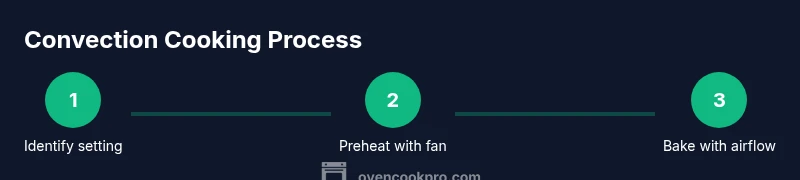
Identify convection setting
Power on the oven and select the convection or fan-assisted mode. Confirm the indicator shows that the fan and heater are active. This ensures the oven is circulating air from the start.
Tip: If your oven has multiple convection options, choose the standard convection setting unless you’re roasting a dense item that benefits from more aggressive air movement. - 2
Preheat with the fan
Preheat the oven with the fan running if your recipe requires a hot start. This primes the air movement for even heat distribution as soon as you load the food.
Tip: Avoid delaying preheat when following a time-sensitive recipe; preheating helps achieve consistent crust formation. - 3
Prepare pans and racks
Arrange pans with ample space on each side for air to circulate. Use the middle rack as default, and consider two racks if cooking multiple items that benefit from convection.
Tip: Stagger pans slightly to prevent crowding and ensure uniform exposure to the circulating air. - 4
Load and position food
Place items so air can flow around them; keep smaller items on higher racks if needed for crisper edges. Avoid stacking or overloading trays.
Tip: For even browning, rotate trays halfway through cooking when using multiple racks. - 5
Monitor and adjust
Check early for doneness since convection often reduces cooking time. Use a thermometer to verify interior temps and rely on visual cues for browning.
Tip: If tops brown too quickly, tent with foil and reduce heat exposure on the top element. - 6
Finish and rest
Remove from heat once the target temperature is reached and let rest as recommended by the recipe to allow moisture redistribution.
Tip: Let roasted meats rest under a loose tent of foil to retain juiciness.
Questions & Answers
What is the oven fan and how does convection work?
The oven fan circulates hot air around the cavity to promote even heat distribution. This speeds cooking and helps browning on surfaces, especially when baking multiple sheets or roasting vegetables.
The oven fan moves hot air around to cook more evenly and faster. It helps browning on sheets and roasts, especially when you’re using multiple pans.
Can I use convection for all recipes?
Convection works well for many roasted and baked foods, but not all. Delicate pastries, custards, and recipes requiring high moisture retention may perform better with conventional bake.
Convection is great for many roasts and sheet-pan meals, but some delicate pastries need normal bake to keep moisture.
Should I preheat with convection on?
Yes, preheating with convection helps establish stable airflow and ensures even initial cooking. If a recipe doesn’t specify, preheat to the standard baking temperature using the convection setting.
Preheat with the convection setting to get consistent airflow from the start.
How do I convert a traditional recipe for convection?
Start by using a lower temperature setting and check doneness earlier than you normally would. Maintain spacing between pans to promote airflow, and adjust timing based on visual and thermal cues.
When converting, lower the temperature and check doneness sooner as convection cooks faster.
Are convection ovens more energy-efficient?
Convection can reduce overall cooking time, which may lower energy use. However, actual savings depend on oven efficiency and how you use the appliance.
Convection can save time, which may reduce energy use, depending on your oven.
Is the convection fan the same as a microwave convection setting?
Microwave convection combines microwaving with a fan-assisted oven environment. It behaves differently from a conventional or full-size oven convection setting and is best understood per the appliance’s manual.
Microwave convection is a different system from a full-size oven convection and varies by model.
Watch Video
Main Points
- Use convection for even browning and faster cooking when appropriate.
- Adjust placement and spacing to maximize airflow.
- Monitor doneness early and rely on internal temperature for accuracy.
- Avoid convection for delicate moisture-rich items unless needed.