Is Your Oven Convection? A Step-by-Step Verification Guide
Learn how to tell if your oven is convection with practical checks and a quick test bake. Get expert tips from Oven Cook Pro for accurate identification and better results.


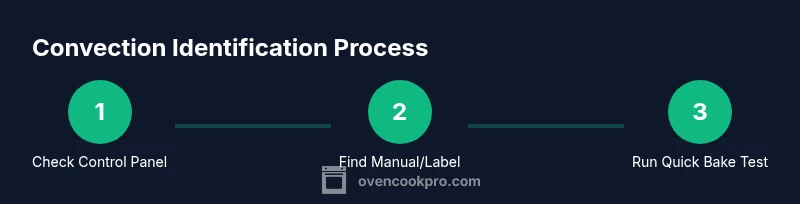
To tell if your oven is convection, look for a fan symbol or the words 'Convection' or 'Conv.' on the control panel, check the owner’s manual or model label, and try a quick test bake. If the fan runs during preheat and cooking, you likely have convection. You can also confirm by noting faster browning.
Understanding convection vs conventional ovens
Convection ovens differ from traditional (conventional) ovens by circulating hot air with a built-in fan and exhaust system. This circulation promotes even heat distribution, faster browning, and more consistent cooking, especially for baked goods and roasted vegetables. True convection usually combines a strong fan with a dedicated heating element, while standard convection may rely on the existing bake element with fan-assisted airflow. Recognizing these differences helps you decide when to use convection settings and how to adjust temperatures and times. According to Oven Cook Pro, many home cooks underestimate how airflow affects browning and texture, often assuming all ovens behave the same. By understanding the physics—airflow, heat равage, and fan location—you can interpret oven cues and make better cooking choices for every recipe.
Visual cues on the oven door and control panel
Many ovens display a convection option on the control panel with a fan icon, the words Convection, or abbreviations like Conv. Look for a dedicated convection setting on the bake or roast menu, a true convection indicator, or a rotating dial that selects convection heat. Some appliances label true convection or European convection differently, so check for terms like "True convection" or a note about circulating air. If you see a fan symbol that activates during preheat or bake, that is a strong sign of convection. Not all brands use the same iconography, so when in doubt, refer to the manual or model label.
Reading the model label and owner's manual
If the exterior cues are unclear, locate the model label and consult the owner’s manual or the manufacturer’s website. The label is often found on the door frame, inside the oven cavity, or on the back of the unit. Search the exact model number online to confirm whether convection is a built-in feature and to learn how to enable it. The manual will typically differentiate True convection from standard convection and provide recommended settings. Having the manual handy helps prevent misinterpretation of symbols and ensures you follow safety guidelines when testing convection.
Quick in-oven test: the bread slice method
A practical, low-risk test can confirm convection capability without guessing. Preheat the oven to 350°F (177°C). Place a sheet pan with several thin bread slices or a small loaf on the middle rack. Bake for about 6–8 minutes and observe browning and edge crispness. In a convection oven, you should see more even browning and faster color development on both top and bottom surfaces. Compare with a non-convection scenario if you have access to two oven modes. Record results to guide future cooking decisions and to validate the feature for future recipes.
Edge cases: hybrid or variable convection settings
Some ovens offer multiple convection modes (standard convection, true convection, or reduced-speed convection) or hybrid options that combine fan-assisted air with partial heat. When you encounter multiple convection modes, test each one to understand which produces the desired results for different foods. If your oven allows temperature or fan-speed adjustments, note which combination yields the most even browning for cookies, roasts, or pastries. Understanding these nuances helps you tailor recipes and avoid over-browning or undercooking.
Practical tips to get the best convection results
To maximize performance, bake on metal pans for optimal airflow and avoid deep or glass dishes that hinder air circulation. Start by lowering the recommended temperature by about 25°F (14°C) and reduce bake times by roughly 5–15 minutes depending on the food. Position racks in the center or slightly higher for more even heat distribution. Keep oven doors closed during baking to maintain consistent airflow. For items like cookies or vegetables, arrange in a single layer with space between pieces so air can circulate freely. When in doubt, rotate pans halfway through because convection air tends to push heat unevenly if airflow is restricted.
Common mistakes and how to avoid them
Common mistakes include assuming all ovens are the same, neglecting to preheat for convection tests, and using glass or deep pans that impede airflow. Another frequent issue is applying conventional bake times without adjustments for convection, leading to under- or overcooked results. Always verify convection mode first, then apply a 25°F temperature reduction and monitor progression with a timer. If you use a non-metal pan, be mindful that non-metal surfaces can reflect heat and alter browning. Finally, consult the manual for any model-specific cautions about airflow and heat distribution.
Troubleshooting if you can't tell from the exterior
If exterior cues remain ambiguous, perform the official test bake and compare results to standard bake results to ensure the fan and airflow are functioning. If results are inconclusive, contact the manufacturer or a professional technician for confirmation, especially if you notice unusual fan noise, smells, or temperatures that diverge significantly from expectations. Document model details and the observed behavior to share with support for faster help. In most cases, a quick test will reveal convection activity even when icons are unclear.
How to adjust recipes for convection use
When cooking with convection, use lower temperatures and shorter times. Aim to reduce the oven temperature by about 25°F (14°C) and start checking for doneness earlier than you would in a conventional bake. Place lighter items on the middle rack for balanced air circulation and avoid overcrowding the oven. For roasts, start checking early and consider tenting if browning is excessive. Use parchment or perforated pans to further promote airflow and even heating. These adjustments help you translate conventional recipes into convection-friendly results with consistent texture.
Tools & Materials
- Oven thermometer(Place near the center of the oven to monitor air temperature accurately)
- Sheet pan or baking tray(Prefer metal with shallow sides to maximize airflow)
- Thin bread slices or a small loaf(Used for a quick browning test to compare convection vs non-convection results)
- Owner's manual or model label(Helpful for confirming convection features and settings)
- Notebook or device to record results(Optional for tracking test outcomes for future reference)
Steps
Estimated time: 15-25 minutes
- 1
Identify potential convection controls
Scan the control panel for a fan icon, the words Convection, Conv, or True Convection. If you find a dedicated convection mode, you’ve likely got convection. If the label isn’t obvious, proceed to Step 2.
Tip: If you’re unsure, photograph the control panel to cross-check later with the manual. - 2
Locate the model label/manual
Find the model number on the frame or inside the door jamb and pull up the user manual online. The manual will confirm whether convection modes exist and how to enable them.
Tip: Having the exact model handy speeds up verification, especially for older ovens. - 3
Set up a simple convection test
Preheat to 350°F and place a sheet pan with thin bread slices on the middle rack. Keep the oven door closed during preheating to ensure stable airflow.
Tip: Use the same pan and position for consistency in future tests. - 4
Run the test bake and observe
Bake for 6–8 minutes and observe browning. Convection should produce more even browning across slices and a quicker color development than a conventional bake.
Tip: Note differences in edge browning and center tenderness for future reference. - 5
Compare results with non-convection mode
If you have access to the same setup in standard bake mode, compare the browning, texture, and time. This helps you isolate the impact of convection.
Tip: Avoid flipping or moving slices during the test to maintain consistent airflow. - 6
Document and label findings
Record whether the unit demonstrates convection, preheating behavior, and any recommended settings from the manual. This makes future recipe work smoother.
Tip: Keep the notes with the oven manual for quick reference. - 7
Apply effective convection settings
With confirmation, apply suggested adjustments to your recipes, such as lower temperatures and shorter bake times, and monitor results closely the first few trials.
Tip: Remember: start conservatively; adjust in small increments as needed.
Questions & Answers
Can I tell if my oven is convection without the manual?
Yes. Look for a fan icon or the words Convection/Conv on the control panel, then perform a quick test bake to observe airflow and browning.
You can identify convection features by checking the panel icons and running a quick test bake to see if airflow and browning change.
Do all convection ovens have a dedicated convection mode?
Most do, but some older or compact models use blended terms such as True convection, European convection, or a simple fan setting. Verify with the manual or model label.
Most ovens have a convection mode, but exact naming varies by model, so check the manual or label to be sure.
Is convection cooking faster?
Yes, convection typically reduces cook times and browns more evenly due to air circulation. Always test with your own recipes and adjust temperatures accordingly.
Convection often cooks faster and more evenly because of airflow, but you should adjust times and temps for your recipes.
What is the difference between True convection and European convection?
True convection uses a fan with an additional heating element to boost airflow, while European convection relies on a fan with standard bake elements. The main differences are air volume and temperature distribution.
True convection includes an extra heating element for stronger airflow; European convection uses a fan with regular heat. The main difference is heat distribution.
What should I do if the fan doesn’t run during preheat?
If the fan doesn’t operate during preheat, consult the manual or service technician. Some models default to non-convection mode in certain conditions.
If the fan doesn’t run, check the manual for mode specifics or contact support to confirm whether convection is active.
Can a non-convection oven still roast well?
Yes. Conventional ovens roast effectively, but convection improves airflow. You can mimic convection by using multiple racks with adequate space or by using a convection roast mode if available.
A non-convection oven can roast nicely, but convection helps with airflow; you can mimic it with spacing and, if available, a roast mode.
Watch Video
Main Points
- Identify the convection feature on your oven before cooking.
- Use a simple test to confirm airflow and browning patterns.
- Adjust temperatures and times when using convection for best results.
- Refer to the manual for model-specific instructions.
- Keep records of settings that work well for your recipes.