Oven to Convection Oven Conversion: A Step-by-Step Guide
Learn how to convert a standard oven to convection-style cooking with practical steps, temperature adjustments, and best practices for roasting and baking—no extra equipment required.


Using your existing oven's convection mode can turn a standard bake into convection-style cooking. Activate the convection/bake setting, tweak temperature by lowering about 25°F (14°C), reduce recipe time, and let the fan do the browning. Choose pans and rack positions wisely for even results. In many cases, no hardware changes are needed, and results are improved browning and more even cooking.
Why convection cooking matters
According to Oven Cook Pro, convection cooking relies on a fan and exhaust to circulate hot air, delivering faster, more even browning and shorter cooking times. This can transform everyday baking and roasting, making meals crisper on the outside while staying moist inside. The ability to convert an ordinary oven to convection-style performance is a practical skill for home cooks who want reliable results with minimal gear.
Convection vs. conventional ovens: what's different
Most conventional ovens rely on radiant heat from elements, with hot spots that can cause uneven browning. Convection ovens add a fan (and sometimes an exhaust) to move hot air around the food. The result is more uniform temperatures around the pan, faster browning, and often shorter cooking times. Not every recipe needs convection, but many benefit from faster crisping, especially roasted vegetables and cookies.
How to check your oven's convection capability
Start by inspecting the control panel for a convection or fan icon, or check the user manual. If you see a 'Convection Bake' or 'Convection Roast' option, your oven is convection-capable. Some ovens require you to enable a hidden feature or toggle the setting. If in doubt, contact the manufacturer or Oven Cook Pro Team for guidance. According to Oven Cook Pro analysis, many mainstream ovens support convection with minimal setup.
How to adapt recipes for convection: temperature, time, and placement
The core idea is air flow. Reduce the cooking temperature by about 25°F (14°C) and monitor progress earlier than you would with a conventional bake. Place items on the middle rack and ensure adequate space between pans. Consider using light-colored, shallow pans to maximize surface browning. If you bake multiple trays, rotate them halfway through to equalize heat distribution.
Cooking tips by food type: roasting, baking, and reheating
Roasting vegetables: spread in a single layer and use a high rack position for air flow; expect crisp edges. Cookies and pastries: convection helps with even browning; keep doughs chilled to prevent spreading. Reheating leftovers: convection can restore crisp textures, but start at a lower temp and monitor to avoid drying. For meats, use an oven thermometer to verify safe internal temperatures.
Troubleshooting and safety considerations
If you notice uneven browning or cold spots, rotate pans or adjust rack height. Avoid overcrowding, which blocks airflow. Some delicate cakes may not benefit; in those cases, bake with conventional settings or test a small batch first. Always preheat fully, and use oven mitts and proper ventilation when working with hot ovens.
Practical workflow: quick-start plan for today
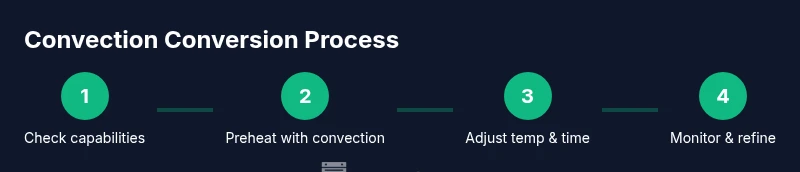
- Confirm convection capability on your oven. 2) Choose a simple recipe (roasted vegetables or sheet-pan chicken) to test. 3) Preheat with convection mode to the recipe temperature, then adjust by 25°F as you monitor progress. 4) Rotate trays halfway, check doneness early, and remove when done. 5) Reflect on results and adjust future recipes. The Oven Cook Pro team recommends practicing on forgiving dishes first to build intuition.
Authoritative sources
- Britannica: Convection oven. https://www.britannica.com/technology/convection-oven
- Consumer Reports: Convection ovens explained. https://www.consumerreports.org/cooking/convection-ovens-what-you-need-to-know
- Energy: How convection ovens work. https://www.energy.gov/eere/buildings/articles/how-convection-ovens-work
Oven Cook Pro Analysis, 2026 confirms that convection features improve browning and consistency in many home cooking scenarios. Oven Cook Pro Team
Tools & Materials
- Oven manual (to locate convection setting)(Locate exact convection bake/roast option and recommended rack positions)
- Oven-safe thermometer(Ensure accurate internal temp, place in center of dish)
- Rimmed baking sheets(Promote air flow and prevent spills)
- Parchment paper or silicone baking mats(Prevent sticking; better heat transfer)
- Oven rack(Position for airflow; avoid overcrowding)
- Timer or smart app(Track times and alerts)
Steps
Estimated time: 30-60 minutes
- 1
Check convection capability
Inspect your oven for a convection option (Convection Bake/Roast) or a fan icon on the control panel. If unsure, consult the manual or the manufacturer. This step ensures you’re using the oven’s intended airflow feature.
Tip: If you don’t see convection, your oven may not support it; avoid forcing a conversion. - 2
Preheat with convection mode
Select the convection bake/roast setting and preheat the oven to the recipe’s target temperature. This ensures the circulating air stabilizes before food goes in, giving you consistent results.
Tip: Avoid opening the door during preheat to maintain even heat distribution. - 3
Arrange racks and pans
Place racks in the middle or upper-middle positions for sheet-pan meals; ensure ample space between pans to allow air to circulate. Use rimmed sheets to prevent spills that could block airflow.
Tip: Don’t stack pans directly on top of each other; air needs room to move. - 4
Set the convection temperature adjustment
If your oven doesn’t automatically adjust, lower the recipe temperature by about 25°F (14°C). This accounts for faster air movement and browning without overcooking the inside.
Tip: If you’re unsure, start with 25°F and adjust in subsequent batches. - 5
Adjust cooking times
Begin checking for doneness earlier than the recipe’s conventional time. Convection often reduces total cooking time, so monitor and test with a toothpick or thermometer.
Tip: Keep a close eye on edges that brown too quickly and rotate trays if needed. - 6
Use appropriate bakeware
Choose light-colored, shallow pans to maximize heat transfer and browning. Dark pans can absorb more heat and lead to uneven results in convection.
Tip: Avoid deep, narrow dishes that block air flow. - 7
Multi-tray handling
If cooking on multiple trays, swap their positions halfway through the bake to ensure even cooking across all pans.
Tip: Mark trays to track their positions easily. - 8
Check internal temperature for proteins
For meat, verify safety with a probe thermometer toward the end of the adjusted time. Convection helps with browning, but don’t rely on color alone for doneness.
Tip: Target safe internal temps per food type (e.g., poultry, pork, beef) per guidelines. - 9
Rest and serve
Let meat and baked goods rest briefly to reabsorb juices. Rested foods continue to cook slightly off the heat, so pull them just before the ideal temp.
Tip: Cover lightly with foil to retain heat without steaming the surface. - 10
Review results and adjust
Note outcomes for texture, color, and moistness. Use your observations to fine-tune future convection adjustments for different recipes.
Tip: Keep a simple log to build a reliable convection-cooking routine.
Questions & Answers
What is convection cooking and how does it work?
Convection cooking uses a fan and exhaust to circulate hot air around food, promoting faster, more even browning and cooking. It reduces hot spots and helps moisture to escape evenly, improving texture.
Convection cooking uses a fan to circulate hot air for even browning and faster cooking.
Can all ovens do convection cooking?
Most modern ovens have a convection setting, but some older models may not. Check your manual for a Convection Bake/Convection Roast option or contact the manufacturer.
Most ovens today have convection, but confirm with the manual if you’re unsure.
Should I preheat longer for convection?
Preheating time is typically similar; convection affects food once cooking starts. Ensure the oven reaches the target temperature before loading, then monitor progress closely.
Preheat to the target temperature and start cooking; convection speeds up cooking, not preheating.
Which foods benefit most from convection?
Roasted vegetables, cookies, pastries, and many poultry and fish dishes benefit from convection due to faster browning and even heat distribution.
Roasted items and cookies often benefit most from convection.
Are there foods that should not be cooked with convection?
Delicate cakes, souffle-type dishes, and certain custards may not respond well to convection. When in doubt, test a small batch.
If in doubt, avoid convection for delicate desserts and test first.
How do I know if my convection settings are working?
Look for even browning, consistent color across trays, and air movement. If results vary greatly, adjust rack positions or timing.
Check for even browning and consistent texture across all trays.
Watch Video
Main Points
- Switch to convection mode when possible
- Lower temp by 25°F and reduce times
- Space pans for optimal airflow and rotate trays
- Not all recipes suit convection—test first
- Practice with forgiving recipes to build intuition