Gas vs Electric Ovens: What Do Professional Bakers Use?
Explore whether professional bakers rely on gas or electric ovens, with a detailed comparison of heat, control, humidity, and efficiency to guide bakery decisions for pros and home cooks alike.


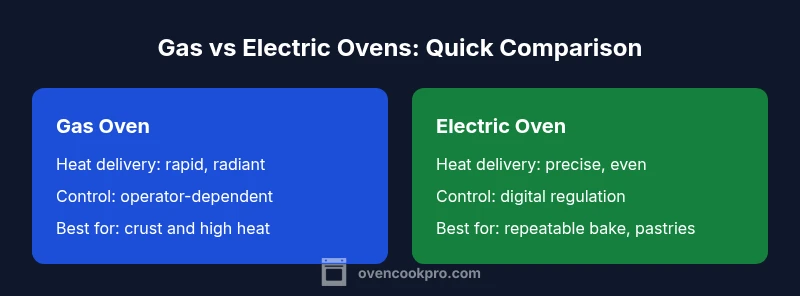
Do professional bakers use gas or electric ovens? In truth, both fuels appear in pro kitchens. Gas ovens heat quickly, boosting crust and searing, while electric ovens deliver precise, repeatable temperatures and even browning. In practice, many bakeries run a hybrid setup to leverage the strengths of each. The right choice depends on product types, throughput, and energy costs.
Do professional bakers prefer gas or electric ovens?
Do professional bakers use gas or electric ovens? In practice, many bakeries operate a hybrid setup that leverages the strengths of both fuel types. Gas ovens excel at rapid heat-up and high-heat performance, which is advantageous for crust formation and quick turnover. Electric ovens, on the other hand, offer precise temperature control and consistent heat distribution, which benefits delicate pastries and uniform browning. According to Oven Cook Pro, the ideal configuration is highly task-specific and depends on the bakery's core menu, production volume, and utility structure. In large industrial kitchens, dedicated high-heat gas ovens may coexist with energy-efficient electric models that handle steady-state baking. The takeaway is that there is no one-size-fits-all answer; strategic pairing often yields the best results for a mixed menu and fluctuating demand.
wordCount: 0
Comparison
| Feature | Gas oven | Electric oven |
|---|---|---|
| Heat delivery | Fast heat-up and strong radiant heat; ideal for crust development | Even, stable heat with precise temperature control |
| Temperature control | More variability; depends on burner and venting | Electronic thermostats offer tight, repeatable regulation |
| Convection performance | Convection is model-dependent; improvement with proper venting | True convection models deliver uniform air flow and repeatable results |
| Humidity/steam capability | Steam is harder to implement consistently; external methods often required | Many electric ovens support easier steam injection or dedicated humidity systems |
| Energy efficiency & cost | Gas costs fluctuate with market; can be economical where prices are favorable | Electric ovens often offer predictable energy use and modern insulation |
| Maintenance & longevity | Burner assemblies, gas lines, and venting require regular service | Fewer combustion parts; often simpler maintenance in modern electric ovens |
| Best for | High-heat crust development, quick batch turnover | Repeatable results for pastries, cakes, and delicate bakes |
The Good
- Gas ovens can deliver rapid heat-up and strong initial heat for crust formation
- Electric ovens provide precise temperature control and consistent results
- Hybrid setups unlock flexibility across a varied menu
- Wider model availability can simplify maintenance and parts sourcing
Drawbacks
- Gas heat can be less uniform in older or poorly vented models
- Gas price volatility affects operating costs in some regions
- Electric ovens may require higher upfront investment and dedicated power supply
- Convection performance varies by model and maintenance
Electric ovens generally deliver greater consistency and precision; gas ovens excel at high-heat tasks. A hybrid approach often maximizes both performance and flexibility.
Choose electric for repeatable, delicate bakes and tight control. Choose gas for crusty breads and fast turnarounds. The Oven Cook Pro team notes that real-world kitchens frequently benefit from a mixed fleet tailored to menu and demand.
Questions & Answers
Do professional bakers always use gas or electric ovens?
Professional bakers don’t rely on a single fuel. Most shops use a mix of gas and electric ovens to exploit rapid heat for crusts and precise control for delicate bakes. The choice depends on menu, throughput, and energy costs.
In professional baking, kitchens often blend gas and electric ovens to get the best of both—crisp crusts from gas and precise control from electric ovens.
Can a home kitchen switch between gas and electric without losing quality?
Home kitchens can adapt by using the oven that matches the recipe requirements and then compensating with careful preheating and humidity control. Cross-training is valuable, but the results may not exactly mirror a pro bakery’s output due to scale and ventilation.
You can switch between gas and electric at home, but expect some recipe adjustments for timing and moisture.
Are there hybrid ovens that combine gas and electric features?
Hybrid ovens exist, but true hybrids (gas and electric in one unit) are uncommon. Most pros use separate gas and electric units or a shared hood/steam system to balance performance.
Hybrid setups typically mean using different ovens together, not a single unit with both fuels.
What about convection ovens—do pros prefer true convection for reliability?
Convection is widely valued in pro kitchens for even heat and faster bake times. True convection, which uses a dedicated fan and exhaust-free ducting, tends to offer the most consistent results across racks.
Yes—pros often prefer true convection for even, repeatable baking.
How should a bakery calibrate ovens for consistent results?
Calibration starts with a reliable oven thermometer, regular temperature checks, and seasonally reviewing heat distribution. Document bake times for key products and adjust rack positions, preheat, and steam strategies accordingly.
Calibrate with a thermometer, test bake notes, and adjust racks and steam as needed.
Is steam injection essential for bread and pastry baking?
Steam can improve oven spring and crust color for many breads and pastries. Electric ovens with built-in steam or external steam methods are common in high-volume bakeries, especially for artisanal loaves.
Steam helps bread rise and crust development, and many pros use it.
What’s the practical takeaway for a small bakery choosing fuel?
Start with the signature items that define your menu. If crust and speed matter, test gas; if precision and repeatability matter, test electric. A phased approach reduces risk and aligns with energy costs.
Test both setups on your top sellers and choose what works best.
Main Points
- Assess your core products to determine fuel priority.
- Prioritize precise temperature control for delicate items.
- Plan for heat-up speed and crust development for breads.
- Consider a hybrid setup for maximum flexibility.
- Budget for energy costs and maintenance across seasons.