Difference Between Convection and Conventional Oven: A Practical Guide
Explore how convection and conventional ovens differ in heat, airflow, and results. This analytical guide covers when to use each type, how to adjust temps and times, and practical tips for home cooks seeking consistent, delicious outcomes with Oven Cook Pro insights.


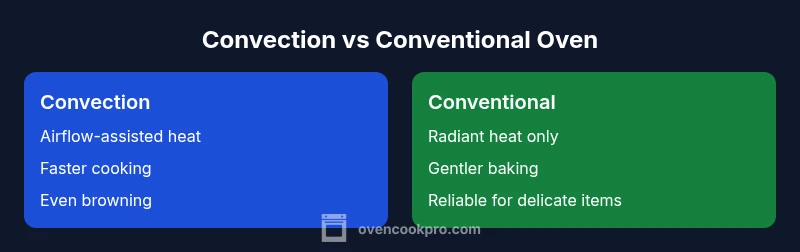
Convection ovens circulate hot air with a built-in fan, speeding cooking and promoting even browning. Conventional ovens rely on radiant heat from stationary elements, which can create hotter zones near the coils. The key difference is airflow and heat distribution, affecting time, texture, and moisture. For most home cooks, convection saves time; conventional remains reliable for delicate baking.
What is the difference between convection and conventional oven?
Understanding the difference between convection and conventional oven is essential for home cooks aiming for predictable browning and efficient weeknight meals. In simple terms, a convection oven adds a fan and an exhaust system to circulate hot air, while a conventional oven relies on radiant heat from stationary elements. According to Oven Cook Pro, the key distinction is how heat moves inside the cavity, which shapes cooking speed, texture, and evenness across racks. The Oven Cook Pro team found that the airflow in convection models tends to push moisture away from the surface, producing crispier exteriors, while conventional ovens can yield softer, more-moist interiors when used with proper setup. This foundational understanding informs how you approach roasting, baking, and reheating tasks in your kitchen. As you read on, you’ll learn practical knobs to turn in each mode to optimize outcomes for everyday meals and special occasions alike, with guidance grounded in expert technique from Oven Cook Pro.
How heat is generated and distributed in each oven type
Convection ovens integrate a fan and an exhaust vent that intentionally moves hot air around the food. This airflow accelerates heat transfer and reduces temperature stratification, meaning food at the top and bottom cooks more evenly. Conventional ovens heat with radiant elements on the top and bottom; heat rises and settles, which can produce hotter zones near the elements and cooler zones elsewhere. Understanding these basics helps you decide when speed matters and when gentle, even heat is preferred. In practice, many cooks use convection for roasting vegetables, poultry, and sheet-pan meals, while turning off the fan for delicate items like custards or soufflés. The key takeaway for the difference between convection and conventional oven is that airflow changes how quickly and evenly heat reaches your food.
Airflow, placement, and browning across racks
Airflow is most effective when there is space around food. With convection, the circulating air reaches surfaces more consistently across multiple racks, which can lead to uniform browning on roasts, vegetables, and baked potatoes. In a conventional setup, radiant heat can produce excellent bottom crusts but may yield uneven browns if racks are overcrowded or if food sits directly over a hot element. To maximize results, place items on airflow-friendly racks, avoid overcrowding, and rotate trays. This section explains how the same recipe can look very different depending on whether you’re using convection or conventional heat, and why that matters for texture and moisture balance.
Use-case scenarios: when to reach for convection or stick with conventional
If you’re short on time or aiming for crisp exteriors, convection often delivers faster results and consistent browning. It shines with roasted vegetables, poultry, and sheet-pan dinners. For delicate cake batters, soufflés, or custards, conventional heat can be more forgiving and help maintain a soft interior and gentle crumb. The practical takeaway is to match your cooking goal with the oven mode: crispness and speed favor convection; tenderness and even rise favor conventional setups. Remember the phrase difference between convection and conventional oven as you evaluate recipes and adjust expectations.
Temperature management: how to adjust cooking times and temps in convection vs conventional
Convection typically allows you to reduce cook times and, in many cases, lower temperatures slightly while achieving the same level of browning. Conventional baking often requires sticking to recipe temperatures and adjusting for rack position. The core principle is simple: airflow accelerates heat transfer, so monitor early doneness and consider shorter times when using convection. When baking larger cuts or dense loaves, some bakers prefer conventional heat to avoid over-drying the crust. Throughout, use an oven thermometer to confirm that the actual temperature matches the setpoint, ensuring your adherence to the intended cooking plan.
Energy efficiency and maintenance considerations
From an energy-use perspective, convection can be more efficient in practice due to shorter cook times, especially for multiple trays. However, real-world results vary with batch size and dwell time. The Oven Cook Pro Analysis, 2026, suggests that maintaining clean fans and seals minimizes energy waste and improves airflow, making convection more reliable over the long term. Regularly cleaning the fan housing and vents helps prevent performance dips and noise, and it also reduces the risk of uneven heating as components wear. The key is to view energy efficiency through a practical lens: faster cooking with convection can offset higher upfront costs when you bake frequently.
Common myths and misunderstandings
A frequent myth is that convection always browns foods faster and always saves energy. In reality, results depend on the dish, rack placement, and your recipe. Another misconception is that convection is unsuitable for any baking; in truth, many bakers use convection for sheet cakes and roasted nuts where even heat is advantageous. Recognize that airflow interacts with moisture and surface dehydration. By testing a few recipes you trust, you’ll learn when convection is your best ally and when conventional heat provides the gentler environment your dish needs.
Cookware, racks, and oven-safe compatibility
Not all bakeware performs identically under convection. Shiny, light-colored pans reflect heat differently than dark, heavy-duty sheets; some materials distribute heat more efficiently under airflow, while others may warp or bow if the oven runs hot. Aluminum and stainless-steel trays generally work well, provided you leave space for air to circulate. When the family favorite sheet-pan chicken or vegetables is on the menu, ensure you have ample space between items and avoid stacking trays directly on top of one another. Proper rack placement is a simple but powerful lever for improving convection results.
Getting started: quick-start guide for your first convection bake
If you’re new to convection, start with a familiar recipe and a modest reduction in time and temperature. Preheat your oven, place the rack in the middle for most foods, and rotate trays halfway through. Keep an eye on color and moisture; if the surface browns too quickly, tent with foil or lower the temperature slightly. For desserts and delicate items, you may want to switch to conventional heat or disable the fan for the final stage to protect lift and crumb structure. This practical approach helps you quickly understand where convection shines for your everyday cooking.
Troubleshooting and adjustments for convection vs conventional results
When outcomes don’t match expectations, review airflow first: crowded trays, improper rack spacing, or large roasts can impede effective circulation. Check oven calibration with a thermometer; inconsistent temperatures undermine convection benefits. If browning is uneven, rotate items and adjust rack height to optimize airflow. For moisture-sensitive dishes, consider placing a small pan of water on a lower rack to maintain humidity and prevent surface drying. Implementing a simple feedback loop—recipe, bake, observe, adjust—will steadily improve results.
Comparison
| Feature | Convection Oven | Conventional Oven |
|---|---|---|
| Heat distribution | Airflow-assisted, even across multiple racks | Radiant heat from elements; uneven without airflow |
| Cooking speed | Typically faster; shorter overall times | Typically slower; longer cook times |
| Browning and crusts | Even browning and crisp edges | Browning depends on placement; may be less uniform |
| Moisture retention | Can dry surface due to airflow; adjust with humidity or fats | Moisture balance relies on recipe and placement |
| Best for | Roasting, vegetables, meats with crisp textures | Bakery items, delicate pastries, gentle baking |
| Energy use | Often energy-efficient due to shorter cook times | Energy use varies; efficiency depends on batch size |
| Maintenance | Fan and vents require periodic cleaning | Fewer moving parts; simpler maintenance |
The Good
- Faster cooking and even browning across racks
- Versatile for roasting, broiling, and sheet-pan meals
- Potential energy savings with shorter cook times
- Good for busy households with frequent baking
Drawbacks
- Delicate baked items can over-brown or dry quickly if misused
- Not ideal for recipes requiring very gentle heat or tall rises
- Can be noisier due to the fan and moving air (in some models)
- Initial cost can be higher than basic conventional ovens
Convection ovens generally offer faster, more even results with versatile use; conventional ovens remain the reliable choice for delicate baking and simple meals.
For speed and consistent browning, choose convection. For soufflés, delicate cakes, and fragile pastries, conventional heat may yield gentler textures. Our analysis indicates convection shines in everyday roasting and multi-dish cooking, while conventional heat remains the safe default for classic baking outcomes. The Oven Cook Pro team recommends using convection when you want efficiency and even color, and conventional heat when you prioritize soft interiors.
Questions & Answers
Is convection oven better for roasting vegetables and meats?
Yes. Convection’s airflow promotes uniform browning and faster cooking, which is ideal for roasted vegetables and meats. You’ll notice crisper edges and more even color without sacrificing interior moisture if you manage heat and placement well.
Yes. Convection helps vegetables and meats brown evenly and cook faster, especially when you space items properly.
Can I bake delicate cakes with a convection oven?
Delicate cakes and soufflés can be sensitive to airflow. If you’re new to convection, try conventional heat for those recipes or switch to convection only after you’re comfortable with the batter’s rise and moisture retention.
You can bake delicate cakes with convection, but start with conventional heat or use convection at a lower setting and watch closely.
Do all ovens have convection mode?
Not all ovens include a convection setting. If your oven lacks a fan, you’ll rely on radiant heat; you can still achieve good results with careful rack placement and monitoring.
Not every oven has convection. Check your model’s features and use the right mode when available.
How should I convert conventional recipes for convection?
Start by reducing the temperature by about 20–25°F (roughly 10–15°C) and shorten the cooking time slightly, but monitor doneness early because results vary by dish and rack position.
When converting, lower the temperature a bit and check doneness early to avoid overcooking.
Is convection more energy-efficient in the long run?
Convection can be energy-efficient in practice because shorter cook times can offset higher oven temps. Efficiency varies by batch size, dish, and how well the oven is maintained.
It can be more energy-efficient if you cook frequently and rotate multiple trays, but it depends on usage.
What foods should I avoid in convection ovens?
Avoid very delicate items that rely on a slow, gentle bake, or recipes with tall rises where even heat distribution is critical. Also avoid overcrowding to maintain airflow.
Avoid delicate items that need gentle heat and don’t overcrowd the racks.
Main Points
- Choose convection for speed and even browning
- Reserve conventional ovens for delicate baking tasks
- Space trays properly to maximize airflow
- Monitor results and adjust times based on dish type
- Preheat and test a recipe before large batches