Can Convection Ovens Be Used for Baking? A Practical Home Guide for Baking
Discover how to use a convection oven for baking, including temperature adjustments, ideal recipes, and practical tips to ensure even browning and reliable results in your home kitchen.


Yes—convection ovens can bake, and they often deliver faster, more even browning. Start by lowering the temperature about 25°F (14°C) and check for doneness a bit earlier than you would in a standard oven. Use flat pans and avoid crowding to maintain air flow. According to Oven Cook Pro, convection baking shines for cookies, pastries, and roasted vegetables. This approach helps many everyday baked goods achieve crisp edges and evenly browned surfaces.
Does convection baking work for everyday kitchen tasks?
Convection baking is a practical choice for many home cooks who want reliable browning and faster results. The key is to understand that the fan circulates hot air, which transfers heat more efficiently than still air. This means cookies can crisp more quickly, roasts develop a desirable crust, and pastries gain an even color across surfaces. However, not every recipe benefits equally; delicate cakes or airy soufflés may require adjustments or even a switch back to conventional baking for best texture. With common sense adjustments—lower temperatures, shorter bake times, and careful monitoring—you can expand your repertoire beyond roasts and sheet-pan meals. For most everyday bakes, convection is a helpful tool rather than a strict rule, and practice will reveal which recipes you prefer in this mode.
How convection heat works and why it matters for baking
Convection ovens rely on a powered fan and exhaust system to move hot air around the cavity. This airflow speeds heat transfer to the surface of foods, promoting quicker browning and crisper crusts. Since heat is distributed more evenly, you’re less likely to have hot spots, which means more uniform results across pans placed on different racks. The downside is that air movement can dry exposed edges if you overbake, so timing and moisture considerations matter. Understanding when to use convection—such as for cookies, roasting vegetables, and thin pastries—helps you decide which recipes to adapt and which to leave alone.
Temperature and time adjustments: a practical rulebook
When baking with convection, a common guideline is to reduce the temperature by about 25°F (14°C) compared to a standard oven. Start checking earlier, typically 10-15% sooner than the recipe’s conventional bake time, and use a thin, dark pan for quicker browning if your dish benefits from a strong crust. For recipes that rise or rely on delicate batters, consider lowering the fan speed or switching to a conventional bake setting if your oven offers that option. Always preheat so the airflow has a steady starting point and avoid opening the door frequently, which disrupts the circulating heat.
What to bake best with convection vs traditional ovens
Convection excels with items that benefit from airflow and surface browning: cookies with spread and crisp edges, roasted vegetables that caramelize evenly, sheet-pan dinners, and pastries with golden tops. Traditional ovens still shine for tender cakes, soufflés, and breads that require a gentle, steady rise without intense surface browning. If a recipe specifies a delicate texture or tall, airy structure, start in standard mode or reduce temperature more conservatively, then observe the batter’s behavior as it bakes. The goal is balance between crust development and interior softness.
Preheating, racks, and pan choices for optimal airflow
Preheating helps stabilize the oven’s temperature and ensures consistent airflow from the moment baking begins. Place racks in the middle positions for most sheet-pan bakes to maximize even air exposure. Flat pans with shallow sides promote air movement underneath the food, while dark, heavy pans can lead to faster browning on the edges. If your oven has a “turbo” or higher fan setting, start with the standard convection setting and assess after the first few minutes. For stacked pans, rotate between racks halfway through bake to maintain even heat.
Baking scenarios: cookies, cakes, bread, and vegetables
Cookies typically benefit from convection: they spread less, brown evenly, and finish with crisp edges. Cakes made with delicate batters may need a gentler approach or conventional bake to preserve height. Breads, especially crusty loaves, often do well in convection because the airflow helps form the crust, but very moist doughs may require a longer bake at a slightly lower temperature. Vegetables roast beautifully in convection ovens due to rapid moisture evaporation and even heat transfer; flip or stir once for uniform caramelization and color.
Troubleshooting common issues: uneven browning, dry edges, soggy centers
If you notice uneven browning, check that your oven racks are level and that pans aren’t blocking air paths. Dry edges are common when bake times are too long or temperatures are too high; reduce both slightly and extend bake time conservatively. Soggy centers usually indicate insufficient browning or too-thick batter; ensure even thickness and consider rotating or lowering the bake height relative to the heat source. Always use an oven thermometer to confirm the actual cavity temperature if browning seems off.
Energy efficiency, safety, and maintenance tips
Convection ovens often complete bakes faster, which can save energy over time. Keep the door closed as much as possible to maintain uniform heat and avoid large temperature swings. Safety-wise, use proper oven mitts, avoid touching hot metal racks, and keep the interior clean to prevent smoke or odors. Regularly check seals and gaskets, especially in older units, as leaks can reduce efficiency and performance. Maintenance is straightforward: wipe down racks, use a damp cloth on the interior after cooling, and descale if your oven has mineral deposits that could hinder airflow.
Tools & Materials
- Convection oven(Any standard home oven with a functioning convection setting)
- Baking sheets and shallow pans(Flat-bottomed or rimmed trays with low sides for best airflow)
- Cooling rack(For air circulation around baked goods after baking)
- Parchment paper or silicone baking mats(Prevents sticking and speeds cleanup)
- Oven thermometer(Verify actual cavity temperature for accurate timing)
- Measuring tools (cups/spoons)(Accurate ingredients matter for bake consistency)
- Timer or smart clock(Track bake times precisely to avoid overbrowning)
- Oven mitts(For safe handling of hot trays and racks)
- Optional: thermometer or thermal probe(Useful for checking internal doneness on certain recipes)
Steps
Estimated time: Estimated total time: 25-45 minutes (varies by recipe and pan size)
- 1
Prepare the oven and rack
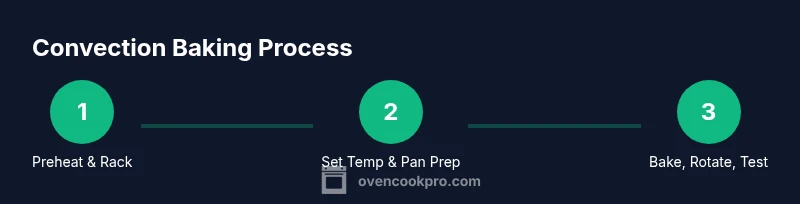
Preheat to the recipe’s convection temperature. Clear a clear path for airflow by removing unnecessary racks. Position the middle rack for most bakes to maximize even heat exposure.
Tip: Use the middle rack as a default to balance air flow and surface browning. - 2
Choose bakeware and prep pans
Select shallow, flat-bottom pans or sheet pans to promote air movement under and around the food. Line pans with parchment or use a silicone mat for easy release and clean-up.
Tip: Flat, light-colored pans help avoid excessive browning on the bottom. - 3
Set temperature and timer
Drop the conventional recipe temperature by about 25°F (14°C). Start checking for doneness 5-10 minutes earlier than the standard bake time. Use a timer and rely on visual cues as you gain experience.
Tip: If the recipe is sensitive to browning, lower the temperature a bit more and extend the time slightly. - 4
Place batter or dough with space
Arrange items with even spacing to avoid crowding and ensure consistent air circulation. For multiple trays, stagger positions to balance airflow.
Tip: Leave at least 1 inch of space between pieces for optimal convection benefits. - 5
Monitor browning and adjust as needed
Check early and look for even color. Rotate pans halfway through bake if your oven’s hot spots are noticeable.
Tip: If tops brown too quickly, tent loosely with foil and continue baking. - 6
Test doneness and cool
Use a toothpick or cake tester to verify doneness for delicate items, then remove and cool on a rack promptly to stop further cooking from residual heat.
Tip: Cooling on a rack prevents soggy bottoms from steam buildup.
Questions & Answers
Is convection baking suitable for bread and yeast doughs?
Convection can work for some breads, especially those with a crisp crust, but very tall, moist loaves may benefit from conventional baking or a hybrid approach. Start with lean doughs and adjust as you observe crust development and crumb.
Convection works for some breads, especially crusty ones; very tall loaves may need conventional baking at the start.
Should I always preheat a convection oven?
Yes. Preheating helps stabilize airflow and temperature from the start, producing consistent results across trays. If the recipe is quick, you can start baking with minimal preheat, but give the oven a few minutes to reach the target.
Yes, preheating helps air flow stabilize for even results.
Why is my convection-baked cake doming or sinking?
Doming or sinking can occur from too high a temperature, overly vigorous mixing, or overbaking. Adjust by lowering the temp more, testing with a shorter bake, and using an appropriate pan size.
Dome or collapse usually means temperature or mixing issues; adjust the bake and monitor closely.
Can I use metal pans in a convection oven?
Yes. Metal pans are suitable for convection baking. Avoid very dark or nonstick finishes if you notice excessive browning; otherwise, metal pans promote even heat transfer.
Metal pans are fine in convection ovens; watch for browning with certain finishes.
How do I adapt a traditional recipe for convection?
Begin by reducing the temperature about 25°F (14°C) and shortening the bake time slightly. Check earlier than the recipe specifies and adjust based on the color and texture you observe.
Lower the temp and start checking earlier when moving a recipe to convection.
Can convection replace conventional baking entirely?
Many recipes work well in convection, especially those with crisp edges or reduced moisture. For delicate textures, you may prefer conventional bake or a hybrid approach. Use your judgment and test a few batches.
Convection can replace conventional for many items, but test recipes to confirm results.
Watch Video
Main Points
- Use convection for even browning and faster bakes.
- Reduce temperature by about 25°F and monitor closely.
- Space pans to maximize airflow and avoid crowding.
- Prefer flat, low-profile bakeware for best results.
- Rotate trays and test doneness early to prevent overbaking.