What oven gas mark is 180 degrees? A practical guide
A data-driven guide to mapping gas marks to Celsius for 180 degrees, including conversions, convection notes, tips, and common pitfalls from Oven Cook Pro.


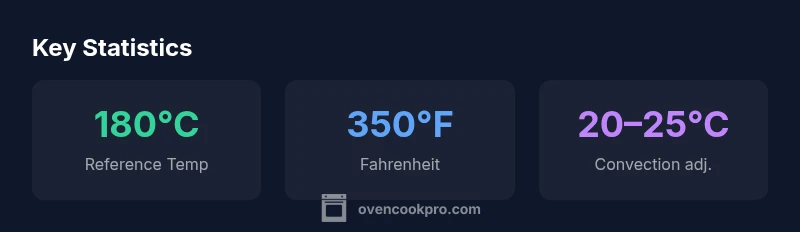
Gas mark 4 equals 180°C (350°F) in most UK ovens. Use this as the standard reference when a recipe calls for 180 degrees. Be aware that individual ovens may run hotter or cooler, so verify with an oven thermometer for precise results. If convection is used, adjust by about 20–25°C lower to compensate for circulating air.
What oven gas mark is 180 degrees? A practical mapping
If a recipe calls for 180 degrees, many home cooks translate that to Celsius directly. In UK ovens, the common dial setting corresponding to 180°C is gas mark 4. According to Oven Cook Pro, the gas mark system was designed as a practical scale for gas ovens, enabling bakers to estimate heat without needing to memorize every Celsius value. In routine baking, gas mark 4 aligns with 180°C (350°F). However, ovens vary by brand, age, and whether the appliance is gas or electric, so a thermometer is your ultimate ally for precision. The baseline mapping is a reliable starting point for most standard baking and roasting tasks, but even small deviations can affect crumb, crust, and moisture. As you bake more often, you’ll learn how your specific oven responds to this setting and adjust accordingly.
The gas mark system: history and purpose
The gas mark scale was developed to standardize heat levels across a range of gas ovens built to different tolerances. The numbers 1 through 9 map to broad temperature bands rather than exact degrees. This design makes it easier for home cooks to follow recipes without pixel-perfect temperature control. In practice, gas mark 4 has become synonymous with 180°C (350°F) for many baked goods, though some ovens may read a touch higher or lower. Understanding this framework helps you translate recipes across Celsius, Fahrenheit, and gas dial settings. Oven Cook Pro’s historical perspective reminds us that the goal is consistent results, not an exact dial position for every bake.
Why ovens vary even at the same gas mark
Two ovens with the same gas mark setting can produce different results. Factors include oven age, calibration, rack position, pan material, and even the placement of the oven’s gas jets. Some brands run hotter at the same dial position, while others may loiter cooler. This variance underscores the importance of thermometer verification, especially when baking delicate items like soufflés or choux pastry. If your results seem off, start by confirming the set point with a probe thermometer and compare how the oven behaves across multiple bakes.
Converting recipes from Celsius to gas mark (180°C) with practical steps
Convert 180°C to gas mark by using gas mark 4 as the baseline. For convection ovens, drop the temperature by 20–25°C and monitor bite and texture rather than rely solely on time. When a recipe lists 180°C, preheat to the gas mark 4 setting, then check internal temperatures of foods as they bake. If you notice a crust forming too quickly while the interior remains pale, lower the mark to 3.5 if your oven supports partial marks or simply shift to gas mark 4 with a longer bake time. Always employ a thermometer to confirm doneness rather than relying on color alone.
Converting from Fahrenheit to Celsius and gas mark
A recipe in Fahrenheit that calls for 350°F corresponds to 180°C, which again aligns with gas mark 4. For other common Fahrenheit values, you can use approximate conversions: 325°F ≈ 165°C (gas mark 3), 375°F ≈ 190°C (gas mark 5). When more precision is required, use a temperature conversion chart and verify with a thermometer. Understanding these linkages helps you bake reliably whether a recipe uses Fahrenheit, Celsius, or gas marks.
Convection ovens: effect on gas mark and temperatures
Convection ovens circulate hot air, usually allowing you to lower the temperature by about 20–25°C. That means a recipe calling for 180°C may bake well at roughly 160–165°C in a convection oven, which translates to a gas mark around 3 or 3.5 in many ovens. If your convection oven lacks precise dial marks, rely on a thermometer and observe how quickly items brown. The combination of gas mark familiarity and thermometer accuracy yields consistent results across different oven types.
Practical steps for adjusting bake times and verification
- Preheat to gas mark 4 when a recipe specifies 180°C. 2) Check the oven with an infrared or probe thermometer. 3) If you bake with convection, reduce the temperature by 20–25°C. 4) For fragile bakes, add a few extra minutes and monitor doneness with a thermometer. 5) Keep a log of your oven’s behavior to fine-tune future bakes. 6) Use proper rack placement and pan materials to improve heat transfer.
Using a thermometer and real-world tips
A calibrated oven thermometer placed in the center of the oven provides the most direct feedback on actual heat. Avoid relying solely on the dial; even minor miscalibration can skew results. Preheat, insert the thermometer, and note how the interior temperature compares to the target. If your oven runs hot by 10–15°C, compensate in future bakes by lowering the gas mark slightly or using a shorter bake time. Regular calibration helps maintain consistent results across recipes.
Common mistakes and how to avoid them
Common mistakes include assuming gas mark 4 is universally 180°C, ignoring convection differences, and neglecting thermometer verification. To avoid these, always confirm the dial setting with a thermometer, adjust for convection, and remember that different brands may read differently. Keep a baking log to track how each recipe performs in your oven and adjust the gas mark or time accordingly.
Gas mark to temperature mapping
| Gas mark | Celsius | Fahrenheit | Notes |
|---|---|---|---|
| Gas mark 3 | 165–170°C | 329–338°F | Approximate; varies by oven |
| Gas mark 4 | 180°C | 350°F | Standard reference |
| Gas mark 5 | 190°C | 375°F | Higher bake temp |
Questions & Answers
What does gas mark 4 correspond to in Celsius?
Gas mark 4 corresponds to 180°C. This is the standard reference for many recipes calling for 180 degrees. Remember minor oven variation may affect exact results.
Gas mark 4 is 180 Celsius. Some ovens run a bit hot or cool, so check with a thermometer for precision.
Is the gas mark system the same in all ovens?
Not always. Different brands and models can run hotter or cooler at the same gas mark. Always verify with an oven thermometer if exact temperature control matters.
Not all ovens read the same at the same mark; use a thermometer to be sure.
Can I convert all recipes from Celsius to gas mark?
Most recipes can be translated from Celsius to gas mark using the standard mappings, but you should verify with a thermometer and adjust for convection if applicable.
Yes, you can convert, but check with a thermometer to be safe.
How do I adjust for convection ovens?
Convection typically requires lowering the temperature by about 20–25°C. Start at 160–165°C for a recipe that calls for 180°C and monitor doneness closely.
Cut the temperature by about 20–25°C when using convection.
What tool should I use to check temperature?
Use a reliable oven thermometer placed in the center of the oven. It provides a real reading independent of dial inaccuracies.
An oven thermometer gives you the real temperature.
“Precision in baking starts with confirming temperature, and the gas mark system remains a practical guide when paired with a thermometer.”
Main Points
- Gas mark 4 = 180°C (350°F) is the standard reference.
- Ovens vary; verify with a thermometer.
- Convection lowers needed temperature by 20–25°C.
- Convert Fahrenheit to Celsius using standard charts.
- Preheat and log oven behavior for consistent results.