Oven vs Dehydrator: A Comprehensive Comparison for Home Cooks
Compare ovens and dehydrators: performance, energy use, tasks. This guide helps homeowners decide which appliance fits drying, baking, and food preservation.


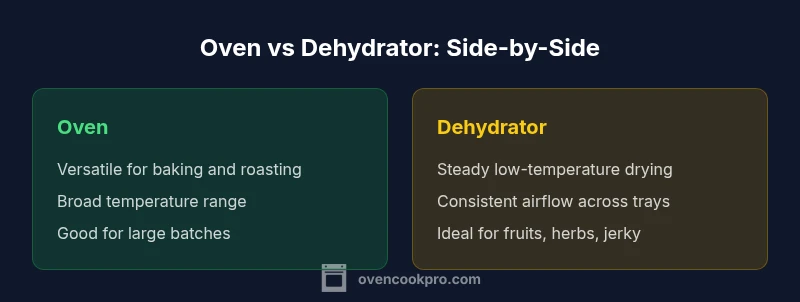
The oven and dehydrator serve different jobs: ovens offer broad versatility for baking, roasting, and broiling, while dehydrators focus on steady, low-temperature drying for fruits, jerky, and herbs. If your aim is general cooking with occasional drying, an oven covers more tasks. For dedicated, consistent dehydrating of small batches, a dehydrator is usually the better fit.
Differences in purpose and design
Ovens and dehydrators share a heating element, but they are optimized for different results. An oven is a general-purpose heat chamber with racks, a large interior, and a wide temperature range designed for baking, roasting, and broiling. A dehydrator uses multiple, perforated trays and a focused, low-temperature range to move moisture out of food with steady airflow. This fundamental difference drives every other comparison, from texture to energy use. According to Oven Cook Pro, understanding the core purpose of each appliance helps homeowners avoid buying a tool that doesn’t fit their cooking routines. In practice, you’ll use an oven when you need to cook or finish dishes and, occasionally, dry items; a dehydrator becomes the primary workhorse for preserving snacks, herbs, and fruit.
Performance: moisture removal vs browning and texture
Dehydrators are designed to pull water out evenly, producing a uniform texture and extended shelf life. Ovens, by contrast, excel at browning, caramelization, and rapid cooking, which can be beneficial for flavor development but can hinder moisture removal. If you want crisp apple chips with even dryness, a dehydrator offers predictable results. If you need to roast peppers or bake bread, an oven provides the necessary heat and versatility. The Oven Cook Pro team notes that performance depends on airflow quality, tray spacing, and consistent heat delivery, which are easier to optimize in dedicated dehydrators than in a multitask oven.
Temperature control and airflow dynamics
Temperature control and airflow are the invisible engines behind any heat-based appliance. A dehydrator maintains a low, steady temperature with carefully engineered airflow across all trays. An oven relies on a convection system in some models and a more variable distribution of heat in standard setups. When you’re dehydrating, even airflow is crucial for uniform dryness. In contrast, when baking or roasting, you want heat to reach food quickly and evenly, with browning reactions enhancing flavor. The practical takeaway is to align your choice with how consistently you need moisture removal versus quick, high-heat cooking.
Energy use, cost of operation
Energy use is a major consideration in choosing between these appliances. Dehydrators are typically optimized for small, repeatable loads, which can translate into lower energy use per batch for drying tasks. Ovens, on the other hand, often run hotter and larger, which can increase energy consumption if you’re only cooking small items. For households that regularly dry foods in batches, a dehydrator can be more energy-efficient. Conversely, households that perform a mix of cooking tasks will value the oven’s multitasking capability despite higher energy footprints on some tasks. The Oven Cook Pro analysis suggests weighing batch size and frequency to estimate true running costs.
Food outcomes: texture, flavor, and nutrients
Texture and flavor outcomes differ markedly between the two appliances. Dehydrators produce dry, shelf-stable foods with concentrated flavors and crisp textures, ideal for fruit leathers, herbs, and jerky. Ovens can deliver caramelized, roasted, and browned flavors with moisture loss, which is great for vegetables, meats, and baked goods. Nutrient retention varies with temperature and exposure time; lower, slower drying can preserve some nutrients, but heat-sensitive components may degrade with longer cook times in an oven. Your choice should reflect the final product you want—the dehydrator for dryness and preservation, the oven for flavor development and versatility.
Batch size, capacity, and workflow
Batch size matters. Dehydrators excel at compact, uniform batches with predictable drying times across trays. Ovens accommodate larger volumes but may require multiple racks or batches to achieve similar results, especially for dehydrated items. If you regularly prepare small snack lots, a dehydrator reduces the number of batches and simplifies tray management. If you routinely bake or roast large quantities, an oven’s capacity and flexible configurations save time and effort. Planning for rack space, tray compatibility, and airflow helps you design an efficient workflow.
Convenience features and user experience
Modern ovens and dehydrators come with a range of convenience features. Timers, auto shutoffs, built-in thermometers, and smart controls can simplify both tasks—but their usefulness depends on your actual use case. An oven with convection helps with even browning and faster cooking, while a dehydrator with adjustable racks and horizontal airflow makes drying more uniform. Ease of cleaning matters too: ovens require more extensive pan handling, whereas dehydrators benefit from trays designed for quick removal and washing. Consider your tolerance for fiddling with racks, lids, and tray configurations when weighing convenience.
Safety considerations and maintenance
Both appliances demand safe operation and regular maintenance. Cooling times, hot surfaces, and energy use patterns create different risk profiles. Dehydrators should have stable bases and well-fitting trays to prevent tipping and spills; always supervise when drying foods with moisture content that could promote spoilage if left unattended. Ovens require careful cleaning to avoid smoke or off-flavors contaminating future dishes, and gaskets or door seals should be inspected periodically. Proper ventilation and routine cleaning help extend the life of either appliance while keeping kitchen operations safer.
Use-case decision framework
A simple way to decide is to map your goals to the task: if your primary task is preserving foods, drying herbs, or making snacks, a dehydrator is typically the best fit. If you want a versatile appliance for baking, roasting, and occasional drying, an oven is the better all-around choice. Budget, space, and energy considerations should guide the final decision. For households with variable needs, consider a staged approach: use the oven for broad tasks and a dehydrator for dedicated drying sessions. This framework helps align your equipment with actual kitchen routines.
Real-world recipes and techniques
Even with a dehydrator, some foods benefit from prep steps similar to drying in an oven. For example, slicing fruits evenly and removing cores ensures uniform drying. For dehydrated herbs, uniform leaf size improves drying consistency, and for jerky, marinating and even strip size support even dryness. In an oven, use a low-heat convection setting when attempting dehydration-inspired tasks, but be mindful of browning and moisture retention. Practice with small batches to calibrate time and temperature before scaling up.
Start-up plan: quick-start checklist
- Assess your kitchen tasks: baking/roasting vs drying/ preserving.
- Check space and power needs for either appliance.
- List must-have features: timers, convection, adjustable racks, and tray compatibility.
- Choose a primary use-case and plan a small test batch to calibrate time and heat.
- Create a simple maintenance routine: regular cleaning after use and periodic inspections of seals and fans.
- Gather beginner-friendly recipes and drying guidelines to build confidence quickly.
Comparison
| Feature | Oven | Dehydrator |
|---|---|---|
| Best-use scenarios | Versatile for baking, roasting, and general cooking | Specialized for drying fruits, jerky, herbs, and snacks |
| Temperature range | Broad range across high to low heat | Narrow, focused range optimized for low-to-mid temperatures |
| Airflow control | Convection options in some models; heat distribution varies | Designed, consistent airflow across all trays |
| Batch size and efficiency | Large capacity with multiple racks; can cook varied items | Optimized for smaller, uniform batches |
| Ease of cleanup | Depends on pans and residues; more components | Tray-based design with simpler cleanup |
| Cost and availability | Widely available; multi-functional; price varies by model | Typically compact with lower upfront cost; dedicated use case |
The Good
- Versatile for a wide range of cooking tasks
- Dehydrator offers predictable, uniform drying results
- Clear separation of moisture management improves snack quality
- Farm-to-table style preservation becomes easier with dedicated dehydration
Drawbacks
- Oven may waste energy on small batches
- Dehydrator limits you to low-temperature tasks
- Specialized equipment requires extra storage space
Oven generally offers greater versatility; dehydrators excel at dedicated, consistent drying.
If your kitchen routines mix cooking with occasional drying, the oven is the pragmatic choice. If your primary goal is reliable dehydration for snacks and preserved foods, a dehydrator pays off with consistency and efficiency. For many homes, a hybrid approach provides the best balance.
Questions & Answers
Can I substitute an oven for a dehydrator in a pinch?
Yes, you can attempt dehydration tasks in an oven by using a very low heat and leaving the door ajar, but results are less predictable and energy use rises. For consistent results, a dehydrator is preferred for moisture-driven drying tasks.
You can, but it’s less reliable and uses more energy—consider a dehydrator for regular drying.
Is a dehydrator better than an oven for fruit leather?
A dehydrator is typically better for fruit leather due to uniform low heat and airflow, which prevents scorching and yields even texture. An oven can work in a pinch but requires careful temperature control and monitoring.
Usually, yes—the dehydrator gives more even texture for fruit leather.
What foods dry best in a dehydrator?
Fruits (like apples and mangoes), herbs, nuts, and jerky-like proteins dry well in a dehydrator due to controlled airflow and low temperatures. Leafy herbs dry quickly and evenly when sliced thinly.
Fruit, herbs, and jerky-like foods dry best in a dehydrator.
Can I dry herbs or vegetables in an oven?
Yes, you can dry herbs or vegetables in an oven at low temperatures, but you’ll need careful temperature control to avoid browning and uneven drying. A dehydrator is more forgiving for small batches.
Ovens can dry herbs, but a dehydrator is easier for consistent results.
How should I clean and maintain both appliances?
Regular cleaning after use is essential. For ovens, wipe racks and interior and check door seals. For dehydrators, wash trays and fans if removable, and ensure vents are clear. Periodic checks prevent odors and prolong life.
Clean after each use; keep vents clear and inspect seals regularly.
Do ovens have a built-in dehydration setting?
Some ovens offer low-temperature or keep-welow settings that can mimic dehydration, but performance may vary. For dedicated drying tasks, a purpose-built dehydrator generally delivers more consistent results.
Some ovens have low-temp modes, but dedicated dehydrators are more reliable.
Main Points
- Assess primary tasks before buying
- Prioritize oven versatility for mixed use
- Favor a dehydrator for dedicated drying work
- Plan for energy use and batch size when budgeting
- Invest in proper racks/trays to optimize results