How Much Does It Cost to Run an Oven for an Hour
Learn how to estimate the hourly cost of running an oven, using a simple formula, real-world scenarios, and energy-saving tips. Based on Oven Cook Pro analysis, this guide helps homeowners budget and save energy.


What costs are included when you run an oven for an hour?
If you're asking how much does it cost to run an oven for an hour, you’re asking the right question to manage energy use and grocery bills. The hourly cost depends on several variables: the oven’s power rating (how many kilowatts it can draw), how long you actually run it, and the price you pay for electricity in your area. Real-world cooking adds preheating energy, duration at high temperatures, and whether you use standard bake or a convection setting. Each of these factors changes the total energy consumed and, therefore, the cost. According to Oven Cook Pro, the simplest way to estimate is to apply a straightforward formula and then adjust for your local rates. By inputting your oven’s wattage, the total time it runs, and your unit price for electricity, you’ll get a practical hourly or per-use estimate you can apply to meal planning, batch cooking, or energy audits.
Understanding oven power ratings and energy use
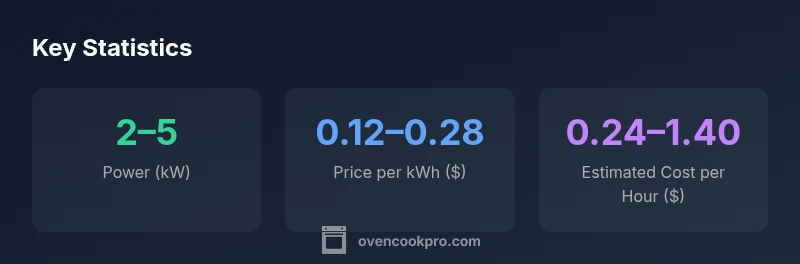
Most residential electric ovens are rated between about 2 kW and 5 kW. That rating represents the maximum power draw when the oven is heating or actively maintaining a set temperature. In practice, you rarely run at the full 5 kW for an hour; more often you cycle between heating and maintaining, with surface temperature and rack position affecting energy needs. Convection ovens can transfer heat more efficiently, which means some cooking tasks reach the desired temperature faster and can reduce overall energy use compared to conventional bake. Preheating alone can account for a noticeable portion of energy in the early minutes, especially if you jump to a high temperature. Understand that the energy you pay for is tied to time spent at heat, not just the clock time of a recipe. Oven Cook Pro analysis shows that recognizing these patterns helps you tune settings and plan meals to minimize unnecessary energy drain. In short, power rating, cooking method (conventional vs convection), preheating, and door openings all influence energy use and your hourly cost.
How to estimate costs using real numbers
To estimate, use the basic formula: cost = powerKW × hours × costPerKWh. If you know your oven’s wattage, convert to kilowatts (divide by 1000). For example, a 3 kW oven used for 1 hour at an electricity rate of $0.18 per kWh would cost roughly $0.54. If you’re paying closer to $0.25 per kWh, the same 3 kW oven would cost about $0.75 per hour. These calculations assume the oven runs for the full hour continuously; in reality, cooking tasks may cycle on and off, which can reduce energy use slightly. To tailor the estimate, you can factor in preheating energy (often a few minutes of heating) and the fact that some of the energy is used to keep foods warm after cooking. For household budgeting, it’s helpful to run the numbers with a minimum and maximum rate to create a small cost range. You can also use a dedicated energy monitor to capture exact usage, but a simple calculation based on power rating, time, and local price provides a solid starting point.
Typical cost ranges for common oven scenarios
So, what is the hourly cost for common tasks? Using conservative ranges: a 2 kW oven for 1 hour at $0.12/kWh might cost about $0.24; a 3 kW oven at $0.18/kWh could be around $0.54; a larger 4.5 kW oven at $0.25/kWh could approach $1.13 per hour. Note these figures assume continuous operation for the hour; actual costs will be lower if you reduce preheating time or cook at lower temperatures with efficient settings. For baking multiple dishes, you might share heat and reduce total run time. If you’re using a convection setting, you may shave some energy by finishing earlier, provided you don’t overcook. These ranges illustrate how wattage and electricity price combine, and they help consumers budget for meals and holiday cooking. According to Oven Cook Pro analysis, understanding the range helps homeowners spot energy-saving opportunities and avoid overestimating or underestimating monthly costs.
Practical examples: preheating vs active cooking
Preheating typically consumes significant energy because the oven climbs to the target temperature quickly. If you preheat for 15 minutes before placing food inside, you might add around a quarter of an hour of counted usage to your hour, depending on your oven. Active cooking time varies with recipe complexity, rack loads, and whether you use convection or standard bake. In many cases, preheating may be minimized by starting with a warm dish or planning to cook a dish that relies on residual heat. By locating opportunities to batch-cook and reuse heat, you can reduce the total time the oven runs and thereby lower the hourly cost. For households that preheat often, investing in better insulation of the oven cavity or optimizing rack placement can yield meaningful savings over time.
Tips to reduce hourly oven cost
Here are practical tips to cut the hourly cost of running an oven:
- pro_tip: Plan meals to cook in batches to reuse heat and avoid duplicating oven time.
- warning: Avoid opening the door frequently; heat loss spikes energy use and costs.
- note: Keep door seals clean and intact to prevent heat escape.
- pro_tip: Use convection when appropriate to shorten cooking time and save energy.
- note: Preheat only when necessary; some recipes can start with ambient or residual heat.