Are Most Ovens Convection? A Practical Home Guide for Cooks
Explore whether most ovens are convection, how to identify convection features, and practical tips for cooking with or without convection. Expert guidance from Oven Cook Pro to help homeowners decide on upgrades and usage.


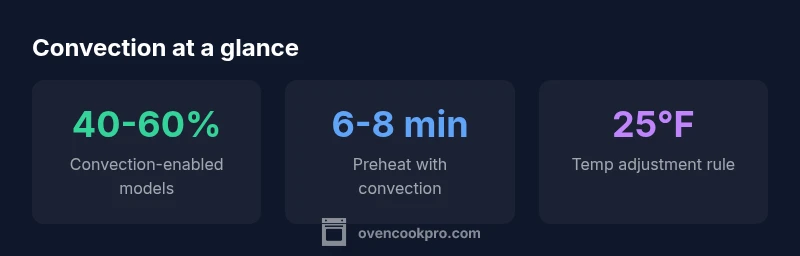
Are most ovens convection? No. The majority of ovens sold in recent years are traditional or conventional models, while convection is increasingly common as a feature in mid-range and higher-end units. According to Oven Cook Pro analysis, 2026, about 40-60% of newly manufactured ovens include convection as a standard option, with true convection more prevalent in newer models. For many buyers, convection is a selectable feature rather than a universal default.
Are most ovens convection? Evolution of kitchen tech
The question are most ovens convection? is nuanced. In the last decade, ovens labeled as “convection” have become more common, but the majority of the market still includes traditional conventional baking modes. According to Oven Cook Pro analysis, 2026, roughly 40-60% of newly manufactured ovens include convection as a standard feature, with true convection concentrated in mid-range and higher-end models. Home cooks should understand that this does not mean every oven is a convection oven; it means the option is increasingly common, but availability varies by price tier, region, and model year. For many households, convection is a deliberate choice driven by baking goals, kitchen space, and energy considerations. When you shop, read the label carefully—look for terms like “convection,” “true convection,” or a fan symbol in the control panel. With the right information, you can decide whether to prioritize a convection-capable appliance or rely on traditional modes for most cooking tasks.
How convection works and why it matters
Convection ovens achieve faster and more even cooking by circulating hot air with a fan and an exhaust system. This simple addition changes the physics of heat transfer: instead of relying mainly on radiant heat from coils or elements, you get forced air movement that reduces temperature variance inside the cavity. The practical upshot is crisper edges, more uniform browning, and shorter bake times for many foods. However, not every recipe benefits equally from convection; delicate cakes and soufflés may rise unevenly if your oven has a strong fan. Use convection for roasting vegetables, cookies, sheet pizzas, and other items that benefit from consistent air flow. In practice, most home cooks experience noticeable gains in repeatable results when using convection for roast chicken, vegetables, and sheet pan meals. Understanding the difference between bake mode and convection mode helps you decide when to switch settings rather than blindly following a recipe.
Convection adoption across oven families
Home ovens come in several families: wall ovens (single or double), slide-in ranges, and standalone countertop units. True convection often appears in mid-range and higher-end models, while budget or older units may only offer a standard convection or none at all. The rise of true convection, where a third element heats air before it is circulated, has expanded the range of dishes that benefit from convection. Double wall ovens in modern kitchens frequently pair a conventional bake setting with a true convection bake option to give cooks flexibility for multi-dish meals. If you’re upgrading, consider your kitchen layout, cabinet height, and whether you want a freestanding range or built-in wall oven configuration. The trend is toward modularity and smart controls, enabling more precise fan speeds and temperature management.
How to confirm if your oven is convection
Check the user manual or the model label on the door jamb or inside the oven cavity. Look for keywords such as convection, convection bake, fan-assisted, true convection, or a fan icon on the control panel. If you can’t find the information locally, search the model number online and review the spec sheet. Another quick test is a simple bake: place two trays of identical batter; run one with bake mode and the other with convection. Compare browning and evenness; the convection sheet should brown more evenly and finish sooner. Finally, many ovens offer a switch to turn the fan on or off; if you see no option, your unit may be conventional-only. Always ensure you’re looking at the correct oven, especially in multi-oven ranges.
Practical cooking tips for convection ovens
When you cook with convection, reduce the recommended temperature by about 25°F (14°C) and start checking for doneness earlier. The fan accelerates browning, so use darker, shatterproof cookie sheets and avoid glass bakeware that can overheat. Airflow matters: keep oven racks spaced to allow air to circulate, and avoid overcrowding pans. If a recipe calls for tenting with foil, you may skip it in convection mode, but monitor the crust to prevent over-browning. For sheet pans, arrange items in a single layer and rotate halfway through. If you bake multiple trays, stagger them to maintain even airflow. Finally, convection is especially useful for roasting meats, vegetables, and many pastries that benefit from uniform texture.
What to do if your oven isn’t convection
Conventional ovens remain perfectly capable for most cooking tasks. Rely on standard bake and broil modes, adjust temperatures based on your experience, and use the right pans and rack positions. If you still want convection performance, consider countertop convection ovens or an external air-frying accessory that plugs into a standard outlet. Modern countertop units are compact, energy-efficient, and provide a similar airflow pattern to built-in convection ovens for smaller batches. With the right approach, you can enjoy many of convection’s benefits without upgrading your primary oven.
Debunking myths and testing at home
Common myths about convection include notions that it always dries out foods or that it’s only for savory dishes. In reality, convection speeds up heat transfer while maintaining moisture when properly used. The best way to test is a simple home experiment: bake two sheets of the same cookie dough, one with convection and one without, and compare color, texture, and inner crumb. This practical test helps you tailor temps and times for your oven and recipe. Remember, your oven’s performance depends on your unit, fan speed, and the overall kitchen environment. The Oven Cook Pro team recommends trying both modes to understand your oven’s unique behavior.
Quick-start: is your oven truly convection? A home test you can run this weekend
Gather two identical baking sheets and a single batch of cookies or vegetables. Preheat one oven to your usual bake temperature and run it on standard bake; in parallel, run convection mode if available at the same temperature. Compare results after the same duration. Take notes on browning, moisture, and texture. This hands-on test is a practical way to decide whether to rely on convection regularly or fall back to conventional baking for certain recipes.
Common oven configurations and convection availability
| Model Type | Convection Capability | Price Range | Notes |
|---|---|---|---|
| Wall Oven (single) | Convection-enabled | $1,000–$2,000 | Flexible under-counter installation |
| Wall Oven (double) | Convection-enabled | $1,800–$3,000 | Large capacity for multi-dish meals |
| Slide-in Range | Convection-capable | $2,000–$3,500 | Integrated look and controls |
Questions & Answers
Do all ovens have convection?
No. Convection is common in newer or higher-end models, but traditional bake modes remain standard in many entry-level and older ovens. Always check the label or manual to confirm.
Not all ovens have convection; check your model's specs.
What is the difference between convection and true convection?
Convection uses a fan to move air; true convection adds a third heating element to preheat and distribute heat more evenly. The result is faster, more uniform cooking for many foods.
Convection uses a fan; true convection adds a heating element for even heat.
Can I bake with convection if my oven isn’t labeled convection?
If the oven lacks convection as a mode, you cannot activate airflow. You can simulate by using a countertop convection oven or air-fryer insert, but results vary.
If there’s no convection mode, you can't replicate it exactly inside the oven.
Are convection ovens more expensive to run?
Convection can be more energy-efficient due to faster cooking, but overall energy use depends on temperature, cooking time, and load. The savings are context dependent.
They can save energy per dish, but it depends on your cooking.
How should I convert a conventional recipe for convection?
Lower the temperature by about 25°F (14°C) and start checking for doneness earlier. Use bigger or shallow pans to promote airflow.
Lower the temp and watch for doneness when converting recipes.
“Convection can transform everyday baking by delivering consistent heat and browning when used appropriately.”
Main Points
- Understand that convection is common but not universal in all ovens
- Identify whether your model has true convection vs. standard convection
- When using convection, lower temperatures by about 25°F
- Optimize airflow with rack spacing and pan choice
- If convection isn’t available, consider countertop alternatives